ثقب أسود بلا أفق: ماذا سترى تلسكوبات الجيل القادم؟ سريع
بئر بلا قاع — ولكن ليس تمامًا. الثقب الأسود العادي له حدود، أفق الحدث، الذي لا يعود منه شيء. وماذا لو أزلنا هذا الحد؟ هذا هو بالضبط الجسم الذي يُدعى JMN-1، والذي قام علماء الفيزياء الفلكية بمحاكاته: جسم ضخم نشأ من انهيار نجم، لكن دون حجاب لا يمكن اختراقه. بدلاً من الأفق، هناك تفرد عارٍ، نقطة تسقط إليها المادة وحيث تتوقف قوانين الفيزياء المعروفة عن العمل.
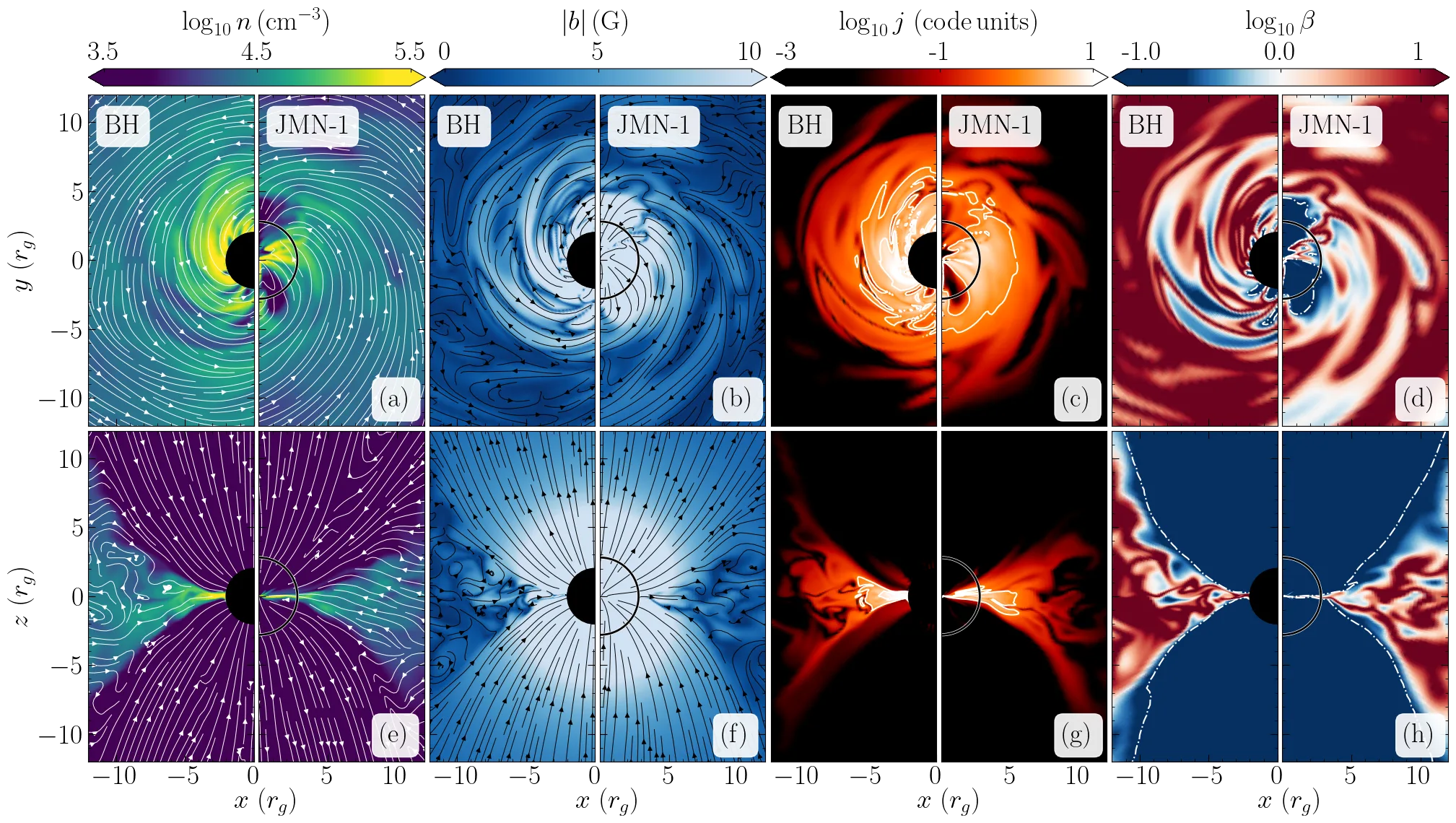
في المحاكاة، تم توجيه تدفق من البلازما نحو JMN-1، تمامًا كما يحدث مع الثقب الأسود في مركز المجرة M87. حول التفرد، تشكل قرص ملتهب تخترقه مجالات مغناطيسية — تمامًا مثل الذي يراه علماء الفلك حول الثقوب السوداء الحقيقية. المادة لم تتراكم في الخارج ولم تُقذف بعيدًا، بل وصلت بهدوء إلى المركز. بلغ معدل الالتقاط حوالي ثلاثة أجزاء من المليون من أقصى حد ممكن — وهو نفس المعدل المتوقع لثقب أسود بنفس الكتلة.
اليوم، هذا الضوء خافت جدًا بالنسبة لأجهزتنا، لكن أجهزة قياس التداخل الراديوية من الجيل القادم ستتمكن من التقاطه. عندها سيكون لدى علماء الفلك اختبار موثوق: إذا كان هناك شيء يومض في مركز الظل — فما أمامنا ليس ثقبًا أسود، بل توأمه الجريء بلا أفق. هكذا ربما تركت لنا الطبيعة تلميحًا حول كيفية النظر إلى ما وراء حدود تصوراتنا المألوفة — إلى ذلك البئر الذي تبين أنه ليس بلا قاع.
الملخص الأصلي
كما كتبه المؤلفون، بالإنجليزية arXiv:2604.15430
We present the first three-dimensional general relativistic magnetohydrodynamic simulation of sustained accretion onto a horizonless singularity in which matter reaches the central object rather than being accumulated outside of it or expelled in outflows. We consider a Joshi-Malafarina-Narayan (JMN-1) spacetime, a well-motivated black hole mimicker that arises from gravitational collapse with anisotropic pressure in general relativity, and adopt a compactness parameter for which the central singularity is null. We find that the system evolves into a sustained magnetically arrested disk state. For parameters appropriate to the low-luminosity active galactic nucleus M87*, we obtain an accretion rate of $$\sim(3.0 \pm 0.5)\times 10^{-6} \dot{M}_{\rm Edd}$$, in full agreement with estimates based on black hole models and, in particular, comparable to that of our reference Schwarzschild black hole simulation. Synthetic ray-traced images at $$230\,{\rm GHz}$$, computed using polarized general relativistic radiative transfer, are broadly consistent with the Event Horizon Telescope observations of M87*. We identify a key observational discriminant between a black hole and JMN-1: the presence of detectable brightness inside of the ``observable" shadow of JMN-1. This emission originates very close to the central singularity, in a region that would be hidden behind the event horizon in a black hole spacetime. Although this signature is beyond the reach of current observations, it falls within the projected imaging dynamic range of next-generation radio interferometric instruments, offering a robust test of the black hole paradigm.
حصل الجسم JMN-1 على اسمه من الأحرف الأولى من ألقاب ثلاثة فيزيائيين — جوشي، مالافارينا، ونارايان — الذين ابتكروا هذا النوع الغريب من الزمكان في إطار النظرية النسبية العامة المعتادة.
فكرة التفرد العاري تم تناولها في رواية "التفرد" للكاتب ويليام سليتور، حيث يحاول الأبطال منع ظهور مثل هذا الجسم بالقرب من الأرض.