خريطة مغناطيسية للجسر بين المجرات سريع
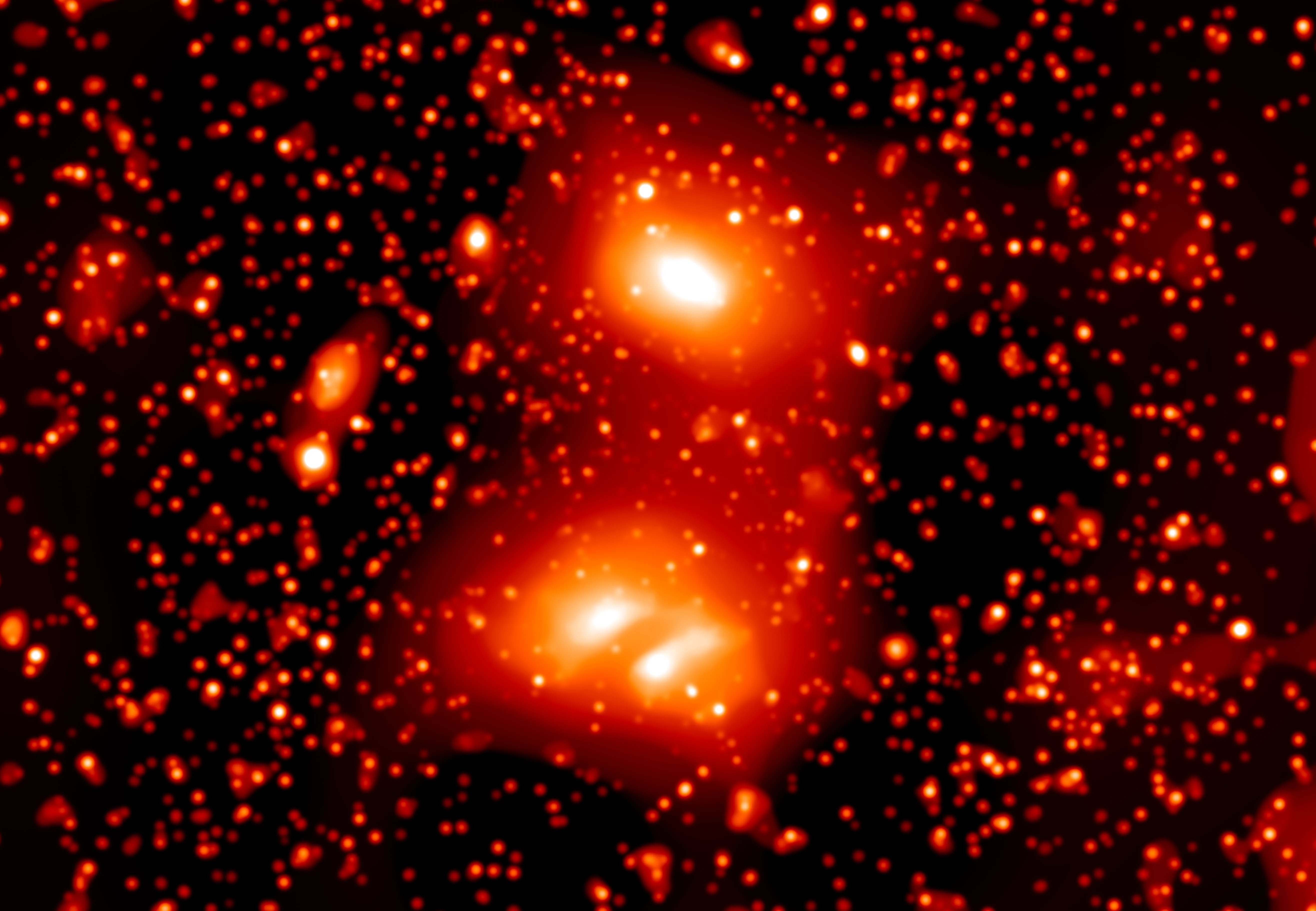
عنقودان مجريان عملاقان، أبيل 3391 وأبيل 3395، يتصادمان ببطء في السماء الجنوبية. بينهما جسر من الغاز شديد الحرارة، مثل ضباب فوق نهر يربط بين ضفتين. لطالما أراد علماء الفلك معرفة ما إذا كان هناك مجال مغناطيسي في هذا "الجسر بين المجرات" وكيف يتصرف.
لا يمكن رؤية المجال مباشرة، لكن يمكن التقاط آثاره. عندما تمر موجات الراديو من مجرات بعيدة عبر غاز ممغنط، فإن مستوى اهتزازها ينحرف قليلاً — وهذا التأثير يسمى دوران فاراداي (Faraday rotation). كلما كان المجال أقوى وأكثر تشابكًا، كان الانحراف أكبر. وجّه علماء الفلك تلسكوب ميركات الراديوي في جنوب أفريقيا نحو هذه المنطقة، وجمعوا إشارات من 434 مجرة بعيدة، وبنوا من انحرافاتها خريطة للمجال المغناطيسي.
هذا التباين يوحي بأن المجال في الجسر ليس موجودًا فحسب، بل إن عملية ما رتبته. ربما تعمل تيارات الغاز المتدفقة بين العنقودين على تمديد خطوط المجال وتقويمها، مثلما يمدد النهر الأعشاب المائية مع التيار. أما في العنقودين نفسيهما، فإن المجال يهتز باستمرار — فالغاز الساخن يغلي، والمستعرات الأعظمية تنفجر، والثقوب السوداء في مراكز المجرات تعمل.
هذا "الجسر المغناطيسي" بين العنقودين فرصة نادرة لعلماء الفلك. فهو يتيح رؤية كيف تتصرف المجالات المغناطيسية على أكبر المقاييس — حيث لا تعود المجرات الفردية مهمة، بل شبكة الكون بأكملها. فهم هذه المجالات سيساعد في توضيح كيفية نمو البنى العملاقة ولماذا تتحرك الجسيمات المشحونة في الفضاء بهذه الطريقة وليس غيرها.
الملخص الأصلي
كما كتبه المؤلفون، بالإنجليزية arXiv:2604.18735
Magnetic fields in cluster outskirts and the intercluster medium are poorly constrained because diffuse synchrotron emission is hard to detect at low surface brightness. Faraday rotation measures (RMs) of polarized background sources can probe foreground large-scale structure. The nearby interacting Abell 3391-3395 system hosts a well-established X-ray bridge, making it an excellent target for studying magnetization in the intercluster environment. We characterize the magnetized environment of Abell 3391/95 and its surroundings by constructing a dense RM grid from wide-field polarimetry. We observed Abell 3391/95 with MeerKAT in full polarization using a three-pointing mosaic. The data were calibrated with direction-independent and direction-dependent techniques and imaged using visibility-plane mosaicing for a large field of view at high sensitivity. Using Faraday synthesis, we formed Faraday cubes and measured RMs for polarized background sources. We defined on- and off-target regions using contours from a wavelet-filtered eROSITA image. We identified 434 polarized sources within the field, with a polarized source density ranging from about 30 sources per square degree in the outer regions to about 110 sources per square degree in the central field, and a field-averaged density of 73 sources per square degree. The clusters show a statistically significant enhancement of RM scatter relative to the off-target region. In contrast, the bridge shows comparatively low RM scatter, while an RM structure-function analysis on matched angular scales yields a tentative indication of larger RM differences in the bridge than off-target. Combined with low per-source depolarization, this suggests a bridge magnetic field relatively ordered on ~10 kpc scales, but less ordered on larger scales. The non-detection of diffuse synchrotron emission in the bridge yields improved upper limits on the emissivity.
كثافة المجرات "الخلفية" التي أمكن استخدامها كمسابير في مركز مجال الرؤية بلغت 110 مجرات لكل درجة مربعة — وكأن حشدًا كاملًا من المصادر الراديوية البعيدة يتجمع في بقعة بحجم ظفر اليد الممدودة.