دوارة الطقس الكونية: كيف يكشف ريح النجم أسراره سريع
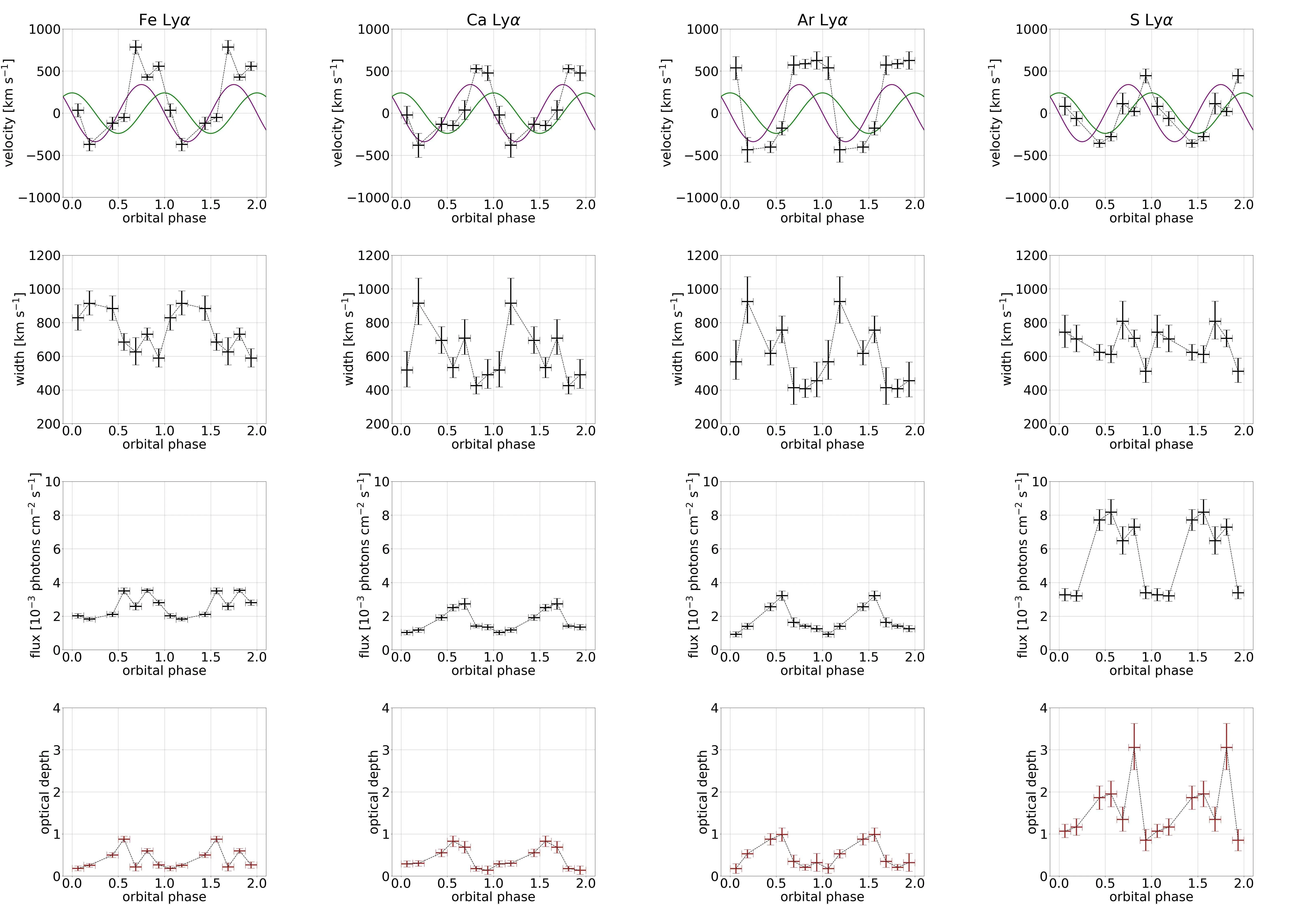
في أعماق كوكبة الدجاجة، يدور نجمان حول بعضهما البعض. أحدهما عملاق، والآخر ثقب أسود. يطلق العملاق باستمرار تيارًا من الغاز في الفضاء — وهو الريح النجمية. عندما يقع هذا الريح تحت أشعة إكس الصادرة عن الثقب الأسود، يبدأ بالتوهج مثل لوحة إعلانية مضيئة. التقط علماء الفلك هذا الضوء وحللوه إلى ألوانه لمعرفة مكونات الريح وكيف يتحرك.
اتضح أن العناصر الكيميائية المختلفة في الريح تتحرك بشكل مختلف. الحديد يبقى قريبًا من الثقب الأسود ويتبع حركته المدارية. أما الكبريت، فينتشر في جميع أنحاء النظام ولا يكاد يتأثر بجاذبية الثقب الأسود. الكالسيوم والأرجون في موقع متوسط بين الاثنين. يشبه هذا حشدًا من الناس يركضون خلف حافلة: أولئك الأقرب يركضون أسرع ويتبعون مسارها بدقة أكبر، أما البعيدون فيسيرون في نفس الاتجاه فقط.
بنى العلماء نموذجًا للريح لفهم سبب توزع العناصر بهذه الطريقة. اكتشفوا أن أشعة إكس الصادرة عن الثقب الأسود تسخن وتؤين الغاز القريب منها بشدة. الحديد، كونه أثقل ويفقد إلكتروناته بسرعة أكبر، يبدو "مرتبطًا" بالثقب الأسود. أما الكبريت الأخف، فيبقى متعادلًا ويتطاير في جميع أنحاء النظام. ساعدت هذه الصورة في تقدير كمية الغاز التي يقذفها النجم في الفضاء: حوالي خمس إلى عشر كتل أرضية سنويًا.
هكذا حوّل تلسكوب أشعة إكس XRISM النظام الثنائي إلى مختبر طبيعي. فبدلاً من بناء منشأة لدراسة الريح النجمية، وجدها علماء الفلك جاهزة في الفضاء. والآن نعرف أنه حتى في بيئة متطرفة مثل محيط الثقب الأسود، تتصرف العناصر الكيميائية بشكل مختلف — اعتمادًا على مدى ارتباطها بمصدر الجاذبية.
الملخص الأصلي
كما كتبه المؤلفون، بالإنجليزية arXiv:2604.23185
Cygnus X-3, hosting a Wolf-Rayet (WR) star whose dense wind produces various spectral lines due to photoionization by X-rays from a compact object, provides an ideal laboratory for studying wind dynamics and density structure. We measured the orbital modulations of the Fe, Ca, Ar, and S Ly$$\alpha$$ lines observed with the X-ray microcalorimeter (Resolve) onboard the $$XRISM$$, taking account of both emission and absorption lines of the Ly$$\alpha$$ complexes. The modulations of Doppler shifts of the Fe, Ca, Ar, and S Ly$$\alpha$$ lines showed amplitudes of 500 km s$$^{-1}$$ and phase offsets of 0.04, 0.09, 0.11, and 0.17, respectively, in units of an orbital period (4.8 hours) relative to the orbital motion of the compact object. This result indicated that H-like Fe most closely follows the compact object's motion. The line widths ranged from 400 to 1000 km s$$^{-1}$$. The intensities of both emission and absorption lines reached their minima around orbital phase 0.0 and their maxima around phase 0.5. The absorption peaks, however, did not align exactly with phase 0.5, suggesting the inhomogeneous structures such as an accretion wake and/or a bow shock. We compared the observed modulations with calculations based on a stellar wind model, accelerated by ultraviolet radiation from the WR star. One of the calculations qualitatively reproduced the observed trend that H-like Fe ions were concentrated near the compact object, whereas H-like S was distributed across the binary system, with H-like Ca and Ar showing intermediate spatial distributions. From this comparison, we estimated that a mass-loss rate of the stellar wind was approximately $$5 \times 10^{-6}$$-$$1 \times 10^{-5}\ M_{\odot}\ {\rm yr}^{-1}$$.
تصل سرعة الريح في نظام الدجاجة X-3 إلى 500 كيلومتر في الثانية — أي أسرع من الصوت في الهواء بمقدار ألف وخمسمائة مرة.
في رواية آرثر كلارك "موعد مع راما"، تستخدم السفينة الأسطوانية الجاذبية الدورانية لخلق قوة جاذبية اصطناعية — يشبه ذلك كيف تحتفظ جاذبية الثقب الأسود بالريح النجمية.