Teruaki Enoto

10 articles · 30 co-authors · latest: 2026-06-15
12,305 citations · h-index 49 · 565 papersData: Semantic Scholar

We have retold 10 papers by this author. 2 of them with a full read. most often about: Solar wind, accretion_disc_wind, magnetar. 30 co-authors across our retellings.

Links in the knowledge graph
A Veil over the Beacon: The Slow Wind of GX 13+1
About 25,000 light-years from Earth, in the constellation Sagittarius, a dense veil wraps around the neutron star GX 13+1. It scatters X-ray photons the way fog scatters streetlight, and for a long time it hid the source's true power from astronomers.

Cosmic Crystal: How a Magnetar Bends the Void
In 1936, two physicists, Werner Heisenberg and Hans Euler, poring over the equations of quantum electrodynamics, found something strange. In a sufficiently strong magnetic field, vacuum should cease to be empty.
High Energy2026-01-172 minarXiv:2601.11917express
A pulsar with a heartbeat of 6.67 hours
The neutron star 1E 161348-5055 in the supernova remnant RCW 103 pulses with a period of 6.67 hours. That's very slow for such a compact object, and astronomers long puzzled over what was going on.
High Energy2026-01-252 minarXiv:2601.17792express
How Iron Reveals the Secrets of Cold Gas
A flashlight shines through fog, and its light changes color slightly. From that change, you can tell what the fog is made of. That's how astronomers study cold gas around X-ray sources: iron atoms in the gas absorb and re-emit X-rays at a very specific energy, like a fingerprint. But there's a catch: if you strip a few electrons from the atom, the line shifts.
Instrumentation2026-02-152 minarXiv:2602.14166express
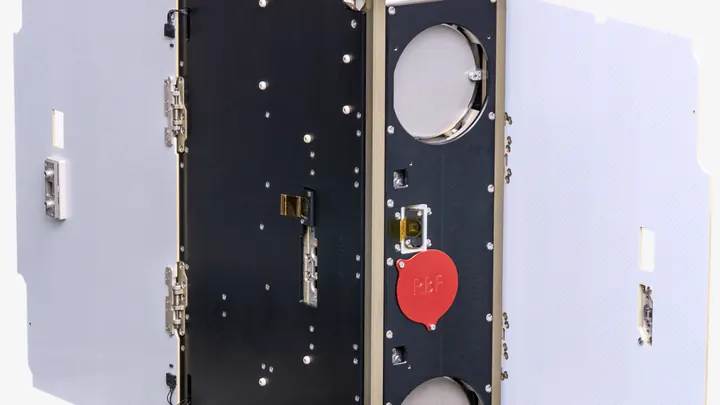
Tiny Satellite Learns to Navigate by Pulsars
The Crab Nebula flickers with X-ray flashes thirty times per second. That's the beat of a pulsar — a dead star that spins and sends us pulses like a lighthouse. Japan's NinjaSat, a satellite the size of a shoebox, caught these flashes to figure out where it was.
High Energy2026-02-221 minarXiv:2602.19200express
A Cosmic Blow with No Straight Lines
The edge of the supernova remnant RCW 86 is where the shock wave from a star's explosion slams into the surrounding gas. The IXPE telescope looked at the southwestern part of this boundary in X-rays and tried to catch polarization — the way these rays oscillate.
High Energy2026-04-062 minarXiv:2604.05050express
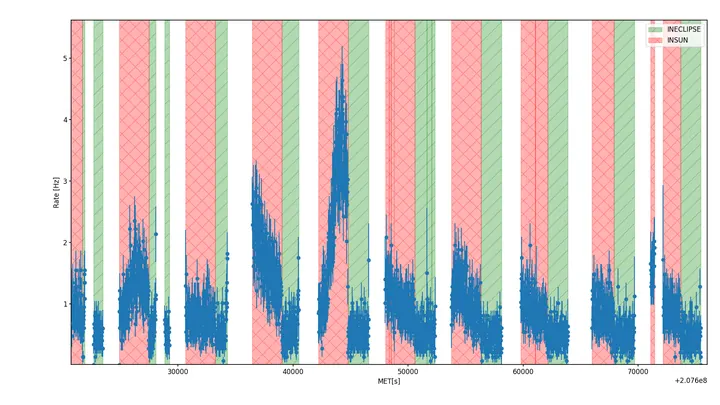
A Pulsar Lighthouse: Counting Its X-Ray Flashes
The lighthouse in the Crab Nebula blinks thirty times per second. It's a pulsar — a dead star that, as it spins, shoots out narrow beams of light, and Earth sweeps through them like a ship crossing a lighthouse beam. This lighthouse has two beams: the main pulse and the interpulse.
High Energy2026-04-252 minarXiv:2604.23185express
Cosmic Weather Vane: How a Star's Wind Reveals Its Secrets
Deep in the constellation Cygnus, two stars circle each other. One is a giant, the other a black hole. The giant continuously ejects a stream of gas into space — a stellar wind. When this wind falls under the black hole's X-rays, it lights up like a neon sign. Astronomers captured this light and split it into colors to learn what the wind is made of and how it moves.
High Energy2026-05-012 minarXiv:2605.01146express
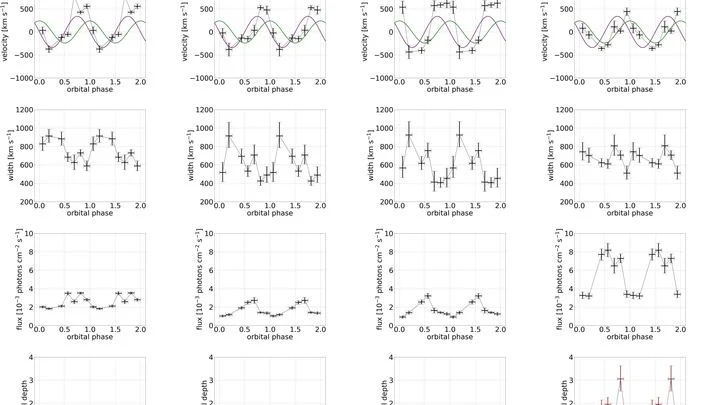
How a pulsar paints us a map of invisible pillars
A lighthouse that changes the color of each flash in time with its rotation: that's one way to describe what astronomers saw when they pointed the latest X-ray telescope, XRISM, at the pulsar Hercules X-1. This object is a neutron star pulling matter from a companion ordinary star.
Galaxies2026-06-152 minarXiv:2606.17141express
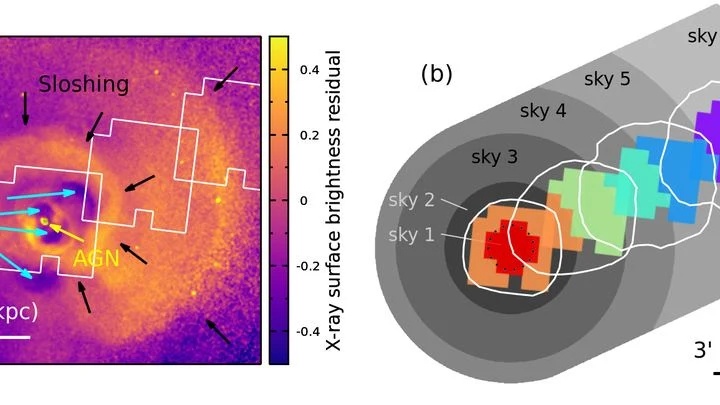
Cosmic Cocktail Without the Secret Ingredient
The Perseus galaxy cluster is a giant metropolis of thousands of star islands, bathed in an invisible ocean of scorching gas. Like urban smog, this gas preserves traces of all the chemical factories that have operated in galaxies for billions of years: supernova explosions that scatter freshly forged atoms across the surroundings.