كيف يرخي الكحول والكلوروفورم جدار الخلية سريع
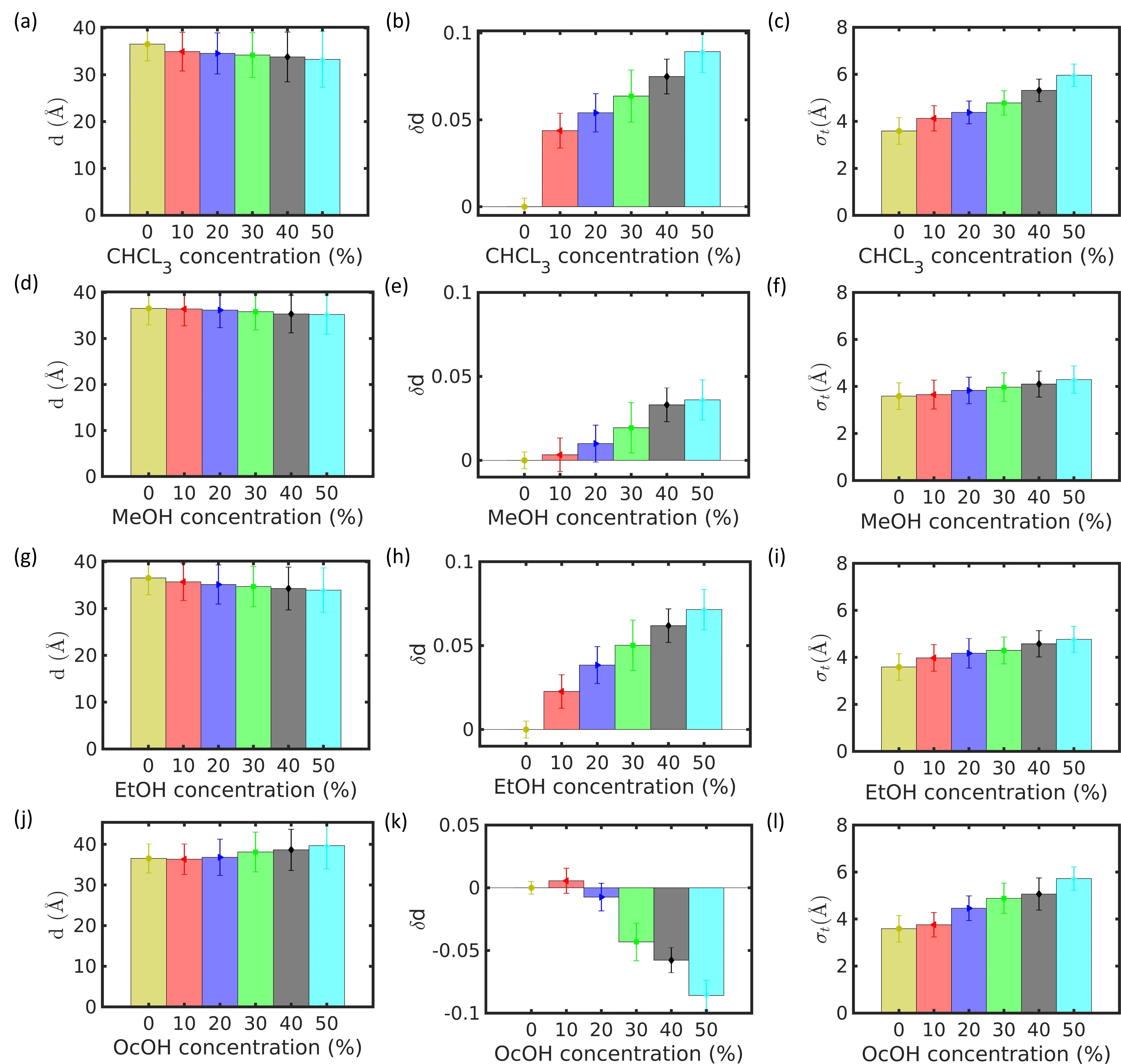
يشبه غشاء الخلية سياجًا من جزيئات متراصة بإحكام — طويلة كأعواد الثقاب، برأس محب للماء وذيل طارد للماء. إنه ليس مجرد غلاف، بل حاجز حي: يمرر ما هو ضروري، ويمنع الغريب، ويحافظ على شكله. لكن بمجرد إضافة القليل من الكلوروفورم أو الكحول إلى الماء، يبدأ هذا السياج في التمايل.
في دراسة حديثة، تمت محاكاة حاسوبية لسلوك مثل هذا الغشاء عند مواجهة أربعة ضيوف: الكلوروفورم وثلاثة كحولات — الميثانول والإيثانول والأوكتانول. تم رفع التركيز من الصفر إلى نصف الحجم الكلي. خلال ألف نانوثانية (أجزاء من المليون من الثانية، لكنها بالنسبة للعالم الجزيئي أبدية كاملة) لم يذُب الغشاء تمامًا ولو مرة واحدة. ومع ذلك، حتى عند الجرعات المتواضعة، أصبح أكثر ليونة بشكل ملحوظ، وبدأ سمكه يتقلب، وذاب النظام الداخلي.
قاس المؤلفون مدى رغبة كل مادة في دخول الغشاء وسهولة اختراقها من خلاله. اتضح أنه كلما زاد التركيز، انخفض الحاجز أمام القفز — خاصة بالنسبة للأوكتانول. وهذا يعني أنه حتى دون تدمير الخلية حتى الثقوب، يجعلها المذيب نفاذة لما كان الدخول إليه مغلقًا سابقًا. الخلاصة بسيطة: العمق الذي يصل إليه الضيف في «السياج» ومدى دفعه للجيران، معًا يحددان ما إذا كان الحاجز سيصمد أم سيبدأ في تمرير كل شيء دون تمييز.
الملخص الأصلي
كما كتبه المؤلفون، بالإنجليزية arXiv:2605.08780
How do solute concentration and molecular chemistry govern the transition from membrane saturation to destabilization? We address this using microsecond-scale molecular dynamics simulations of dipalmitoylphosphatidylcholine (DPPC) bilayers with chloroform (CHCl$$_3$$) and a homologous series of alkanols (methanol, ethanol, octanol) over $$0-50\%$$ concentrations. Although complete membrane melting is not observed within $$1000\, ns$$, all systems exhibit clear precursors of destabilization, including enhanced thickness fluctuations, reduced lipid order, and mechanical softening. Chloroform induces pronounced thinning and large fluctuations, consistent with deep, transient insertion. Methanol perturbs primarily the headgroup region, while ethanol shows intermediate behavior with partial insertion. Octanol preserves bilayer thickness at high concentrations due to lipid-like insertion but significantly increases fluctuations and interdigitation. Across all systems, increasing concentration decreases the area compressibility modulus and deuterium order parameter, accompanied by smoothing of lateral pressure profiles, indicating stress redistribution. Free energy analysis reveals increased membrane partitioning and reduced translocation barriers with concentration, strongest for octanol and weakest for methanol. These results demonstrate that membrane destabilization is governed by the interplay of insertion depth, interfacial crowding, and lipid packing disruption.
الإيثانول العادي الموجود في المشروبات الكحولية يعمل على أغشية خلايانا بنفس المبدأ: فهو يرخيها ويجعلها أكثر سيولة — ولهذا يلسع الكحول الأغشية المخاطية ويطهر.