سبيكة ذات ثلاثة أوجه سريع
قضيب معدني عند تسخينه يصبح فجأة صلبًا، ويفقد أو يكتسب خصائص مغناطيسية. في السبائك القائمة على النيكل والمنغنيز، لا تحدث هذه التحولات بشكل تدريجي بل بشكل قفزي — إذ تعيد الذرات ترتيب نفسها في نظام جديد، وتتغير سلوك المادة. في هذا العمل، درس الباحثون أربعة تركيبات قريبة جدًا من Ni-Mn-Cu-Ga، حيث تختلف نسبة النحاس بكسور من المئة فقط. كان هذا كافيًا للحصول على ثلاثة سيناريوهات مختلفة: في أحدها تختفي المغناطيسية أولاً ثم تتغير الشبكة، وفي آخر بالعكس، وفي الثالث يحدث الحدثان في وقت واحد.
الحيلة الرئيسية هي التحليل الديناميكي الحراري الجديد. عادةً، تُقاس درجة حرارة التحول المغناطيسي (نقطة كوري) ودرجة حرارة إعادة ترتيب الشبكة بشكل منفصل، لكنهما هنا تؤثران على بعضهما البعض. أخذ المؤلفون في الاعتبار كيف أن تغير البنية البلورية يغير قوة التفاعل بين لفات الإلكترونات — وهي معامل التبادل الذي يحدد ما إذا كانت المادة ممغنطة. وتبيّن أنه بالنسبة للسبيكة نفسها، تختلف نقطة كوري في الطور عالي الحرارة (الأوستينيت) وفي الطور منخفض الحرارة (المارتنسيت) بأكثر من 50 درجة. قطعة المعدن نفسها لها "شخصيتان مغناطيسيتان" مختلفتان اعتمادًا على كيفية ترتيب ذراتها.
الفائدة العملية للطريقة هي أنها تسمح باستخراج درجات حرارة التحولات المخفية من القياسات القياسية للمغنطة. سابقًا، كانت التجارب المعقدة مطلوبة لذلك، أما الآن فيكفي تتبع كيفية تغير الاستجابة المغناطيسية عند التسخين وتطبيق الحساب الجديد. وهذا مهم للضبط الدقيق لسبائك الفيرومغناطيسية ذات ذاكرة الشكل — وهي مواد يمكن أن تنحني وتعود إلى وضعها الأصلي تحت تأثير مجال مغناطيسي. وتُستخدم في المشغلات الدقيقة وأجهزة الاستشعار وحتى الأدوات الطبية حيث تكون الحركات الصامتة دون محركات مطلوبة.
الملخص الأصلي
كما كتبه المؤلفون، بالإنجليزية arXiv:2605.08920
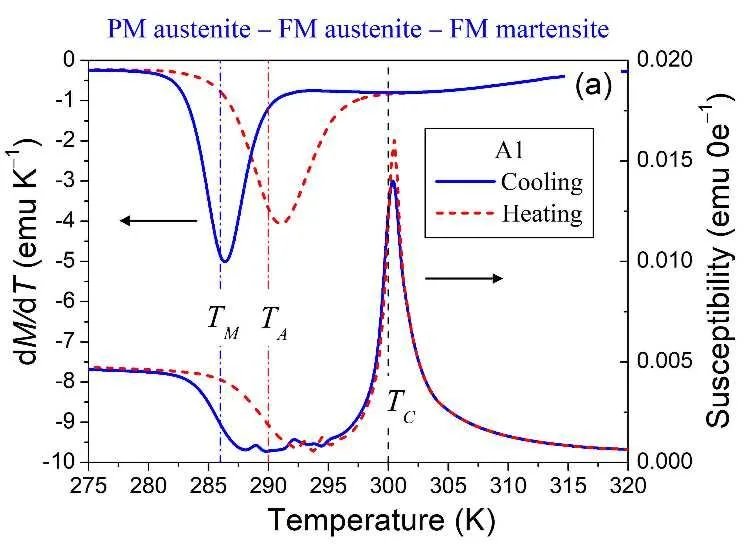
Ferromagnetic solids acquire nontrivial magnetic and caloric properties when the temperature of the structural phase transition approaches the Curie point. Deciphering magneto-structural transitions, i.e. determining their characteristic temperatures and elucidating the related properties, remains challenging. In the present paper, three types of transformational behaviour of Ni50Mn25-xCuxGa25 (x = 6.25, 6.5, 6.75, 7) and Ni50.5Mn18.5Cu6.5Ga24.5 alloys have been identified, arising from small variations in chemical composition: (i) structural martensitic transformation (MT) in the ferromagnetic phase; (ii) magneto-structural phase transition from paramagnetic austenite to ferromagnetic martensite; (iii) MT in paramagnetic phase. The temperature-dependent values of magnetization, M(T), and of magnetic susceptibility, $$\chi(T)$$, were measured for each alloy. A novel thermodynamic analysis was used to determine the Curie points and MT temperatures. The novelty lies in considering the interplay between structural and magnetic characteristics of the alloys through the impact of the structural transition on the spin-exchange parameter. The theoretical analysis of experimental data revealed that this impact results in a large difference ($$\geq$$ 50 K) between the Curie temperatures computed for the austenitic and martensitic states of each alloy. The characteristic temperatures, corresponding to the extrema of the dM(T)/dT and $$\chi(T)$$ functions, were calculated. The correlation of these temperatures with the Curie temperatures and the MT temperatures is not straightforward and depends strongly on the type of transformational behaviour (i) - (iii). The proposed approach provides a robust framework for extracting unmeasurable characteristic temperatures from standard magnetization data, applicable to ferromagnetic Heusler systems and other multiferroic ferromagnetic materials.
سبائك Ni-Mn-Ga يمكن أن تطول بنسبة 10% تحت تأثير مجال مغناطيسي — وهذا تشوه هائل لمادة صلبة، يمكن مقارنته بتمدد المطاط، لكنها تظل قوية كالفولاذ.