نلتقط الغروب على كوكب آخر سريع
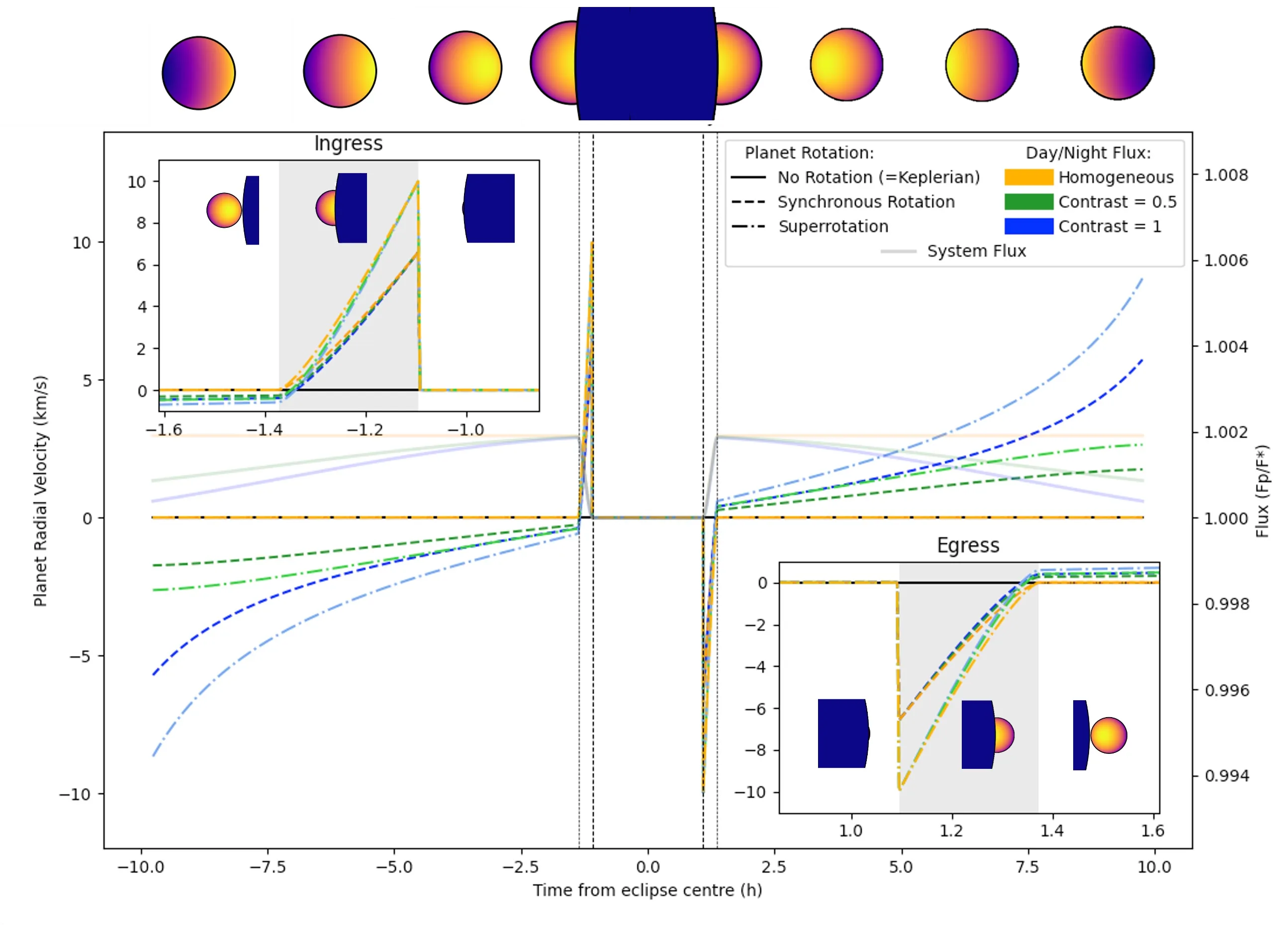
عندما يمر كوكب خلف حافة نجمه، يضيء النجم غلافه الجوي — تمامًا كما تضيء شمس الغروب السحب فوق الأفق. هذه اللحظة العابرة، التي تستمر بضع دقائق فقط، تحمل بصمة الغازات التي مر عبرها ضوء النجم. وجّه علماء الفلك تلسكوب SPIRou نحو نظام WASP-33: حيث يكمل كوكب خارجي من نوع المشترى الحارق دورة كاملة حول نجمه في 1.2 يوم أرضي فقط. لالتقاط التلميح الخافت لأول أكسيد الكربون (CO) في الطيف — ضوء النجم مقسمًا إلى ألوان — انتظروا بصبر ثمانية غروبات وشروق.
في السابق، كانت مثل هذه الحيل تنجح فقط مع المراصد الفضائية التي تنظر عبر نوافذ لونية واسعة. هنا، عملت أداة أرضية عالية الدقة: فهي تميز الظلال بدقة مثلما يميز الفنان ضربات الفرشاة على القماش. ثمن التفاصيل هو إشارة ضعيفة. لتقويتها، تم دمج ثماني لحظات قصيرة من الدخول إلى الظل والخروج منه معًا — كما لو تم تراكب صور شفافة فوق بعضها البعض. وظهرت إشارة CO. لأول مرة من بيانات الكسوف وحده، دون مساعدة ساعات طويلة من مراقبة النهار الكامل.
هذا النجاح — مثل أول خطوة مترددة نحو خرائط ثلاثية الأبعاد للأغلفة الجوية. حتى الآن، تمكنوا فقط من تحسين تقدير سرعة دوران الكوكب قليلاً، لكن الاختبارات تظهر: خمسة عشر غروبًا إضافيًا من هذا القبيل — وسيظهر رقم موثوق. وعندما تدخل التلسكوبات من الجيل التالي الخدمة، ستسمح الطريقة بالنظر إلى أعماق طبقات السحب لعشرات من الكواكب المشترية الحارة. ستُقرأ الرياح والتركيب الكيميائي لهذه العوالم من حافة ضوء نجم يحتضر.
الملخص الأصلي
كما كتبه المؤلفون، بالإنجليزية arXiv:2605.22931
In the last decade, ground-based high-resolution spectroscopy (HRS) has emerged as a powerful method to probe exoplanet atmospheres both in transit and thermal emission. With HRS science now maturing to reveal these planet's thermal, compositional, and dynamical structure in three dimensions, novel strategies will be key to extracting the maximal scientific output from these rich datasets. In this article, we investigate the potential of exploiting eclipses in order to retrieve spatial constraints on exoplanet dayside atmospheres with HRS, as has been successfully applied at lower spectral resolutions with space-based facilities. To attempt this, we obtained an observations of 8 eclipses (ingress and egress) of the ultra-hot Jupiter WASP-33b with SPIRou. We analysed these data with the publicly available ATMOSPHERIX pipeline, which we combined with the starry Python package to fit the eclipse mapping signal. Additionally, we performed injection-recovery tests on archival data to evaluate the detection limits that could be reached with further observations. From our data, we obtain the first tentative detection of CO from in-eclipse data alone, validating that ingresses and egresses may be stacked coherently to boost detection limits. In combination with longer phase-coverage dayside data, our eclipses marginally improve constraints on the planetary rotation velocity. Through injection recovery tests, we show that our results are scaling according to expectations for a synchronously rotating WASP-33b, implying that a further 15 eclipses with SPIRou would be required to measure the planet's rotation using this method. Finally, we present promising detection limits for this method on the population of hot-Jupiters with next generation telescopes, and highlight remaining challenges in data processing for short time series and/or slowly accelerating planets.
أول أكسيد الكربون (CO) على الأرض سم خطر بلا لون ولا رائحة، أما على الكواكب الحارقة مثل WASP-33b فيصبح علامة مفيدة: إشارته في طيف النجم يسهل تمييزها واستخدامها لقياس درجة الحرارة وحركات الغلاف الجوي.