خدعة كمومية تسرّع الكون دون طاقة مظلمة سريع
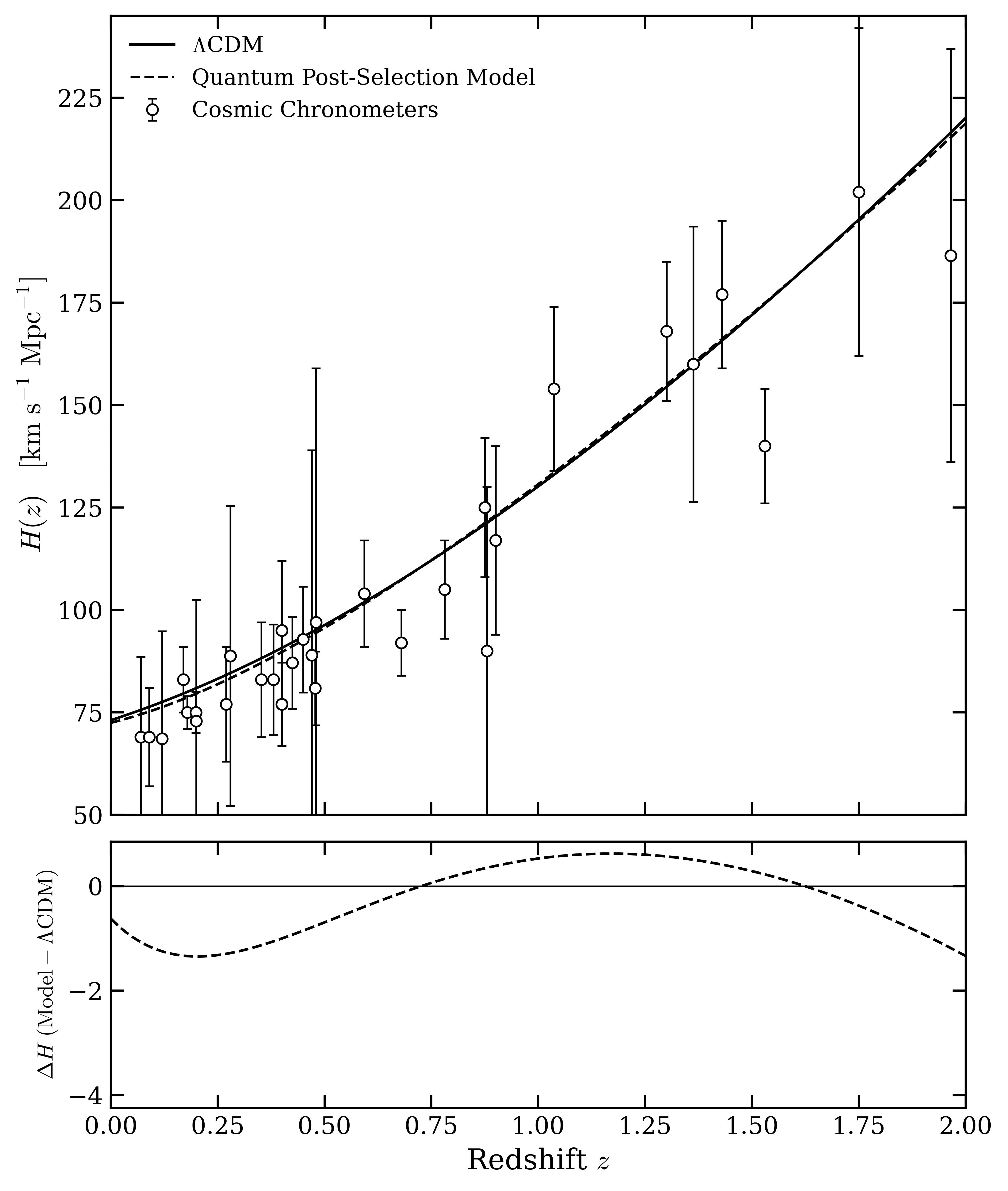
منذ نهاية القرن العشرين، من المعروف أن توسع الكون يتسارع — حيث تتباعد المجرات بسرعة متزايدة. حصل هذا الاكتشاف على جائزة نوبل لكل من آدم ريس وسول بيرلموتر وبراين شميدت. يعتمد التفسير القياسي على الطاقة المظلمة — قوة غير مرئية تدفع الفضاء بعيدًا. لكن بحثًا جديدًا يقدم آلية مختلفة: فالأمر كله يتعلق بالانتقاء اللاحق — قاعدة كمومية تشبه قصة بوليسية ذات نهاية معروفة، حيث تُضبط الأدلة لتتناسب معها. ينتقي المستقبل فقط تلك الخيارات من الأحداث التي تؤدي إلى النتيجة المرغوبة. هذا يحل لغزًا طويل الأمد: لماذا بدأ التسارع الآن تحديدًا، عندما نوجد نحن والمجرات. لا يُدخل النموذج أي غموض، ويتوافق تمامًا مع البيانات حول المستعرات العظمى وأعمار المجرات. كما يصف بدقة العصور المبكرة بعد الانفجار العظيم. استنتاج غير متوقع: لولا هذا 'الضبط'، لكان التسارع قد بدأ في عصر الذرات فقط — وما كانت النجوم لتُضيء أبدًا.
الملخص الأصلي
كما كتبه المؤلفون، بالإنجليزية arXiv:2606.12297
The origin of cosmic acceleration remains a central problem in cosmology, commonly attributed to a cosmological constant within the $$\Lambda$$CDM model or to dynamical dark energy. Here, we develop an alternative approach in which acceleration emerges from quantum post-selection, a standard feature of quantum theory that is not usually incorporated into cosmological modelling. While quantum theory admits both pre-selected and post-selected ensembles, quantum cosmological models are almost exclusively formulated in terms of initial conditions. Building on previous work on post-selected quasiclassical dynamics, we construct a minimal predictive cosmological model in which post-selection and coarse-graining generate effective late-time acceleration without introducing a cosmological constant, dark energy, or modifications of general relativity. The resulting expansion history is highly constrained theoretically and depends on at most two parameters beyond standard Friedmann evolution. Confrontation with type Ia supernova and cosmic chronometer data yields statistically competitive fits while naturally avoiding the coincidence problem. The model also reproduces the standard radiation- and matter-dominated behaviour at early times and predicts a present-day jerk parameter significantly different from the $$\Lambda$$CDM value. These results suggest that cosmic acceleration may arise as a macroscopic quantum cosmological effect rather than from additional cosmological fluids or modified gravitational dynamics.
المستعرات العظمى من النوع Ia هي انفجارات نجمية ذات طاقة متساوية تقريبًا: تُستخدم كـ'مساطر' قياسية لقياس المسافات بمليارات السنين الضوئية.
الانتقاء اللاحق يذكرنا بقصة 'قصة حياتك' لتيد تشيانغ، حيث معرفة المستقبل تحدد الأفعال في الحاضر.