الجاذبية في خمسة أبعاد: ماذا تقول الموجات سريع
عندما ترسل إلينا مجرة بعيدة ضوءها، يضعف الضوء مع المسافة — ومن هذا الضعف يمكننا معرفة مدى بعدها. تقريبًا بنفس الطريقة تعمل الموجات الثقالية: كلما كان مصدرها أبعد، كان ارتعاش الفضاء الذي تلتقطه الكواشف على الأرض أضعف. ولكن إذا كان لعالمنا أبعاد خفية، فقد تتسرب الجاذبية إليها، وتخمد الموجات أسرع من المعتاد.
أخذ مؤلفو العمل كتالوجًا يضم 141 اندماجًا للأجسام المدمجة — الثقوب السوداء والنجوم النيوترونية — وقارنوا جهارة الموجات المقاسة بالمسافات إلى المجرات من كتالوج GLADE+. تُسمى هذه الطريقة بـ"العازفة الصامتة" (dark siren): على عكس الومضات البصرية، لا تتطلب رؤية الضوء الناتج عن الاصطدام. إذا كانت الجاذبية تتسرب إلى البعد الخامس، فإن الموجات تضعف أكثر مما تتنبأ به النسبية العامة.
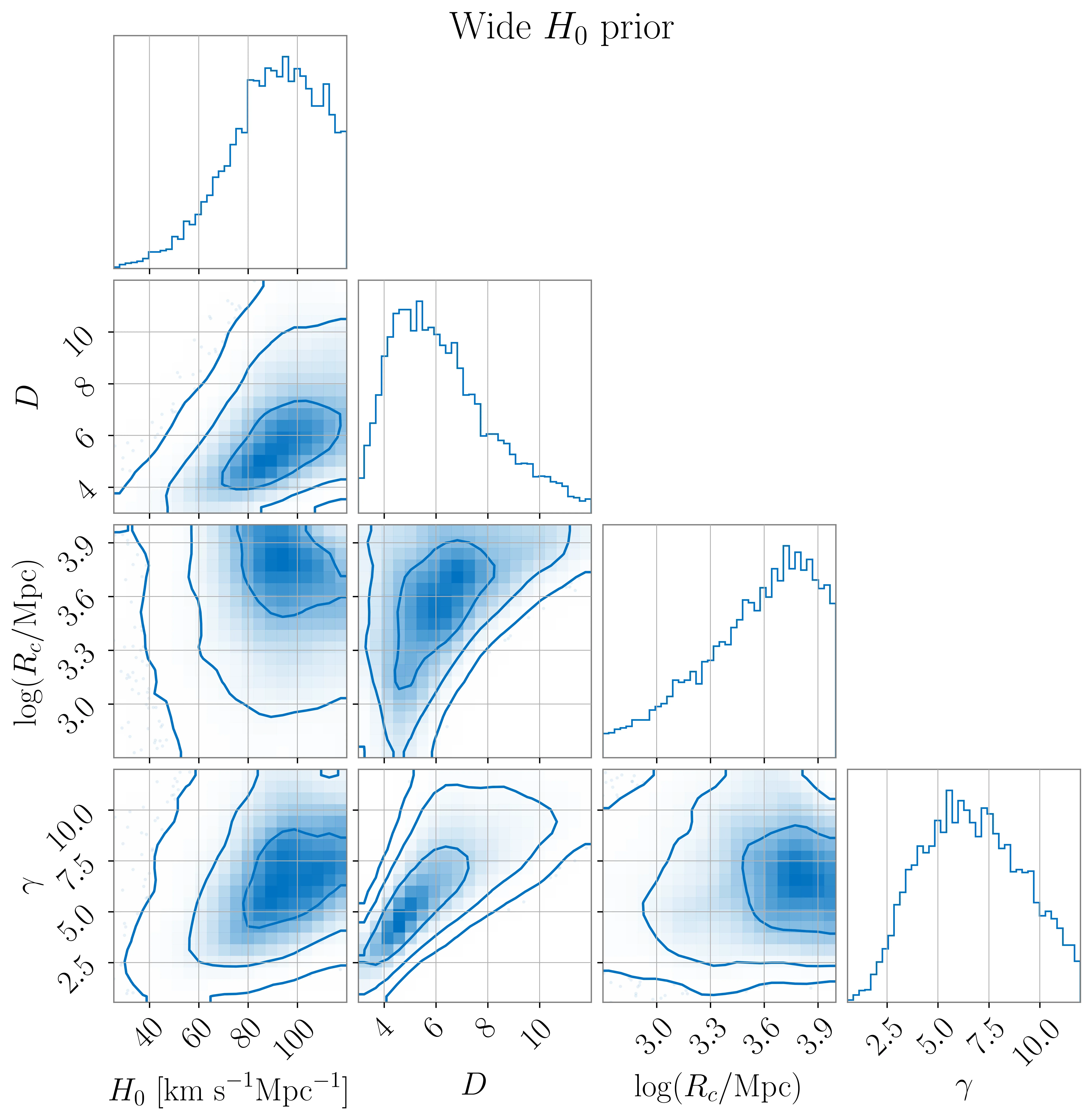
أدخل العلماء معلمتين: عدد الأبعاد D ومقياس الانتقال $R_c$، الذي تتغير عنده سلوك الجاذبية. أظهر التحليل أن D = 4.38 مع نطاق واسع من عدم اليقين — من 3.37 إلى 6.29. هذا يعني أن البيانات لا تتعارض حتى الآن مع الأبعاد الأربعة المألوفة. بقيت قيمة $R_c$ غير محددة تقريبًا: قد يكون مقياس الانتقال كبيرًا جدًا، والكواشف الحالية لا تشعر به ببساطة.
الاستنتاج حذر: النسبية العامة رباعية الأبعاد صمدت مرة أخرى. لكن طريقة "العازفة الصامتة" بدأت للتو في اكتساب القوة. مع كل كتالوج جديد من الملاحظات، ستزداد الحساسية، وربما يومًا ما سنرى ذلك الانكسار في توهين الموجات — علامة على أن الفضاء أكثر تعقيدًا مما يبدو.
الملخص الأصلي
كما كتبه المؤلفون، بالإنجليزية arXiv:2606.14549
Higher-dimensional theories of gravity predict that gravitational waves (GWs) can propagate into extra spatial dimensions, leading to modified amplitude damping over cosmological distances. Measurements of GW luminosity distances therefore provide a unique probe of the dimensionality of spacetime. In this work, we constrain higher-dimensional GW propagation using the dark-siren method with the Gravitational-Wave Transient Catalog 4.0 (GWTC-4). We adopt a phenomenological parameterization motivated by braneworld scenarios, in which deviations from General Relativity are characterized by the spacetime dimension number $$D$$ and a crossover scale $$R_c$$ governing the transition between four- and higher-dimensional gravity. We perform a hierarchical Bayesian analysis combining 141 compact binary coalescences from GWTC-4 with line-of-sight galaxy information from the GLADE+ catalog. For a prior $$H_0 \in [65,77]\ {\rm km~s^{-1}Mpc^{-1}}$$ and $$\log(R_c/{\rm Mpc}) \in [2.7,4.0]$$, we obtain $$D = 4.38^{+1.91}_{-1.01}$$ (68\% credible interval). We also find that the inferred posterior distribution of $$R_c$$ accumulates near the upper prior boundary, indicating that the crossover scale remains poorly constrained by current observations. We further show that the inferred constraint on $$D$$ depends sensitively on the assumed prior range of $$R_c$$, which determines the characteristic distance scale at which deviations from General Relativity become significant. Our results provide the first GWTC-4 dark-siren constraints on higher-dimensional GW propagation and demonstrate that current observations remain consistent with four-dimensional General Relativity.
إذا كانت الجاذبية تنتشر في خمسة أبعاد، فإن قوة التجاذب كانت ستنخفض مع المسافة بشكل أسرع — كمكعب وليس كمربع. كانت الكواكب ستتناثر، ولم تكن النجوم لتتجمع في مجرات.