كيف تكشف النظائر النووية المثارة عن نفسها بومضات غاما سريع
اصطدام نجمين نيوترونيين هو بمثابة معمل كوني تُصاغ فيه أثقل عناصر الجدول الدوري خلال ثوانٍ. في عام 2017، التقطت الكواشف موجات ثقالية من هذا الاندماج، ورصدت التلسكوبات وميضًا — كيلونوفا (kilonova). يتغذى توهجها على اضمحلال الأنوية غير المستقرة التي وُلدت في عملية الالتقاط السريع للنيوترونات (r-process). لكن لهذا المعمل الكوني مساعدين صامتين لم يُنتبه إليهم من قبل.
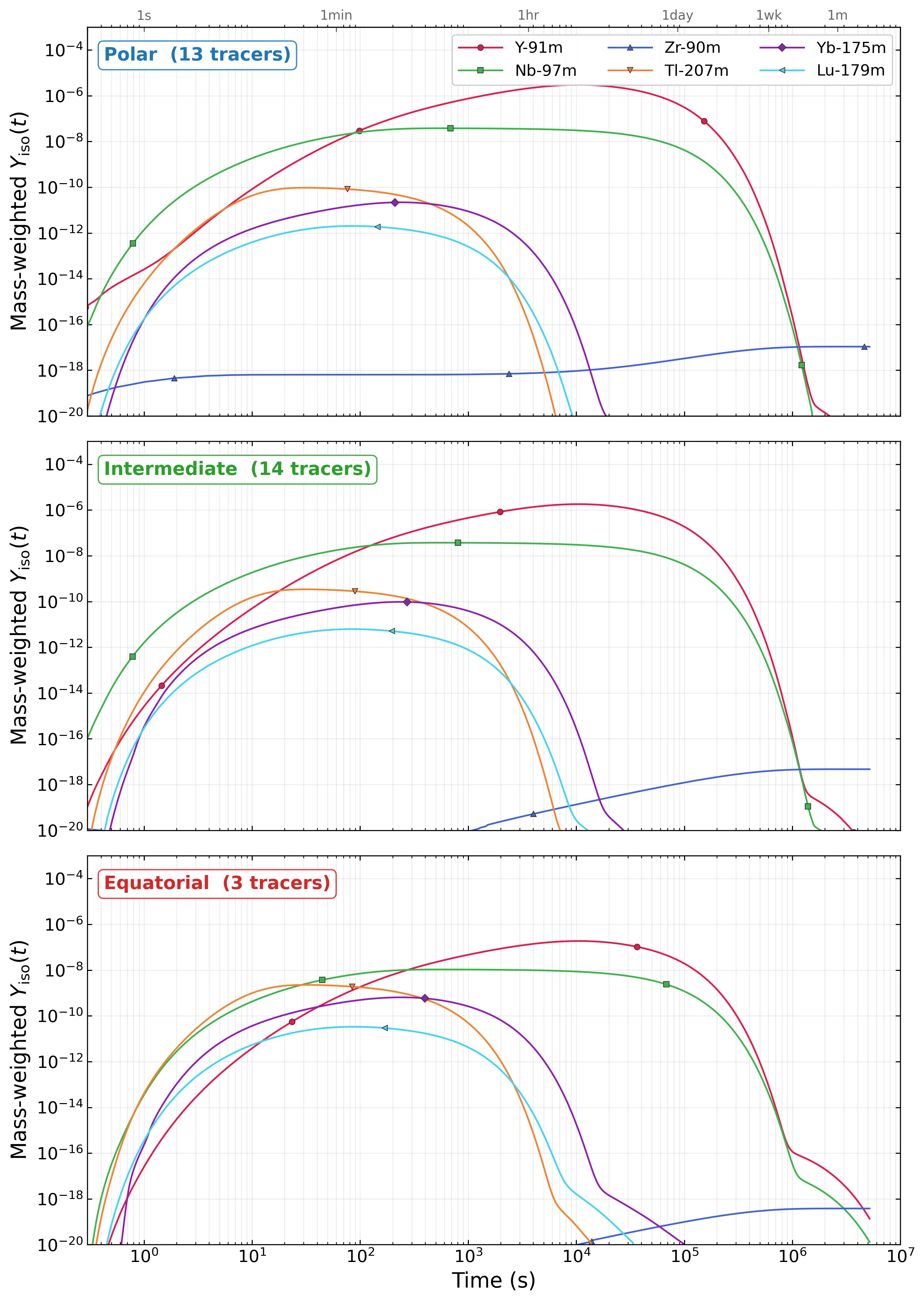
نقصد النظائر المثارة (nuclear isomers) — حالات تعلق فيها النواة لفترة تتراوح بين أجزاء من الثانية وساعات، قبل أن تفرغ طاقتها وتنتقل إلى الحالة الأساسية. في الحسابات التقليدية لم تكن تؤخذ في الاعتبار: كان يُعتقد أنه بعد اضمحلال بيتا، تستقر النواة الابنة فورًا. ولأول مرة، تتبع المؤلفون سلوك عدة نظائر مثارة باعتبارها مشاركين مستقلين في التفاعل. وحسبوا كيف تؤثر درجة الحرارة على الانتقالات بين الحالة المثارة والحالة الأساسية، وكيف يملأ اضمحلال بيتا مستويات مختلفة من النواة.
اتضح أن خطين قد يكونان ساطعين بما يكفي لترصدهما مراصد غاما مثل COSI أو AMEGO أو LOX — إذا حدث الانفجار في مجرتنا. هذان هما خط 743,3 كيلوإلكترون فولت من النظير المثار النيوبيوم-97 وخط 555,6 كيلوإلكترون فولت من الإيتريوم-91. حتى الآن أُجري الحساب لجزء صغير فقط من النظائر المثارة المعروفة، لكن من الواضح بالفعل: بدونها ستكون صورة سماء غاما بعد الاندماج ناقصة. المعمل الكوني يعمل بدقة أكبر مما كنا نظن، والآن لدينا فرصة لسماع إشاراته الخافتة.
الملخص الأصلي
كما كتبه المؤلفون، بالإنجليزية arXiv:2606.26447
The multi-messenger observations of GW170817 have provided strong evidence that binary neutron star mergers are a site of heavy-element production through the rapid neutron capture process. The decay of unstable $$r$$-process nuclei produces a significant number of $$\gamma$$-rays, which not only power the associated kilonova, but may also be observable in current and future $$\gamma$$-ray observatories, providing a direct probe of the nuclei synthesized. Current models of the emitted $$\gamma$$-rays link a nuclear reaction network with individual decay spectra. Typically, only the population of the ground state of the nuclei is tracked in the reaction network, and rapid de-excitation of the daughter nuclei is assumed when calculating the decay spectra. This may not be accurate in nuclei where there are longer-lived, high-energy nuclear isomers. In this work, we relax these assumptions, modeling the dynamic behavior of nuclear isomers for a select list of nuclei. These isomers are included as independent states in the network, with temperature-dependent effective transition rates between ground and isomeric states and $$\beta$$-feeding probabilities calculated using the nuclear level structure. We estimate the $$\gamma$$-ray flux from isomeric transitions, finding that the 743.3 keV line of Nb-97m and the 555.6 keV line of Y-91m may be detectable in $$\gamma$$-ray observatories such as COSI, AMEGO, and LOX at galactic distances. These results, calculated for a small fraction of nuclei with isomers, highlight the need for the robust inclusion of nuclear isomers in nuclear reaction networks, as well as careful modeling of the resultant $$\gamma$$-ray spectroscopy to characterize observational signals.
بعض النظائر المثارة تعيش طويلًا لدرجة أنه يمكن تخزينها في المختبر لسنوات — على سبيل المثال، النظير المثار للهافنيوم-178 له عمر نصف يبلغ 31 عامًا.
في رواية «عمى كاذب» للكاتب بيتر واتس، تستخدم المسابير الفضائية الغريبة ومضات غاما للتواصل — ربما ستساعدنا خطوط النظائر المثارة يومًا ما في فك شيفرات الرسائل الكونية.