من يعالج أفضل: ذكاء اصطناعي عام أم متخصص ضيق؟ سريع
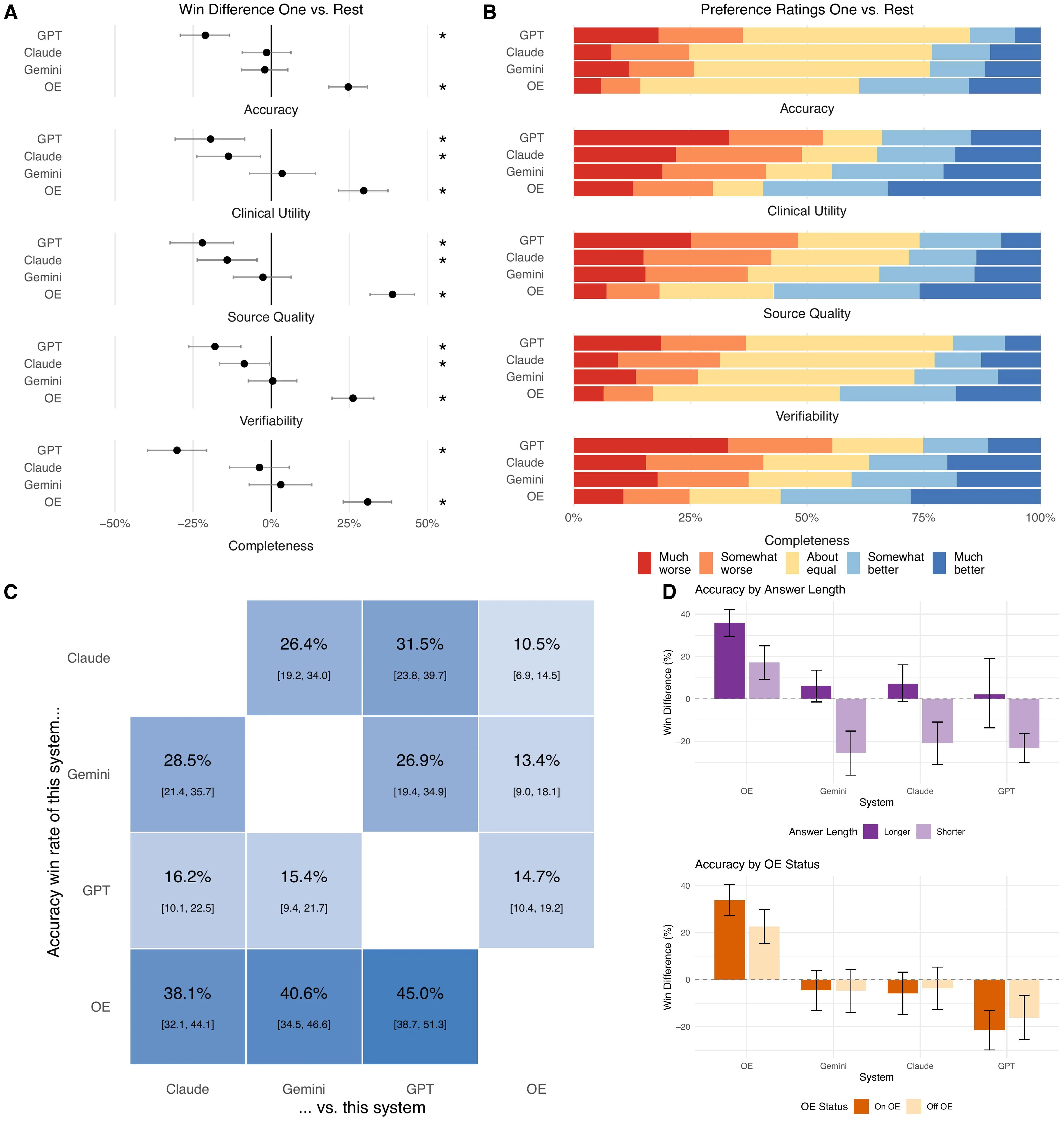
كل أسبوع، يطرح الأطباء ملايين الأسئلة على مساعدي الذكاء الاصطناعي بجانب سرير المريض. لكن عادةً ما تُختبر هذه الأدوات على مسائل امتحانية، وليس على ما يُسأل في العيادة الحقيقية. قررت مجموعة من الباحثين تصحيح هذا الأمر.
جمعوا 620 سؤالًا حقيقيًا من أطباء في 30 تخصصًا — من أمراض القلب إلى كشف سرطان الدماغ. طُرحت هذه الأسئلة على منصة OpenEvidence. ثم قارن 149 طبيبًا ممارسًا من 36 ولاية إجابات ثلاث نماذج عامة رائدة (Claude Opus 4.8، Gemini 3.1 Pro، GPT-5.5) والأداة الطبية المتخصصة (OE). كان كل محكّم من نفس تخصص الطبيب الذي طرح السؤال.
قُيّمت الإجابات وفق خمسة محاور: الدقة، والفائدة السريرية، وجودة المصادر، وقابلية التحقق، والاكتمال. فازت الأداة المتخصصة في جميع البنود. بلغ الفرق بين الانتصارات والهزائم من 25 إلى 39 نقطة مئوية — بدلالة إحصائية قوية جدًا (p<0.001). لم تعتمد النتيجة على ما إذا كانت الاقتباسات ظاهرة، أو طول الإجابة، أو ما إذا كان المحكّم قد استخدم هذه الأداة من قبل.
هناك نتيجتان. الأولى: يجب اختبار الذكاء الاصطناعي الطبي على أسئلة حقيقية وبمشاركة أطباء من نفس التخصص — وإلا ستكون الصورة ناقصة. الثانية: تفوق الأداة المتخصصة لا يعني أن النماذج العامة عديمة الفائدة. بل يُظهر أن الضبط الهندسي الموجه يحقق مكسبًا ملموسًا للمستخدم. مثل سماعة طبية مضبوطة جيدًا تسمع ما يفوته ميكروفون عام.
الملخص الأصلي
كما كتبه المؤلفون، بالإنجليزية arXiv:2606.28960
Physicians now pose millions of clinical questions to AI tools each week, yet these tools are evaluated largely on hypothetical or exam-style questions, not those actually asked in practice. We report a blinded evaluation built on 620 Real-world Point-Of-Care Queries (Real-POCQi) submitted to the OpenEvidence (OE) platform by physicians spanning 30 specialties, as well as 187 questions from HealthBench. 149 practicing physicians across 36 states made head-to-head comparisons between answers from three frontier general-purpose models (Claude Opus 4.8, Gemini 3.1 Pro, and GPT-5.5) and a specialized clinical tool (OE), with graders matched to each question's specialty. When comparing answers along five dimensions relevant to clinical decision support -- accuracy, clinical utility, source quality, verifiability, & completeness -- physicians scored the specialized tool highest on all axes; in the primary analysis on Real-POCQi, win differences (margins between win and loss rates) ranged from 25 to 39 percentage points (p<0.001). Results remained consistent in sensitivity analyses stratifying by citation display, answer length, OE-user status, and Real-POCQi versus HealthBench. In parallel, LLM judges were found to systematically differ from expert judges, though both generally agreed on the best model. These findings underscore two conclusions: (i) AI tool evaluations should reflect real-world query distributions and use expert judges that mirror the specialization defining modern medicine and (ii) the consistent advantage of the specialized tool over general-purpose models does not necessarily mean that the latter cannot serve similar purposes, but that targeted engineering and customization can yield meaningful gains in performance for its users. We release Real-POCQi as a public benchmark, as well as the prespecified statistical analysis for reproducing results of this study.
بلغ الفارق في الانتصارات 39 نقطة مئوية — وكأن فريقًا يفوز في 7 مباريات من أصل 10، بينما يفوز الآخر في 3 فقط.