ذاكرة زوج التوصيل الفائق سريع
غالبًا ما يُصوَّر التوصيل الفائق على أنه رقصة متجمدة للإلكترونات: فهي تتحد في أزواج وتتحرك دون مقاومة، مثل متزلجين على جليد مثالي. لكن في الموصلات الفائقة عالية الحرارة، يتبين أن هذا الجليد ليس أملسًا تمامًا. كارل شفارتسشيلد أظهر يومًا كيف تحني المادة الزمكان؛ وهنا، مجال الأزواج نفسه يحني «ذاكرته» عن الحالات السابقة.
في العمل الجديد، لم يعد مجال أزواج التوصيل الفائق Δ مجرد رقم في معادلة. إنه يتفاعل مع مجالات محلية تنشأ من نقاط خاصة على سطح فيرمي — العقد المضادة. تعمل هذه النقاط كممر مرايا: فهي تنتقي فقط أطوال موجية معينة من الاهتزازات، مشكلةً تجويفًا طيفيًا (رنانًا لموجات الإلكترون). ونتيجة لذلك، لا تضمحل استجابة الزوج للصدمة بشكل سلس، بل على منحنى جرسي — غاوسي. عمر هذه الذاكرة حوالي $τ_g$ — مقياس زمني مميز يمكن قياسه.
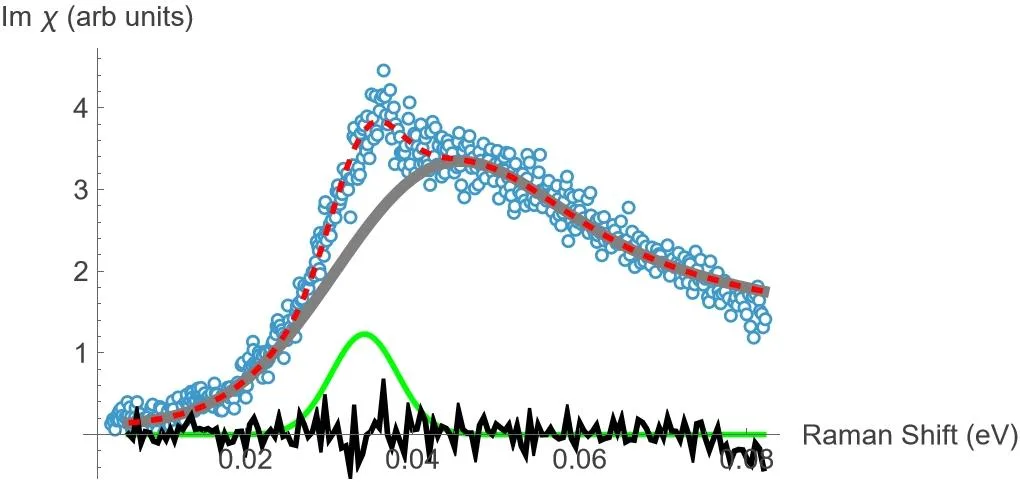
تحت درجة الحرارة الحرجة، تظهر قناة ذاكرة ثانية — متماسكة، مرتبطة بمكثف الأزواج. تضيف إيقاعًا واضحًا إلى صدى غاوسي مشوش. الانتقال إلى حالة التوصيل الفائق يعيد توزيع الوزن الطيفي بين هاتين القناتين: الذاكرة غير المتماسكة للفجوة الزائفة والذاكرة المتماسكة للمكثف. تجارب تبعثر رامان، ARPES (مطيافية الانبعاث الضوئي) والنفق ترى إسقاطات مختلفة لنفس المتصل الغاوسي — مثل ظلال جسم واحد من جهات مختلفة.
الملخص الأصلي
كما كتبه المؤلفون، بالإنجليزية arXiv:2607.03937
We develop a dynamical description of the superconducting pair field in which the Cooper-channel Hubbard--Stratonovich field $$\Delta$$ is treated as a memory-dressed Bogoliubov pair field rather than as a purely static order parameter. Starting from the standard pair-field effective action, we couple $$\Delta$$ to antinode-selected collective or self-generated fields. An ensemble of such modes produces a distribution of local Bogoliubov frequencies; when this distribution is approximately Gaussian, ensemble averaging gives the memory factor $$\exp[-t^2/(2\tau_g^2)]$$. In cuprate superconductors, the antinodal gap or pseudogap restricts the active electronic phase space and acts as a momentum-space spectral cavity. It selects fluctuation wavevectors $$\mathbf Q_a$$ that may become charge-density-wave-like instabilities in an ordered limit, but behave as a reservoir of local collective fields in the fluctuating regime. The same framework admits resonant algebraic prefactors, so that threshold and forced-oscillator responses generate the hierarchy $$p=-1/2,1/2,1,3/2,\ldots$$, while the Gaussian envelope cuts off secular growth and converts these branches into finite spectral components. The resulting picture contains a robust pseudogap memory channel and, below $$T_c$$, an additional condensate-assisted coherent channel proportional to $$|\Delta_0(T)|^2$$. Thus the superconducting transition primarily reorganizes pair-field spectral weight between incoherent pseudogap memory and coherent Bogoliubov memory. The frequency-domain response is expressed in terms of parabolic-cylinder functions, and comparisons with Raman, ARPES, tunneling, and doping-dependent ARPES scaling suggest that these probes are complementary projections of the same Gaussian-memory pair continuum. We compare our numerical results with the recent experimental data on Bi$$_2$$Sr$$_2$$CaCu$$_2$$O$$_{8+\delta}$$.
دوال الأسطوانة المكافئة المستخدمة في هذا العمل ظهرت لأول مرة في مسائل انحراف الضوء عند حافة شاشة — والآن تساعد في فهم ذاكرة أزواج التوصيل الفائق.