Why a bare-bones weather model can't feel the winter ✛
Over warm oceans, like a huge snake, a wave of moist air creeps along. It moves slowly, at the pace of a walking person, dragging rain with it. Scientists want to understand why this wave appears and disappears, so they built a very simple model, like a skeleton that holds the most important parts.
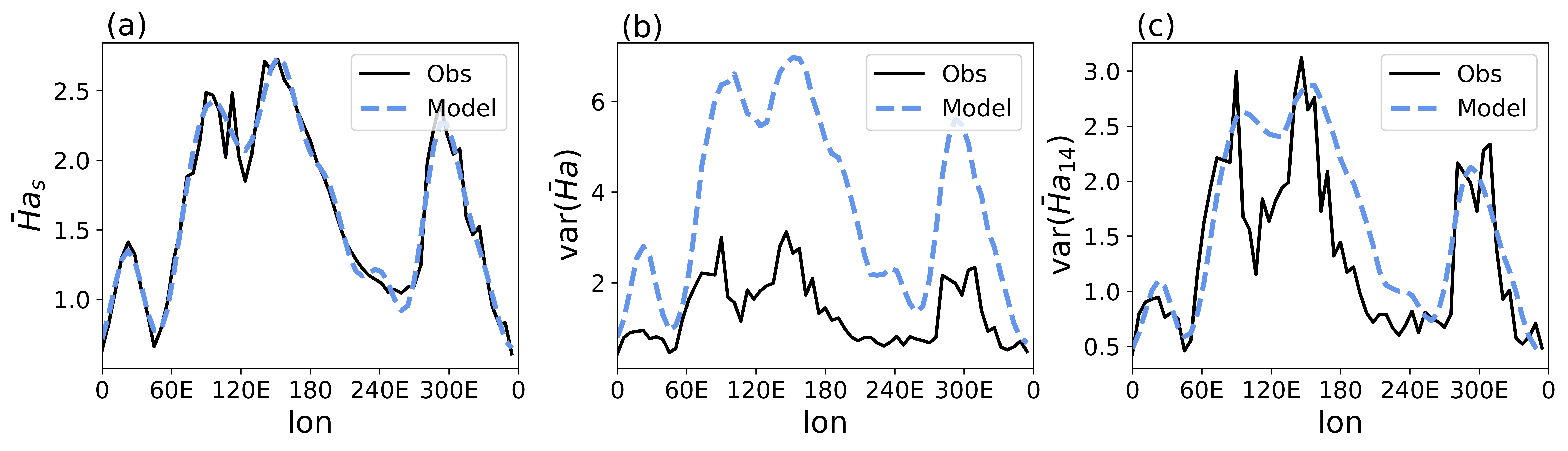
Previously, this skeleton was given uniform heating and cooling all year round, as if the tropics always had the same weather. Now, for the first time, they gave it real data: how much heat was released during rains and how much escaped into space, month by month. The skeleton came to life and began to behave almost like a real wave: it lived about as many days and was just as strong.
It's as if a skeleton person walked perfectly but didn't feel cold in winter. So, to sense the seasons, you need not just bones but also skin, blood, and nerves. Scientists now know that they need to add a connection to the ocean and other details to the model so that it starts to notice the seasons.
The MJO skeleton model contains only three parameters and one quadratic nonlinearity, yet it reproduces a phase speed of 5 m/s and a flat dispersion relation, something that complex climate models do not always achieve.