The Madden–Julian Skeleton under Realistic Forcing ✛
Context
This work sits at the fringe of the knowledge map: its nearest neighbors concern quantum gravity, stochastic evolution, and neutrinos, not intraseasonal atmospheric dynamics. Within the thematic group spacetime, quantum_gravity, gravity, quantum_field, this article is the only one on tropical meteorology. Therefore, its contribution should be assessed not against its neighbors but against earlier versions of the skeleton model: previously, the forcing was static and identical for heating and cooling; now it has become realistic and time-dependent.
Methods
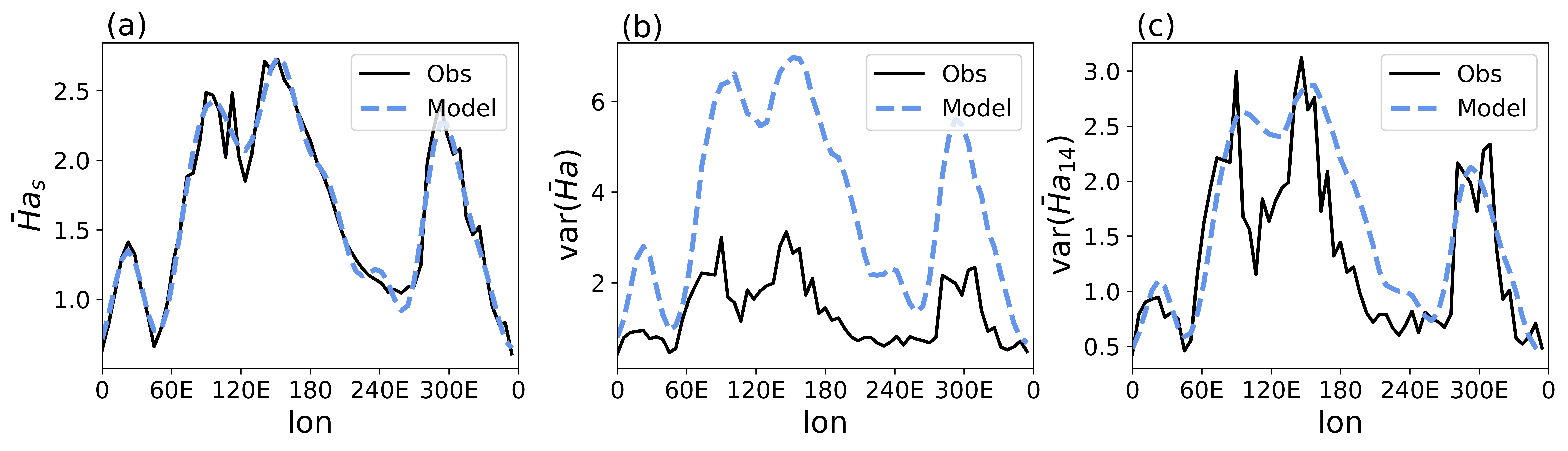
The authors used the stochastic version of the MJO skeleton model, where convective activity is described by a birth–death random process. The forcing functions, latent heating and radiative cooling, were computed from NCEP/NCAR latent heat flux data and GPCP precipitation for 1979–2021 at monthly resolution. Unlike previous studies, the profiles were not time-averaged but smoothed with a three-month running mean to make the model generate MJO events at the desired frequency. Events were identified using the SMM index, constructed analogously to the observational RMM index but using model zonal wind and negative convective heating.
Results
The model reproduces the MJO phase speed of about 5 m/s, a flat dispersion relation, and intermittent event occurrence. The mean duration of model events was 39.6 ± 0.8 days versus 36.1 days in observations; the mean angle traversed in phase space was 0.75·2π in both cases; the mean maximum SMM/RMM amplitude was 2.53 versus 2.50. Statistical tests showed that the duration and angle distributions still differ (p = 0.0006 and p = 0.0428, respectively), while the amplitude distribution is indistinguishable (p = 0.8116). The model does not reproduce the seasonality of events: in observations, the MJO is more frequent in winter and spring, whereas in the model the frequency is uniform year-round. When stratified by ENSO phase, the model showed no significant differences in duration, angle, or amplitude, although in observations events during El Niño are shorter (33 days versus 40 during La Niña).
Implications
Unlike neighboring works on quantum gravity and stochastic evolution, this article tests not a new theory but the boundaries of a long-known minimal model. Its novelty lies in the realism of the forcing: for the first time, heating and cooling profiles are taken from data and retain temporal variability. It turns out that even such realistic forcing does not rescue the model from failing to capture the MJO–ENSO connection. This suggests that the issue is not the forcing but missing physical mechanisms, such as oceanic coupling or changes in the mean wind.
Future development
The topic could develop toward adding oceanic coupling and changes in the mean atmospheric state to the skeleton model, as is done in more complex models. It is also important to study how the length of the forcing smoothing window affects the frequency and properties of MJO events. A method for tracking the MJO convective center may be needed for more accurate comparison with observations.
Impact
The results will influence the development of simplified models of intraseasonal variability and the understanding of what minimal ingredients are necessary for the MJO–ENSO connection.
Next steps
Test the model's sensitivity to the length of the forcing smoothing window and add oceanic coupling or mean wind variability to see whether a response to ENSO phases emerges.
Key open problems
For meteorology, a key unresolved problem is why models fail to reproduce the modulation of the MJO by El Niño. This work shows that realistic forcing is not enough; additional mechanisms, likely related to the ocean or the mean state, are needed.
The knowledge machine's view
This section is addressed to the author of the paper and their colleagues. Neighbouring works were found by meaning-based search across our archive, not by word overlap. We do not review: we show the field around the work.
What the work does
The authors used a stochastic skeletal MJO model with time-dependent forcing computed from reanalysis data and precipitation. The model reproduces the average statistics of MJO events (duration, amplitude, phase speed) but does not capture seasonality or the response to ENSO phases.
Where its strength is
Realistic time-varying forcing in a minimal model is a step toward understanding which physical mechanisms are needed to link the MJO to ENSO.
Where it could go next
- It might be interesting to see how solar activity influences intraseasonal variability in our model, using an approach similar to that in the work on solar pacing of ice ages.based on: The Sun Conducts Ice Ages arXiv:2604.12143
- Related work on chameleon gravity considers the influence of external fields on dynamics; perhaps a similar mathematical technique could account for variability in the mean wind in the MJO model.based on: Chameleon Gravity and Solar Neutrinos arXiv:2606.12915
Worth trying
- Test whether the statistics of MJO events change when the model forcing is modulated with a solar cycle period.
- Assess how the results change if forcing profiles with higher temporal resolution (e.g., daily) are used.
Why this may matter
Refining the limits of applicability of the minimal MJO model is important for understanding which processes need to be included in more complete models for predicting intraseasonal variability.
Nearby works in our archive
- How Neutrinos Switch Flavors While Traveling Through the Sunsimilarity 0.49
- Black Hole Refrigerator: How Charge Controls Heatsimilarity 0.46
- The Sun Conducts Ice Agessimilarity 0.46
- Chameleon Gravity and Solar Neutrinossimilarity 0.45
The archive is sparse around this work: the closest review is only 0.49, against a usual 0.64. It looks like few have drilled nearby.
The MJO skeleton model contains only three parameters and one quadratic nonlinearity, yet it reproduces a phase speed of 5 m/s and a flat dispersion relation, something that complex climate models do not always achieve.
Key numbers
- MJO phase speed: about 5 m/s
- mean event duration (model): 39.6 ± 0.8 days
- mean event duration (observations): 36.1 days
- mean maximum SMM/RMM amplitude: 2.53 (model) and 2.50 (observations)
- number of model events: 980 from 15 runs