The Weather Skeleton That Ignores the Seasons ✛
Over the warm waters of the Indian and Pacific Oceans, a giant wave of moist air is born every month or two. It creeps eastward at a pedestrian pace, about five meters per second, dragging bands of downpours and droughts behind it. Meteorologists call it the Madden–Julian Oscillation MJO. For weather forecasts two to four weeks ahead, this wave matters more than the day-night cycle.
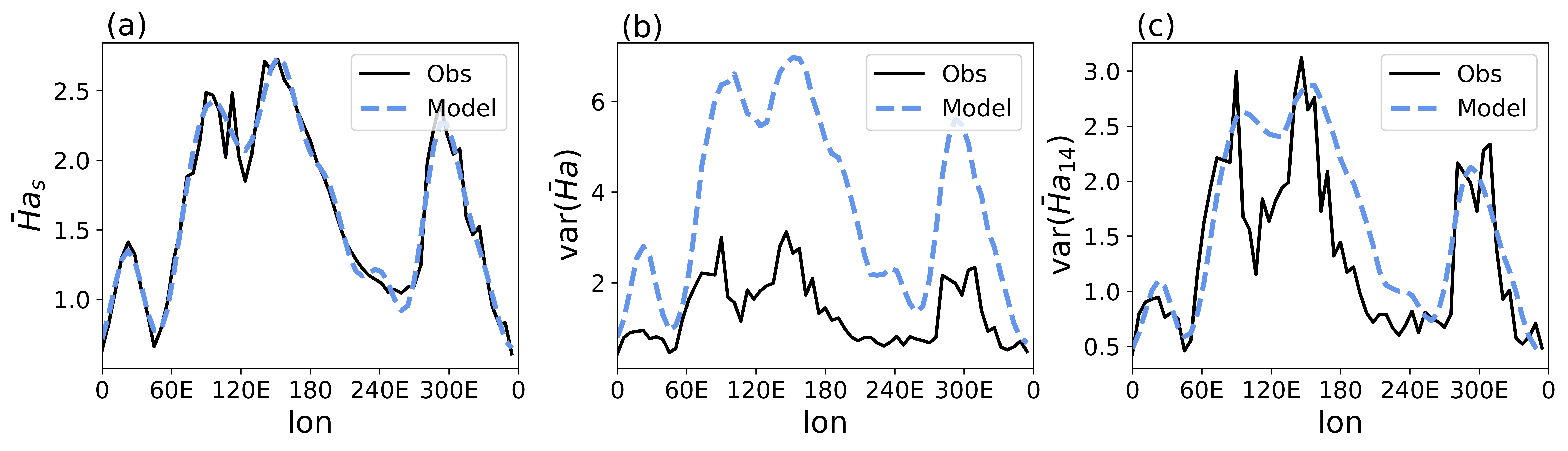
Scientists have long tried to describe it as simply as possible to grasp its essence. The result is a skeleton model: a few equations in which air warms from condensing vapor and cools by radiating heat into space. Previously, this heating and cooling were set as uniform and unchanging, as if the tropics always lived in the same climate. In the new study, the skeleton was given real data for the first time: how much heat was released by rain and how much escaped to space, month by month, from 1979 to 2021.
The result was almost lifelike. Model waves lived on average 39.6 days, while real ones lasted 36.1 days. They traveled about three-quarters of a circle, and their strength matched observations. But when the researchers looked at the calendar, the skeleton stumbled: in the model, waves were born equally often in winter and summer, whereas in reality they prefer winter and spring. Likewise, the model saw no difference between the warm phase of the Pacific (El Niño) and the cold phase (La Niña), even though real waves live shorter during El Niño.
This result is valuable not because the model failed, but because it now clarifies where to look for what's missing. Realistic heating did not help capture the wave's link to El Niño, so the issue is not tuning the forcing but missing organs: connections to the ocean or changes in the mean wind. Developers of simplified models now know which minimal details to add so the skeleton can start feeling the seasons. For now, it walks steadily, unaware that outside it's sometimes winter, sometimes summer.
The MJO skeleton model contains only three parameters and one quadratic nonlinearity, yet it reproduces a phase speed of 5 m/s and a flat dispersion relation, something that complex climate models do not always achieve.