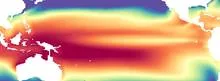
The Multivariate ENSO Index (MEI) is a single number that summarizes the state of the El Niño–Southern Oscillation (ENSO) — the natural climate cycle that causes El Niño and La Niña events. Instead of relying on just one variable like ocean temperature, the MEI combines six different atmospheric and oceanic measurements taken over the tropical Pacific. This makes it a more robust indicator of ENSO than any single metric alone.
History
The MEI was introduced in 2002 by Klaus Wolter at NOAA, building on earlier work that used a similar multivariate approach. A revised version, MEI.v2, was released in 2017 to improve consistency with modern datasets.
How it works
The MEI is calculated by taking six variables: sea-level pressure, surface zonal (east-west) winds, surface meridional (north-south) winds, sea surface temperature, surface air temperature, and total cloudiness. These are measured over the tropical Pacific and then combined using a statistical technique called principal component analysis. The result is a time series of values — positive values indicate El Niño conditions, negative values indicate La Niña, and near-zero values indicate neutral conditions.
In practice
The MEI is used by climate scientists and forecasters to monitor ENSO in real time, helping to predict seasonal weather patterns such as droughts, floods, and changes in hurricane activity across the globe.
In winter, one part of town gets three times as much snow as the neighborhood next door. One year is a scorcher, the next is a cold snap. That's the whims of weather. But over decades, a different, slow shift emerges: winters, on average, get milder. Telling the two apart is the central challenge for climate scientists.
In 2017, the LIGO and Virgo detectors recorded the spacetime tremor from the collision of two neutron star merger — event GW170817. After the initial burst came an after-ring: a kilohertz oscillation of the newly formed superdense remnant.
Gravitational signals from dying massive stars are whispers reaching us from the most violent laboratories in the Universe. Einstein predicted these gravitational waves over a century ago, but only today, with detectors like LIGO, are we beginning to hear them.
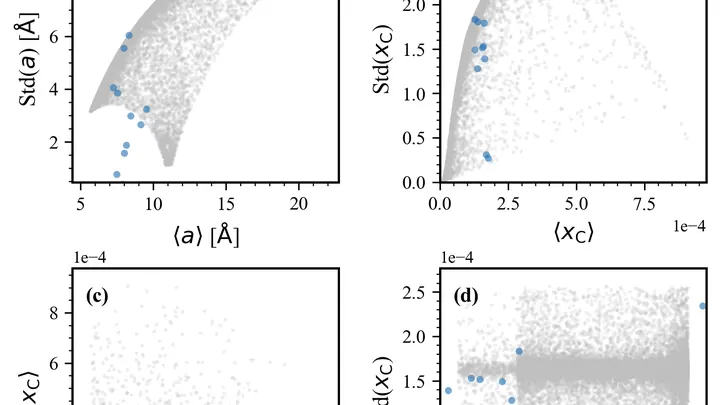
The search for new materials is like sailing across an uncharted archipelago: islands of stable crystals rise amid the raging ocean of possible combinations, and only a few survive the storm of thermodynamics. A true breakthrough came with entropy-stabilized oxides, where chaos, not order, binds the atoms.
Every year, as December approaches, the water off the coast of Peru becomes anomalously warm or anomalously cold. This is El Niño and La Niña, two phases of the same climate pendulum that swings in the equatorial Pacific. The pendulum is not a simple one: it remembers what happened to it several months earlier, and this memory determines which way it will swing next.
A translator in a conference hall tries to convey the speaker's words, but the hall is noisy: someone coughs, chairs creak, and the street outside is loud. If the speaker lowers their voice, the translator still keeps translating, but their voice drowns in the noise.
A student who has spent years solving problems from other people's textbooks suddenly receives three notebooks with real ocean observations. There are few problems, but they have already seen hundreds of similar ones, and now a couple of examples suffice to catch the new teacher's style.
Every winter, the tropical Pacific Ocean seems to replay the same script: sea surface temperatures off the coast of Peru rise, trade winds weaken, and a wave of droughts and floods spreads across the planet. This is El Niño, and its peak almost always falls in December. Why winter in particular?
A tuning fork produces a pure tone, but if you strike it too hard, it starts to rattle, and a musician might mistake that rattle for complexity in the sound.
In the Pacific Ocean, there is a warm current that flows eastward against all the others. It is called the North Equatorial Countercurrent, or NECC. In normal years, this band of warm water, a few hundred kilometers wide, quietly carries heat from Indonesia toward the Americas.
An orchestra plays in a dark hall, and the listener hears only a hum: hundreds of instruments blend into a dense noise in which no melody can be discerned. That is roughly what spectra extracted from climate data by methods like the Koopman operator look like: hundreds of components, each with its own frequency, and it is unclear which ones are true musicians and which are the rattling of chairs.
Neutrinos are often compared to a radio broadcast picked up by different receivers. One station sends a signal, but antennas in Japan, Antarctica, and at the bottom of the Mediterranean Sea hear it differently — due to distance, interference, and antenna orientation.
Two stones fall into a pond. Ripples spread from each, but when they collide, there's a splash and a short, sharp clap. That's roughly what the merger of two neutron stars sounds like: those ultra-dense remnants of exploded stars.
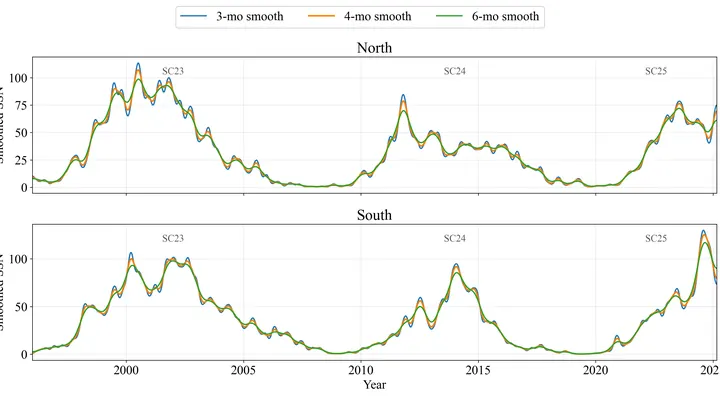
The Sun doesn't burn steadily: it erupts in series. Like a campfire that dies down and then suddenly throws out showers of sparks, these "fiery seasons" last from six months to a year and a half, and during them the star shows an unusually high number of sunspots.
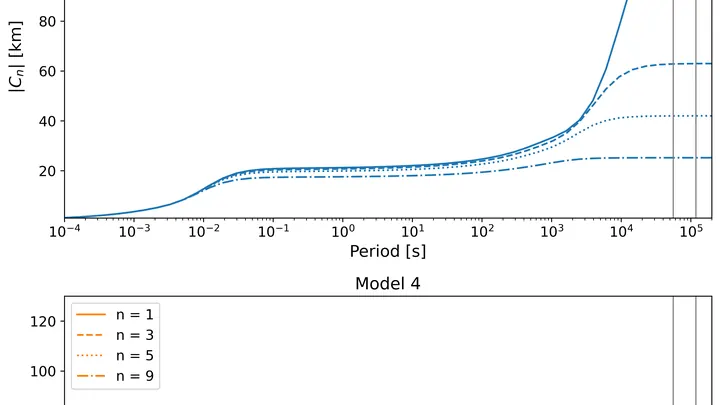
Enceladus is a tiny moon of Saturn, covered in a thick crust of ice. Beneath it sloshes a salty ocean, and deep down, a hot, porous core may be at work, like a sponge soaked with water and heat. But how do you see through tens of kilometers of ice? No need to drill: you can use an electromagnetic "echo."
A person with a metal detector walks along a beach.
Two observers watch the Pacific Ocean. One studies surface heat maps, the other listens to the rhythm of temperature and heat stored in the water column. On their own, each notices only part of the picture, but together they can sense the approach of El Niño months before the warm current alters weather across the planet.
A barometer on Tahiti and one in Darwin, Australia, breathe in opposite phases. When pressure rises on one, it falls on the other, and this difference, known as the Southern Oscillation Index, serves as a pendulum for the global climate.
The Sun pulses in a slow rhythm, and that rhythm can be heard in the rains over Brazil. Sunspots on the solar disk thicken and thin roughly every eleven years, and along with them, pressure in the Pacific Ocean shifts, sea surface temperatures change, and then rainfall amounts in the northeast of the country follow suit.
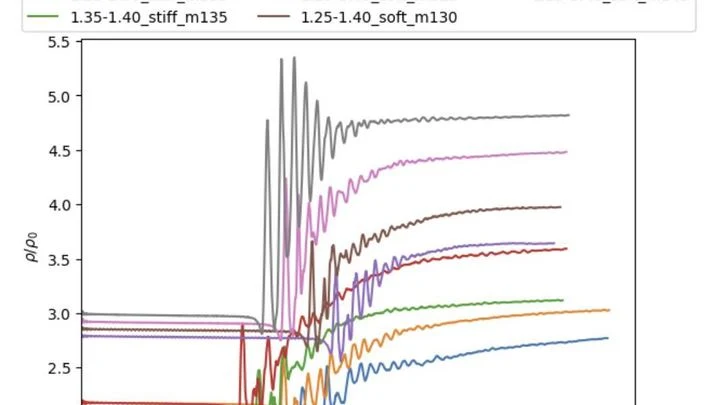
When a massive star dies and collapses into a supernova, a neutron star is born — a city-sized sphere with the Sun's mass. Its matter is so compressed that a teaspoon weighs more than Mount Everest. Physicists are trying to learn the "recipe" of this matter — the equation of state that explains how matter behaves under extreme pressure.
Over the warm waters of the Indian Ocean, every six to eight weeks, a vast wave of moist air gathers. It moves eastward at a pedestrian pace—about five meters per second—and takes forty to ninety days to circle half the planet.
In 2023, the ocean off the coast of Peru warmed so much that fishermen came back empty-handed, while meteorologists argued over the strength of the upcoming El Niño. The sea surface temperature map they were looking at was the only one available, but how much could they trust it?
The ocean does not shout about its intentions. It whispers: a warm patch off the coast of Peru, a cold tongue near Hudson Bay, a barely perceptible shift in a current. The atmosphere does not respond immediately, and by winter Europe may get either mild slush or Siberian frosts.
Two pendulums hang on the same wall, swinging out of sync, but suddenly they move as one, only with an 18-month delay. One pendulum is the Indian monsoon, the seasonal wind that brings rain to South Asian farmland. The other is the deep water of the tropical oceans, which slowly accumulates heat and remembers it for years.
Every few years, the Pacific Ocean off Peru warms so abruptly that fish disappear and rains flood the desert. This phenomenon is called El Niño, and it acts like a pendulum that swings the planet's climate. But when the planet itself warms, the pendulum behaves strangely: first its swing widens, then it suddenly fades.
The bronze plates of a gamelan do not sound according to a single tuning standard: each orchestra on Java keeps its own tuning, and two neighboring ensembles may play the same melody in slightly different intervals.
Two barometers hang on the wall. One reads clear, the other says partly cloudy. Which weather do you trust? That is roughly the question facing a group of climate scientists when two independent methods predicted different futures for the Pacific Ocean in 2026.
Thousands of models simmer in a single cauldron, and the steam rises thick and impenetrable. Each whispers something about the future of El Niño, but in the general din you cannot tell who is right and who is just boiling over.
The Pacific Ocean breathes slowly and deeply. Every few years, its warm surface waters shift eastward toward the coast of South America, and then Peru gets drenched while Australia goes up in flames. A year or two later, the water retreats, and the picture flips. This breathing is called El Niño, and until now its rhythm could only be guessed a couple of steps ahead.
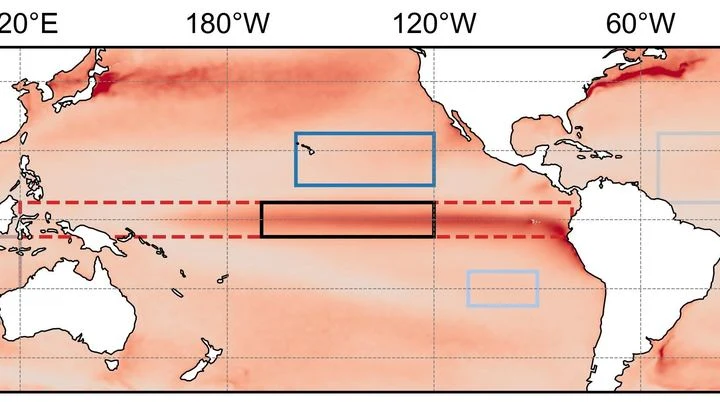
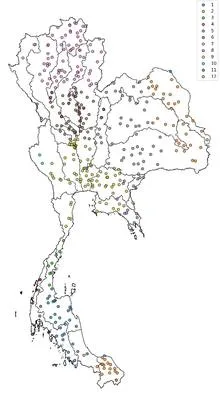
Tuning an old radio receiver requires patience: you slowly turn the dial, catch a crackle, turn it again, until a voice emerges through the static. In much the same way, a reinforcement learning agent searched the ocean for two patches whose temperature difference best predicts rains in Thailand.
Cosmic dust isn't dirt: it's tiny grains, like soot from a campfire, scattered between the stars. Some of them spin at breakneck speeds, millions of times per second, emitting faint radio waves. Astronomers call this anomalous microwave emission: it interferes with studies of the early universe, but it's also a mystery in its own right.
The tropical Pacific Ocean heats and cools like a giant battery, and its rhythm affects weather from India to Canada. This rhythm is called El Niño–Southern Oscillation, or ENSO for short. Forecasting it months ahead is like predicting when a pot will boil without knowing the strength of the flame.
In 1997, the Pacific Ocean warmed so much that corals bleached from Indonesia to the Galápagos, and floods and droughts swept across five continents. Such events, which climate scientists call extreme El Niños, occur every few decades, and to understand how often they will arrive in the future, we need thousands of years of observations.
A warm ocean off the coast of Peru can make winter in Moscow unusually mild. Climate scientists call these invisible threads that link weather in distant corners of the planet teleconnections. For a long time, they were thought of as something like permanent wiring: the signal sources may pulse, but the wires themselves lie still.
The Pacific Ocean is like a giant swing: warm water piles up in the west, then slides toward the east, and the temperature off the coast of South America jumps. Such warm years are called El Niño, and cold ones La Niña. But the swing doesn't move on its own: it's pushed by the wind.
An orchestra of a hundred musicians plays without a conductor. As long as the score is familiar, each player confidently follows their part, and together they sound harmonious. But when the composer changes the rhythm, discord creeps in: some instruments keep playing the old tune, others try to adapt, and a few fall silent.
Every day, about 40,000 thunderstorms flash across the planet. In that moment, the atmosphere resembles an orchestra without sheet music: warm air rises like a bow stroke, winds aloft carry the melody, and lightning punctuates the finale. But who conducts this orchestra?
An orchestra of a thousand musicians plays in harmony as long as the conductor keeps the tempo. But the moment he changes the score, the violins in one corner start playing louder, while the brass in another come in late.
Two conductors stand before one orchestra. One waves the baton quickly, setting the tempo every few bars. The second is almost motionless, but his slow breathing changes the overall sound throughout the symphony. So it is in the tropical Pacific: one part of the wind governs the fast oscillations of El Niño, the other governs decadal climate shifts.
Imagine an interpreter in a negotiation room who hears the tropics whisper and repeats it too loudly. That is how the neural-network climate model DLESyM behaves when forced with real Pacific sea surface temperatures. The ocean whispers "El Niño," and the atmosphere shouts back as if being shaken by the shoulders.
A camera on a tripod shoots the same landscape for decades. If you don't touch the lens, the images get hazy: the landscape changes, but the focus stays put. That's roughly how climate norms work. According to World Meteorological Organization rules, they are calculated as the average over the last 30 years.