Seasonal forcing refers to the regular, predictable variation in incoming solar radiation that the Earth receives over the course of a year. This variation is caused by the tilt of the Earth's axis and its elliptical orbit around the Sun, leading to the familiar cycle of seasons. While the forcing itself is purely periodic, its interaction with the climate system is far from simple. The annual cycle of heating and cooling acts as a powerful external 'pacemaker' that can modulate, amplify, or even trigger shifts in climate variability, such as the timing of monsoons, the intensity of El Niño events, or the onset of ice ages in the distant past.
History
The recognition that the seasonal cycle is not just a background but an active driver of climate variability emerged in the late 20th century, with key contributions from researchers like Klaus Hasselmann and others who studied stochastic climate models and the role of periodic forcing in the 1970s and 1980s.
How it works
The Earth's climate system is a complex, nonlinear network of interacting components—atmosphere, oceans, ice, and land. When a periodic external forcing like the seasonal cycle is applied, it can resonate with the system's internal modes of variability. For example, the ocean has a natural memory of months to years, and the seasonal cycle can interact with this memory to create patterns like the biennial oscillation of the Indian monsoon. In some cases, the seasonal forcing can push the system across a threshold, causing a 'regime shift'—a sudden change from one stable state to another. This is particularly relevant for phenomena like the El Niño–Southern Oscillation, where the seasonal cycle influences the timing of event onset and can even determine whether a weak perturbation grows into a full-blown El Niño or fades away.
In practice
Understanding seasonal forcing is essential for seasonal forecasting, as it provides the fundamental basis for predicting monsoon onset, hurricane season intensity, and the development of El Niño events, which are crucial for agriculture and disaster planning.
Fun fact
The seasonal cycle is so strong that it can 'phase-lock' certain climate phenomena, meaning that events like El Niño tend to peak at a specific time of year, typically around December, which is why it was named 'El Niño' (the Christ Child) by Peruvian fishermen.
A spotlight with an adjustable beam width sweeps along the shore. Its light is the long ocean waves that are born in the surf zone and spread in both directions: toward the beach and out to the open sea. Previously, this spotlight was considered a point source, but the actual breaking zone, where short waves break, has a finite width, and it changes as the wave front advances and retreats.
A forest does not live in a static world. Between winter and summer, day and night, conditions shift, and each fluctuation is like a rhythm that all its inhabitants must keep pace with. Yet until now, ecologists have mostly studied how communities of living beings persist in an unchanging environment, like testing a bridge's strength only in calm weather.
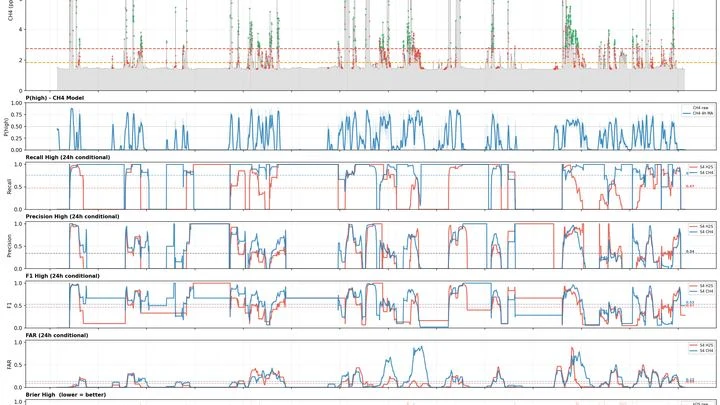
At a landfill on the outskirts of town, the wind shifts direction, and a couple of hours later the nearest village smells of rotten eggs. That's hydrogen sulfide — a gas produced when waste decomposes, and in large doses it's hazardous to health. Usually, authorities only learn about the problem after residents have already breathed it in and called to complain.
The solar wind is a continuous stream of charged particles flowing from the Sun. It has two main components: protons (hydrogen nuclei) and alpha particles (helium nuclei, four times heavier).
In the solar corona, it rains from time to time — only not water, but plasma. The hot gas cools, clumps into blobs, and rushes downward along magnetic loops, like drops running down invisible gutters.
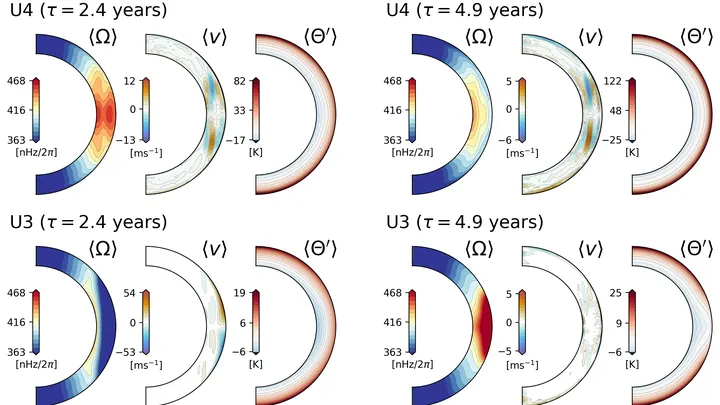
27 days at the equator, 32 at the poles. Five days' difference, and over a year, the equator gains almost a week. A gas ball 1,4 million kilometers in diameter spins like a layered top: each layer moves at its own speed.
The Sun continuously scribbles magnetic fields across its surface. These patterns are not mere ripples but a handwriting in which nature has encoded warnings of flares. A flare is an explosion that releases the energy of billions of nuclear bombs in minutes, ejecting streams of plasma and radiation into space.
Every year, as December approaches, the water off the coast of Peru becomes anomalously warm or anomalously cold. This is El Niño and La Niña, two phases of the same climate pendulum that swings in the equatorial Pacific. The pendulum is not a simple one: it remembers what happened to it several months earlier, and this memory determines which way it will swing next.
A translator in a conference hall tries to convey the speaker's words, but the hall is noisy: someone coughs, chairs creak, and the street outside is loud. If the speaker lowers their voice, the translator still keeps translating, but their voice drowns in the noise.
Two pendulums suspended from a single invisible spring swing in a shared air current. One always lags the other by exactly half a period: when the first swings left, the second is already returning from the right. By watching the first, you can tell where the second will be half a period later.
Every winter, the tropical Pacific Ocean seems to replay the same script: sea surface temperatures off the coast of Peru rise, trade winds weaken, and a wave of droughts and floods spreads across the planet. This is El Niño, and its peak almost always falls in December. Why winter in particular?
The Sun is not just a source of light but a giant laboratory where ghostly particles are born. Every second, billions of neutrinos fly through your body, barely noticing you. But inside the Sun, these particles behave differently: they change their type on the fly, like an actor playing three roles in a single play.
Inflation is the ultra-fast expansion of the universe in its first moments. It was driven by a field resembling a ball rolling down a hill. But there could have been a second, almost imperceptible ball nearby. The authors of this work considered exactly that scenario: a light spectator field (the axion), frozen at the top of its potential.
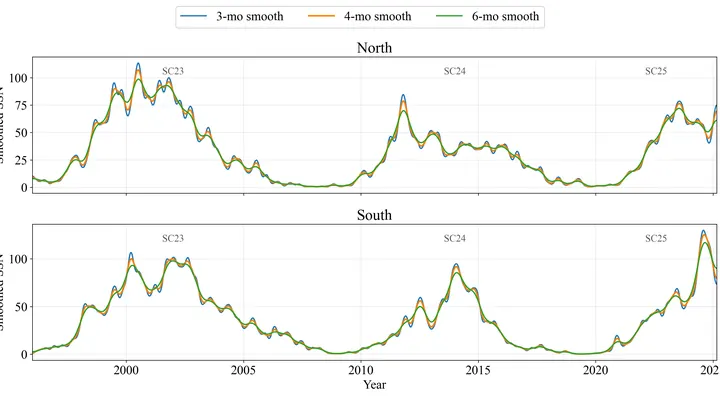
The Sun doesn't burn steadily: it erupts in series. Like a campfire that dies down and then suddenly throws out showers of sparks, these "fiery seasons" last from six months to a year and a half, and during them the star shows an unusually high number of sunspots.
In a hall with a hundred instruments, a symphony is playing, but the conductor is hidden behind a screen. The scientist hears only the notes played by the instruments and wants to understand who sets the rhythm. Scientific data resembles such an orchestra: we record instrument readings but do not see the hidden mechanisms that drive them.
The crown of a huge tree sways in the wind, but the roots and trunk are hidden underground. On the Sun, magnetic fields play the role of such invisible roots. They emerge from the depths, thread through the entire atmosphere, and govern the motion of the hot gas — plasma.
Magnetic fields on the surface of the Sun appear as dark spots and bright faculae. But they are born deep inside, where flows of hot gas act like a giant dynamo. The question is whether sunspots on the surface can predict what will happen inside the star years from now.
The authors applied a mathematical theorem similar to the rule linking the area of a shape to its boundary.
For 800,000 years, ice ages have occurred every 100,000 years. The rhythm matches the elongation of Earth's orbit. But the orbit changes the flow of solar heat so subtly — as if the conductor barely moved the baton, yet the orchestra thundered. It remained a mystery how this weak signal controls the ice sheets.
The Sun pulses in a slow rhythm, and that rhythm can be heard in the rains over Brazil. Sunspots on the solar disk thicken and thin roughly every eleven years, and along with them, pressure in the Pacific Ocean shifts, sea surface temperatures change, and then rainfall amounts in the northeast of the country follow suit.
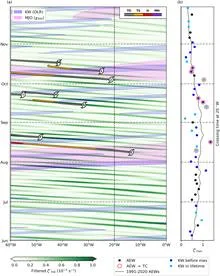
Over the warm waters of the Indian Ocean, every six to eight weeks, a vast wave of moist air gathers. It moves eastward at a pedestrian pace—about five meters per second—and takes forty to ninety days to circle half the planet.
Two pendulums hang on the same wall, swinging out of sync, but suddenly they move as one, only with an 18-month delay. One pendulum is the Indian monsoon, the seasonal wind that brings rain to South Asian farmland. The other is the deep water of the tropical oceans, which slowly accumulates heat and remembers it for years.
Imagine a radiator in a room: it heats up, but if its surface is clogged with dust, heat escapes less efficiently. Something similar is happening to our planet. Earth receives energy from the Sun and must radiate the excess back into space, otherwise temperatures rise. Scientists call this ability to shed excess heat radiative feedback.
A solar panel on a roof produces little current in the morning, a lot at noon, and stays silent at night. Wind doesn't blow randomly either: it's often stronger in the morning and evening than during the day. Energy providers need to know in advance how much energy will be available in an hour or three, so they can switch on backup plants or store electricity in batteries in time.
The Sun constantly emits a stream of charged particles — the solar wind. Among them are many electrons, some of which fly back toward the Sun. But observations show that fewer electrons return than expected.
Sunspots are traces of magnetic fields that emerge on the surface. They live their own lives: spots closer to the equator tilt more, while those farther away tilt less. These two effects, like two knobs on an old radio, control how much magnetic field reaches the Sun's poles and accumulates there for the next cycle.
The Sun is not a calm sphere but a boiling cauldron that follows its own rhythms. Roughly every 11 years, its activity peaks: more dark spots appear on its surface, and streams of charged particles fly into space. But hidden within this grand cycle is a shorter one — about 1.7 years.
A student learned physics from a textbook and is taking an exam. The first two problems are solved brilliantly, but on the third, they err on something not covered in the book. That is roughly what the hybrid atmospheric model NeuralGCM faced when run through three levels of testing: cyclones, El Niño, and anomalous warming.
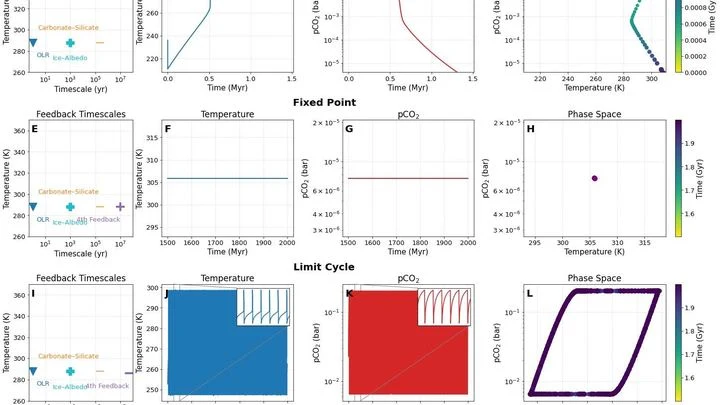
A planet's climate is like an old spring mattress: press down on one edge, the springs compress; let go, they rebound and put everything back. Earth has three such springs, working as a team. Carbon dioxide weathers out of rocks, clouds reflect sunlight, and ice caps bounce heat back into space. Together, they keep the planet from boiling or freezing.
Glaciers don't just darken from soot. Their surfaces host tiny algae that, as temperatures rise, bloom and turn the ice dark. Dark ice absorbs more sunlight, melts faster, and further warms the planet. It's like how a black t-shirt in the sun gets hotter than a white one.
The second player in overheating is forests.
For a long time, the climate of ancient Mars remained a mystery: the beds of dried-up rivers spoke of water, but models couldn't explain how it got there — after all, 4 billion years ago the Sun shone 30% dimmer. New research shows that the planet swayed, as if on a swing, between long glaciations and short wet epochs.
The Sun is slowly brightening, and in hundreds of millions of years its heat would become lethal for Earth. Fortunately, the built-in planetary thermostat — the carbon cycle — when overheating triggers rocks to absorb carbon dioxide faster, cooling the climate.
A warm ocean off the coast of Peru can make winter in Moscow unusually mild. Climate scientists call these invisible threads that link weather in distant corners of the planet teleconnections. For a long time, they were thought of as something like permanent wiring: the signal sources may pulse, but the wires themselves lie still.
Two conductors stand before one orchestra. One waves the baton quickly, setting the tempo every few bars. The second is almost motionless, but his slow breathing changes the overall sound throughout the symphony. So it is in the tropical Pacific: one part of the wind governs the fast oscillations of El Niño, the other governs decadal climate shifts.
The orchestra assembled, the instruments were tuned, but there was barely any music: that's what the 2025 Atlantic hurricane season looked like. The ocean was the fifth warmest on record, and a weak La Niña usually adds strength to storms. But instead of a continuous concert, we got isolated thunderous chords: three Category 5 hurricanes, with silence in between.
Why was the orchestra silent?
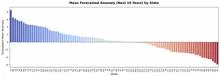
The climate of the United States is not a straight line creeping upward. It is an orchestra without a conductor, where every violin and every drum plays its own part, and together they create an intricate pattern of warm and cold, wet and dry years.
A camera on a tripod shoots the same landscape for decades. If you don't touch the lens, the images get hazy: the landscape changes, but the focus stays put. That's roughly how climate norms work. According to World Meteorological Organization rules, they are calculated as the average over the last 30 years.
After the Moon's birth, Earth resembled a sizzling lump of dough: a continuous liquid magma and a dense shroud of gases. The Moon acted like a giant spoon, constantly kneading this lump with its gravity. Friction generated heat, delaying cooling.
Imagine a pendulum that is pushed in time with the seasons: harder in winter, softer in summer. But this pendulum has a quirk: a switch that operates with a delay. When the pendulum passes through zero, the switch clicks and changes the direction of the push. That is exactly how the simplified El Niño model built by mathematicians works.
In summer, the South China Sea can show a strange pattern: the water in the north warms while the south cools at the same time. A year later, it's the opposite. This isn't random; it's a steady seesaw that the ocean rocks every summer.
The tropical Pacific Ocean lives in two rhythms. The first is fast: a wave of thunderstorms born over the Indian Ocean races eastward and dies out off the coast of the Americas within a month or two. The second is slow: every few years, the ocean surface warms enough to alter weather across the entire planet. That is El Niño. Between these rhythms lies a bridge, and building it took climatologists decades.