A Heart Without Pauses: Movie of Every Beat express
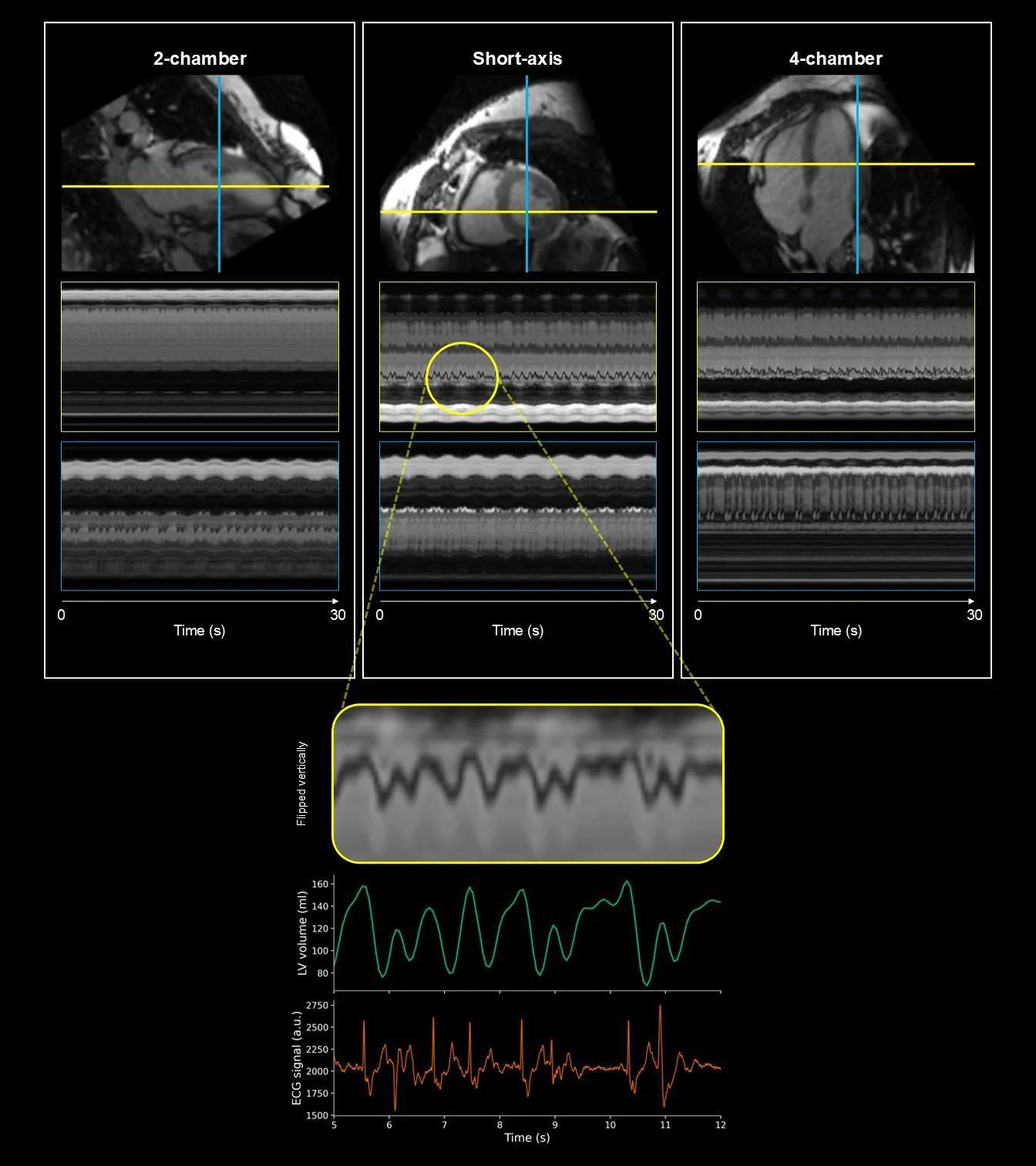
The heart beats irregularly. Standard MRI pretends all beats are the same: it stacks them on top of each other, like a photographer shooting a dancer with a long exposure. The result is a blurry smudge — pretty, but useless if you need to see each individual movement.
The new approach films the heart like a video: frame by frame, with no gaps. The patient breathes freely, and the scanner itself tracks the organ's motion and corrects the image. The doctor manually outlines the heart on one frame, and the software transfers that contour to all the others, so you can measure the ventricle's volume at every moment.
The method was tested on a heart phantom, ten healthy volunteers, and ten patients with premature ventricular contractions. For the phantom, the result matched the reference almost perfectly: ejection fraction of 17.86% versus the true 17.27%. In humans, the ECG recording confirmed that each volume spike coincided with the moment of the arrhythmia.
Previously, such details were hidden in the averaged image. Now you can see how the heart stumbles and then falls back into rhythm.
Ejection fraction is the fraction of blood the heart pumps out with each contraction. In a healthy person, it's about 55–70%, while the phantom in this study had only 17.86%.
In the movie 'Total Recall', the hero's brain is scanned in real time to reveal hidden memories. Here's a similar idea: instead of averaged snapshots, continuous imaging of a living organ, where every glitch is visible.