In a cyclic or bouncing universe, contraction is the phase when space itself shrinks, pulling galaxies, radiation, and even the geometry of spacetime together before a subsequent expansion. This idea challenges the standard Big Bang narrative by replacing the initial singularity—a point of infinite density—with a smooth transition from a previous contracting phase to our current expanding one. Contraction is central to models that aim to explain the universe's homogeneity and flatness without invoking a period of rapid inflation.
History
The concept of a contracting phase in cosmology dates back to the early 20th century, but the modern quantum bounce scenario was developed in the 2000s within loop quantum cosmology, notably by Martin Bojowald and others.
How it works
During contraction, the scale factor of the universe decreases, meaning distances between objects shrink. In quantum-corrected models, this phase does not proceed to a singularity; instead, quantum gravitational effects become significant at high densities, generating a repulsiveforce that triggers a bounce. The contraction phase also amplifies small perturbations, which can later seed the large-scale structure we observe, while smoothing out anisotropies through a process akin to cosmic mixing.
In practice
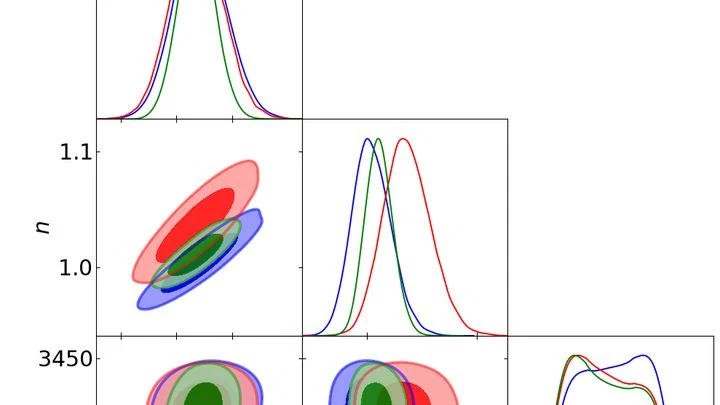
Contraction models are used in theoretical research to test alternatives to inflation, providing predictions for the cosmic microwave background that can be compared with satellite data.
Fun fact
In some bouncing models, the universe undergoes an infinite series of contractions and expansions, making time itself cyclical rather than linear.
A cloud of waves collapses under its own gravity. While it's loose, everything goes by the book: the field oscillates gently in nearly flat space, and approximate formulas work perfectly. But add just a bit more energy, and the picture changes.
Physicists used a numerical model to catch the moment when simple calculations stop describing reality.
A stable system behaves like a ball in a bowl: give it a push, and it rolls back to the bottom. The spread of possible trajectories, uncertainty, shrinks over time. But the speed depends on the slope of the bowl's walls. In complex systems, this 'bowl' has sections of varying steepness.
The universe hasn't always been expanding. In some models, it first contracted, nearly empty and flat, and then, upon reaching a limit, bounced back and started growing, like the world we know. This scenario is called bouncing cosmology.
A translator hears not just words, but intonation, pauses, the tremor in a voice. Ordinary entropy analysis of cosmic perturbations is like meeting minutes: it records facts but loses the nuances. Pseudoentropy entropy is a new tool that captures the hidden "music" of the early universe.
The birth of the universe resembles not an explosion, but a traffic jam. At first, a tiny fraction of a second after the Big Bang, space expanded sluggishly, like cars stuck in gridlock. Then came a sharp surge — accelerated expansion, which cosmologists call inflation.
The classic story of the Universe’s birth from a blazing point called the Big Bang raises uncomfortable questions: why is the cosmos so homogeneous, and what was before the singularity?
A pendulum chooses how to swing on its own. If you give it a strong push, it quickly returns to a smooth rhythm. If you hold it at its extreme position, it will stay there, but as soon as you let go, it resumes its usual motion.
Spread a handful of coins on the table. Each coin is a possible outcome: heads, tails, or something else. If we know how chaotic this set is (its entropy), which combinations of probabilities will we encounter more often? It turns out the answer depends on how much chaos we allow.
Usually, the story of the universe goes like this: there was nothing, then a bang, and ever since everything has been flying apart. But what if there was no 'nothing'? A group of physicists has shown that the universe could have existed forever: it just sometimes contracts and then expands again, like a spring.
You're inflating a balloon, but with each pump of the bulb, the rubber doesn't just stretch: it subtly changes its elasticity. Gravity works similarly in the new model: not as a rigid stage for the cosmic play, but as a living material that responds to every speck of matter.
A spring compressed to the limit breaks. Likewise, classical gravity theory leads to a singularity — a point where all laws break down. Quantum mechanics turns this end into an elastic bounce.
Traditional cosmology begins with the Big Bang — the idea of Georges Lemaître. However, a new approach, inspired by the work of Stephen Hawking, bypasses the mystery of the initial moment.
In the first moments after the Big Bang, the cosmos was like a pot of boiling broth. In it, like lumps of flour, dense clumps of energy — oscillons — curdled and swelled. They grew, gained strength, and soon took over the expansion of the Universe.
The early universe was far from perfect: some regions stretched faster than others, creating folds and warps. But a quantum bounce — the transition from contraction to expansion, driven by the laws of the microworld — fixes everything.
In the first moments after the Big Bang, the Universe underwent rapid expansion: inflation. But perhaps it was contracting before that, and then bounced. Both scenarios leave nearly identical imprints on the cosmic microwave background, and cosmologists have debated for decades which one is correct.