ECG Learns to See the Heart Like Ultrasound express
The heart beats like a drum in the next room: from the rhythm and the dullness of the thump, an experienced physician can guess whether there’s an enlarged chamber, a thickened wall, or a valve flapping out of sync. But to see it for sure, the patient lies on a couch while a probe glides across the chest — echocardiography (heart ultrasound). It’s expensive, requires a specialist, and the waiting list stretches for weeks.
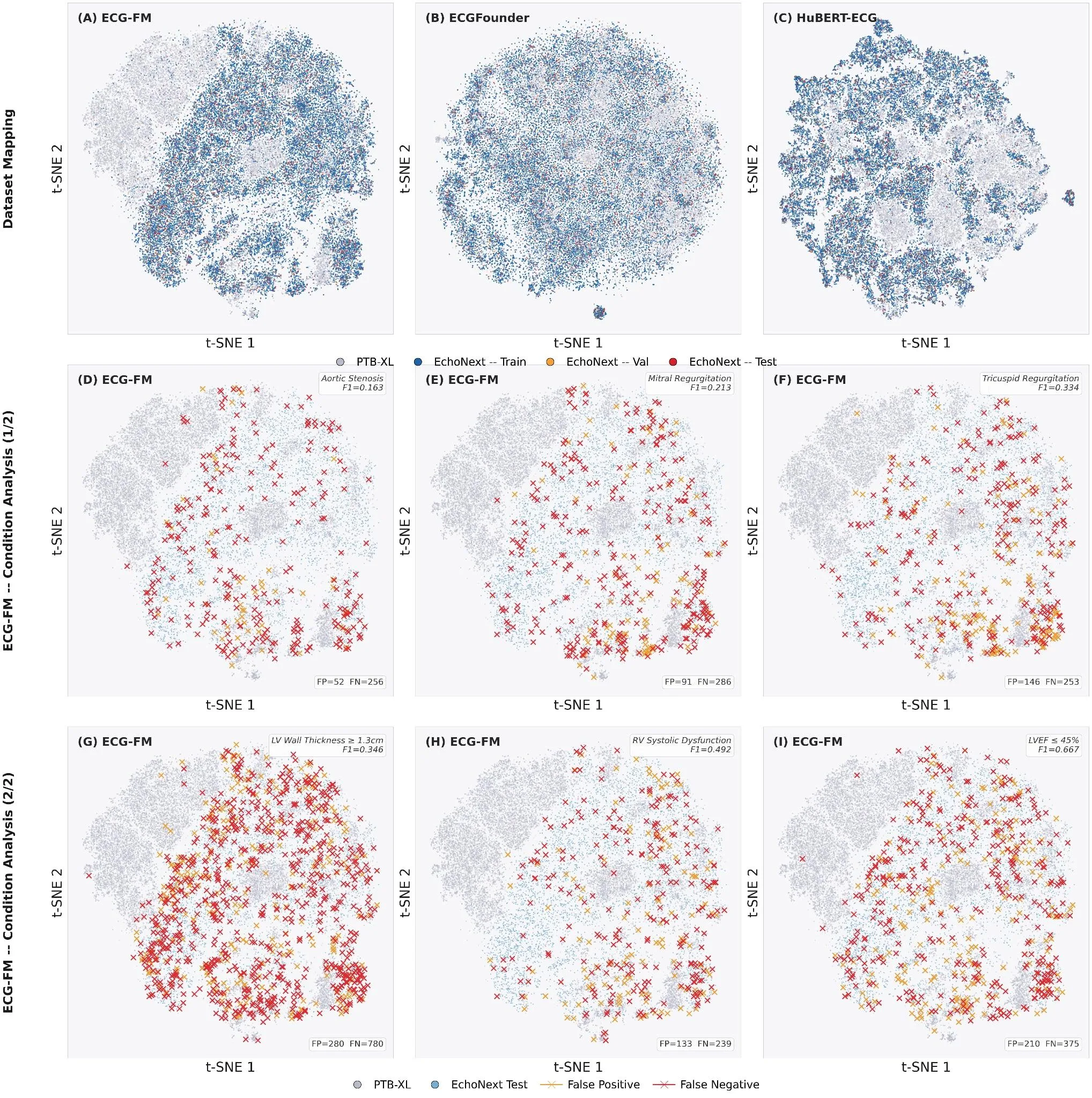
The authors used the open EchoNext Mini-Model dataset — thousands of records where each patient has both a standard ECG and an ultrasound report. They compared three strategies: the classic approach with hand-crafted features and gradient boosting, training a neural network from scratch directly on ECG curves, and transfer learning from large pretrained models that had already 'seen' millions of ECGs. Transfer learning far outperformed the others, especially when the model was first fine-tuned on raw signals from the target database without labels, like a musician tuning to the acoustics of a hall before a performance. This adapted 'foundation' gave the best metrics: an area under the error curve (AUROC) of 0.85 and a positive predictive accuracy (AUPRC) of 0.43 across all six labels.
The engineers also tested gentle fine-tuning modes — LoRA (low-rank adaptation) preserved quality while halving the number of trainable parameters. That means such a model can be deployed in a hospital faster and cheaper, without retraining from scratch for each new ECG machine. The takeaway is simple: for an ECG to speak the language of ultrasound, it doesn’t need a bulky interpreter, just a quick 'on-site tuning'.
Original abstract
as written by the authors arXiv:2604.23385
Transthoracic echocardiography is the reference standard for confirming structural heart disease (SHD), but first-line screening is limited by cost, workflow burden, and specialist availability. We evaluated whether open pretrained electrocardiogram (ECG) foundation models can support echo-confirmed multi-label SHD detection using the public EchoNext Mini-Model benchmark. Six echocardiography-derived abnormalities were targeted: reduced left ventricular ejection fraction, increased left ventricular wall thickness, aortic stenosis, mitral regurgitation, tricuspid regurgitation, and right ventricular systolic dysfunction. Under a common pipeline, we compared engineered ECG features with gradient boosting, end-to-end waveform learning from scratch, and transfer from open ECG foundation models. We then applied in-domain self-supervised adaptation of an ECG foundation model (ECG-FM) on EchoNext waveforms followed by selective supervised fine-tuning, and evaluated trade-offs between discrimination and adaptation cost. Adapted ECG-FM models achieved the best overall performance: peak macro-AUROC 0.8509 and macro-AUPRC 0.4297, while a parameter-efficient operating point preserved AUROC (0.8501) and attained the highest fixed-threshold macro-F1 0.3691. Late fusion with covariates did not improve threshold-independent discrimination, and evaluated LoRA, alternative backbones, and mixture-of-foundations strategies did not surpass the best adapted single-backbone models. These results indicate that for ECG-based case finding and echocardiography triage, combining target-domain self-supervised adaptation with selective supervised updating of a pretrained ECG backbone is the most effective transfer strategy.
The electrical signal of the heart that the ECG traces travels through the muscle 5–10 times faster than the muscle itself contracts — at about 2–4 meters per second, like a sprinter on the 100-meter dash.
In the series 'The Expanse,' a handheld scanner delivers a full internal diagnosis in seconds — smart ECG seems to be taking the first step toward such a tricorder.