Ultrasound is sound with frequencies above the upper limit of human hearing, typically beyond 20 kilohertz. Unlike ordinary sound, which we perceive as audible tones, ultrasound propagates through matter as mechanical waves, and its short wavelengths allow it to interact with structures much smaller than those accessible to audible sound. In medicine, it is best known for producing real-time images of soft tissues without ionizing radiation, but it also serves as a tool for targeted energy delivery, particle manipulation, and even non-invasive brain modulation.
History
The use of ultrasound for medical imaging began in the 1940s and 1950s, building on sonar technology developed during World War I. The first practical applications were in obstetrics and cardiology, and the technique has since evolved into a versatile diagnostic and therapeutic tool.
How it works
Ultrasound is generated by piezoelectric crystals that vibrate when an electric field is applied, producing high-frequency pressure waves. These waves travel through a medium, and when they encounter boundaries between materials of different acoustic impedance, part of the wave is reflected back. By timing these echoes and measuring their intensity, a device can reconstruct an image of internal structures. For energy delivery, focused ultrasound concentrates waves at a specific point, where their mechanical energy can heat tissue, disrupt particles, or open barriers like the blood-brain barrier.
In practice
Ultrasound is used in medical imaging (e.g., fetal scans, echocardiography), physiotherapy for deep tissue heating, and in research for manipulating particles and cells in microfluidic devices. It is also being explored for targeted drug delivery and non-invasive brain stimulation.
Fun fact
Bats and dolphins use ultrasound for echolocation, and some insects can detect bat ultrasound to evade capture.
A doctor looks at a screen and sees two images of the same part of the body. One shows where blood is rich in oxygen, the other shows how fast it rushes through the finest vessels. Previously, these images were made by different devices, and combining them was difficult. Now engineers have built a device that takes both images simultaneously.
A flashlight shines through frosted glass: the rays bend, lose brightness, and take different paths. That's roughly how high-intensity ultrasound passes through the skull to the brain. For years, calculating this path required bulky computer models that 'chew' on data for hours.
A bell hidden in a thick box can be made to ring without opening the lid. Just send a sound wave through the walls, and the clapper will tremble. That's roughly how transcranial ultrasound works: sound passes through the skull bones and makes neurons deep in the brain 'ring'—generating electrical impulses.
The galaxy is not a smooth lake but a pond with ripples. These ripples are created by ultralight dark matter (particles billions of billions of times lighter than an electron).
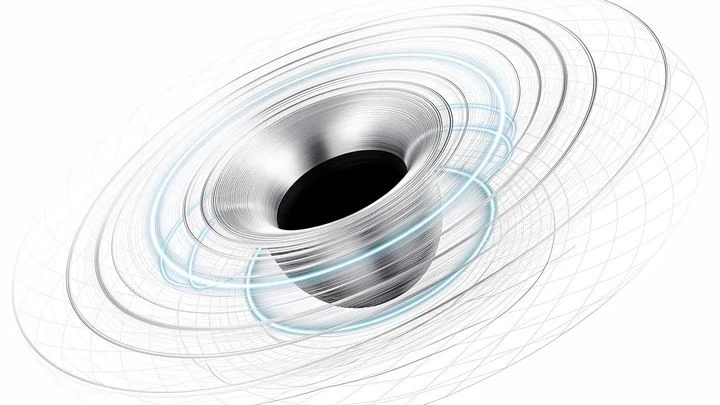
Imagine a river at a rapid: the current accelerates until no wave can go against the flow. So it is with gas near a black hole: reaching the speed of sound, it locks itself in — an acoustic black hole is born, a twin of the gravitational abyss. Here the event horizon is woven from a flow faster than its own sound.
The universe is permeated by invisible mass, dark matter, whose existence was first proposed by Fritz Zwicky in the 1930s, based on his observations of galaxies moving in clusters.
Photographing a delicate spiderweb trembling in the wind: that's roughly what it takes to look into the blood vessels of a living brain. Ultrasound localization microscopy (ULM) turns ordinary ultrasound into a tool capable of seeing individual capillaries, but only if you get the settings just right.
The universe is permeated by an invisible substance, dark matter, whose gravitational influence is obvious, but whose composition remains a mystery. One hypothesis suggests it consists of ultralight particles so light that they exhibit wave-like behavior, forming a kind of cosmic ripple.
The brain is a fortress. It's protected by a dense layer of cells that only lets in what it needs. Drugs can't get through this barrier, which is why many brain diseases are so hard to treat.
Scientists have found a way to crack the fortress gates. They built a device that sends focused ultrasound into the brain. Tiny gas bubbles are injected into the blood.
Ultrasound penetrates bone like sunlight through frosted glass, but the image comes out blurry. The skull is uneven and dense, scattering sound waves, so hitting a precise spot in the brain is tricky. Conventional devices try to fix this with electronics, but the result is still far from perfect.
Each vowel sound is a distinct shape of the mouth, tongue, and throat. When you say 'ah,' 'ee,' or 'oo,' not only does the air inside your head change, but so does the way radio waves pass through it. Researchers peered into this process using MRI scans taken right during speech and built a precise computer model of the head — from bones to soft tissues.
A laser flash lasting 50 femtoseconds is like a shot that lasts one billionth of a second. In that time, light travels only 15 micrometers — less than the thickness of a human hair. But if you send such a flash through an amplifier, it starts to stretch like a rubber band and loses its sharpness.
At night in a dark room, the human body emits a barely perceptible glow. This light is so faint that only highly sensitive detectors can catch it. Some researchers thought this glow from the head could tell us about brain activity — no scanners or wires needed.
But when put to the test, the story changed.
Your back hurts, and the doctor asks you to bend forward and backward to see how your vertebrae move. Usually, this means a series of X-rays: they show motion, but only in a plane, like a shadow on a wall. And volumetric methods like CT scans can't keep up with movement.
Engineers proposed a different approach: a robot sweeps an ultrasound probe over your back while you bend.
An ordinary rubber pad dampens vibration the way a thick blanket muffles sound: the thicker and heavier, the better. Engineers have long dreamed of a material that is light yet "eats" oscillations as well as a massive damper.
Ultrasound in a liquid is like shaking a bottle of soda vigorously: shake it, and bubbles appear. In science, this is called cavitation, and the bubbles don't just float around: they are born, grow, and collapse with tremendous force.
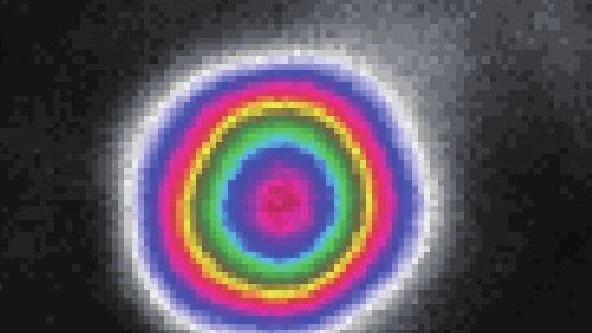
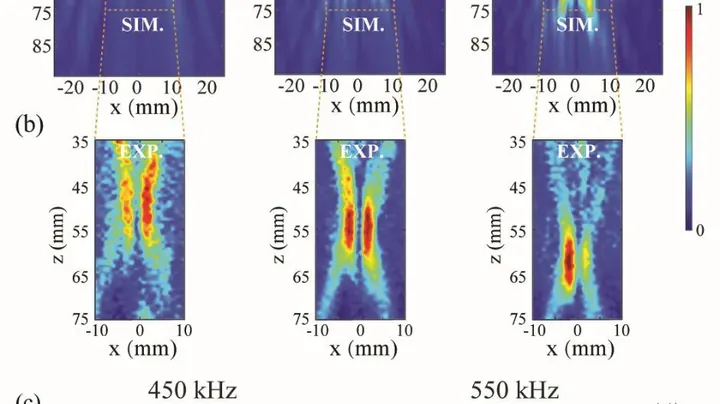
Sound can do more than be heard: it can push. An ultrasound vortex is a sound wave twisted like a whirlpool in a shell: silence at the center, rotating pressure at the edges. Such a whirlpool can grab tiny particles and carry them without a touch.
Light is a great tool for studying tissues, but it fades fast deep inside the body. Within a few millimeters, photons scatter so much that you can't make out anything. Scientists came up with a workaround: instead of shining light from outside, deliver a tiny light source right inside. The challenge is how to power that source without wires.