Viral Clocks: Why Some Infections Hurry and Others Linger express
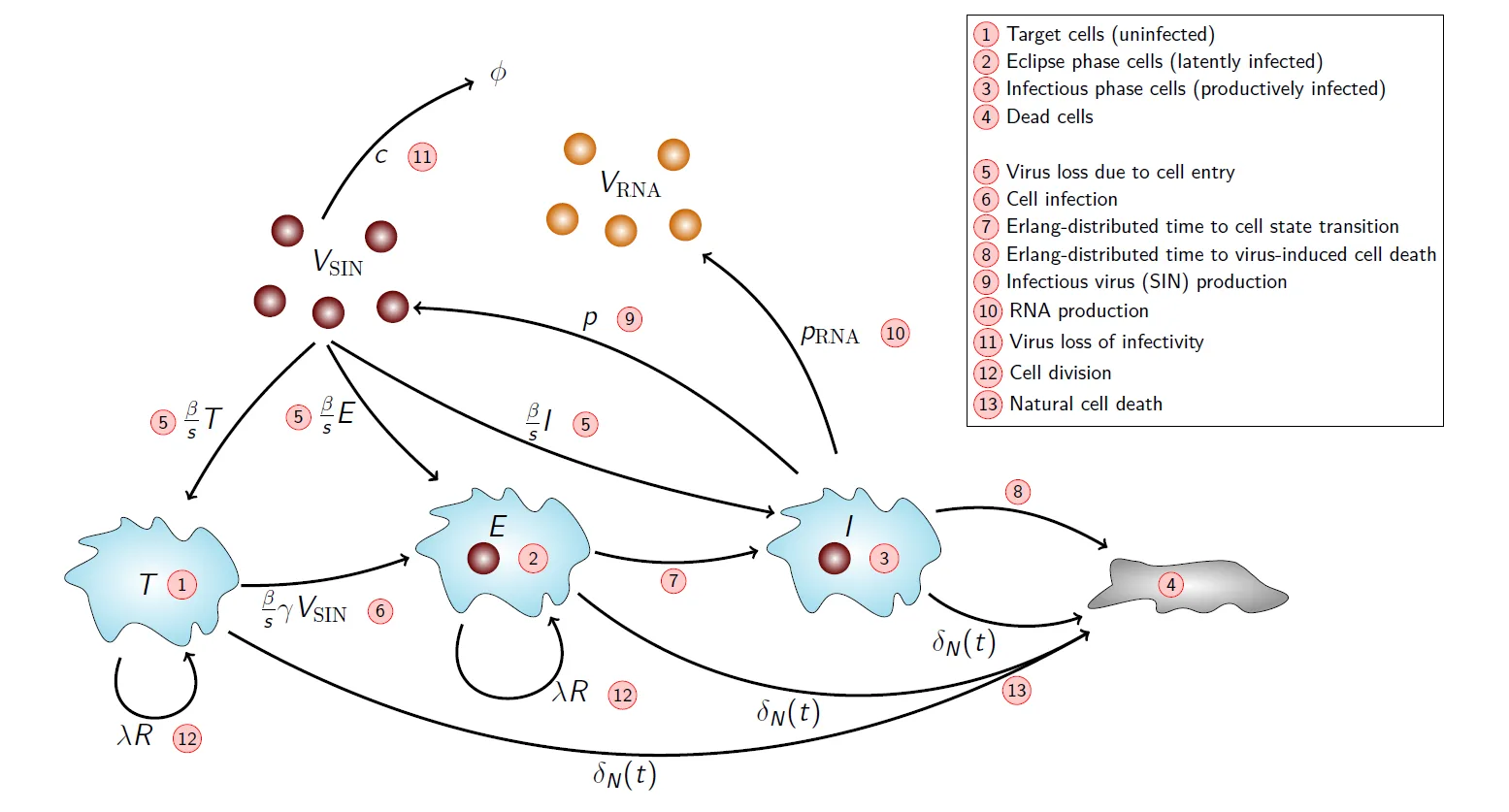
A cell gets infected by a virus, and an invisible timer starts ticking inside. At first, the virus seems to vanish: you can't find it; it's gathering resources. This latent period (the time from virus entry to the appearance of new particles) is unique to each strain. For Bunyamwera virus, it turned out to be noticeably longer than for Batai virus. And when the assembly line finally kicks in, Batai stamps out copies faster: each infected cell releases more viral particles per hour.
But here's the twist: a virus can enter an already infected cell a second time. Then the latent period shortens, as if a second signal speeds up assembly. The model showed that this effect is much stronger for Bunyamwera. Without re-infection, it spends a lot of time preparing; with it, it accelerates sharply. Batai virus barely depends on such help.
These calculations aren't just numbers. They explain why one virus can cause a rapid outbreak while another smolders for weeks. Different durations of the infectious period and different rates of virus release change the whole picture of spread. Stochastic modeling (accounting for random processes) helps capture these nuances. In the end, two close relatives behave in the cell like two different factories: one works slowly but for a long time, the other fast but quickly burns out.
Original abstract
as written by the authors arXiv:2606.21481
We develop a deterministic mathematical model to quantify the distinct in vitro infection dynamics of Bunyamwera virus (BUNV) and Batai virus (BATV) in A549 cells, incorporating cell division and natural death, continued entry of virions into already-infected cells, and shortening of the eclipse phase driven by re-infection. The model parameters were estimated making use of viral decay data, growth curves at two different inoculum concentrations, and extra-cellular genome copy measurements (for BUNV) via Markov chain Monte Carlo. Genome copy measurements were essential for constraining estimates of the number of cells that can become infected per unit of infectious virus for BUNV. We found that BUNV exhibited substantially longer eclipse and infectious periods than BATV, while BATV showed a higher per-cell virus production rate. Re-infection was predicted to shorten the eclipse phase for both viruses, but the effect was markedly stronger for BUNV. Together, these results provide a quantitative comparison of the in vitro viral kinetics of BUNV and BATV and reveal substantial differences in their replication dynamics.
The latent period for Bunyamwera virus can last several hours — during that time, a cell would have had time to divide in two if it hadn't been infected.