A method for studying complex systems by constructing a mathematical model that includes random variables and probabilistic transitions, and then numerically reproducing it many times (Monte Carlo method). Stochastic modeling is indispensable when the analytical solution of equations is too cumbersome or unknown, but the statistical properties of elementary events are available. It is used in physics, biology, finance, and epidemiology for risk and uncertainty assessment.
History
The formal foundations were laid in the early 20th century by the works of A. A. Markov, A. Einstein (Brownian motion), and N. Wiener. The Monte Carlo method was invented by Stanislaw Ulam and John von Neumann in the 1940s for the Manhattan Project. With the growth of computers, stochastic modeling became a standard tool in all sciences, including climatology (ensemble forecasts) and computational biology.
How it works
A probabilistic model is defined: for example, the SDE dX_t = μ(X_t,t)dt + σ(X_t,t)dW_t, where W_t is a Wiener process (a continuous random process with independent normal increments). A numerical scheme (Euler–Maruyama) generates discrete increments by adding Gaussian white noise. By repeating the simulation N times, we obtain N trajectories, from which histograms, confidence intervals, etc. are constructed. The convergence of the method is on the order of 1/√N.
In practice
Predicting the spread of infections, modeling crowd movement, calculating power plant reliability.
Fun fact
Physicists already in the mid-20th century modeled the movement of neutrons in a nuclear reactor using random numbers — this is how the Monte Carlo method appeared, named after the casino.
A translator at the negotiating table doesn't listen to every word; they grasp the meaning of whole phrases. Electron microscopy poses a similar challenge: you need to figure out the crystal's thickness and its tilt in the beam, and all you have is a diffraction pattern, a mosaic of thousands of bright and dark spots.
In the ICU, the decision of how much fluid to give a sepsis patient and what dose of a vasopressor to administer is made every hour. A mistake in either direction can be fatal. But how do you know which decision would have been best? You could take thousands of patient records and ask a program to "replay" them, trying different actions.
That's exactly what the authors did.
Two photographers shoot the same mountain. One takes a hundred shots from the summit and only a couple from the base; the other does the opposite. If you try to align their images, the algorithm might decide that the summit in one photo matches the summit in the other simply because there are many similar points there, not because it's the same spot. Sampling density throws it off.
A laser hits an atom, and tears out an electron. The brighter the light, the stronger the kick, and the faster the electron flies away. That's how the familiar picture works, where light is a smooth wave. But what if the light isn't smooth but 'squeezed,' with quantum fluctuations, like the trembling of a string?
A doctor places a stethoscope on the chest and listens: lub-dub, lub-dub. The rhythm is there, but how do you measure it when it's noisy around and the patient can't lie still? Conventional devices look for sharp peaks in the heartbeat recording, like catching hammer blows. But if the hammer hits a pillow instead of an anvil, the peaks blur and the device gets lost.
CORAL, the new method, works differently.
A drop of saltwater dries on a table. The salt doesn't settle just anywhere: crystals first appear at the rim, forming a ring, like coffee grounds at the bottom of a cup. Everyone who has seen the stain left by a dried droplet knows this behavior. But what if the droplet contains swimming bacteria?
Every winter, hospitals fill up, and by summer they seem to empty. Epidemics breathe like the tide. But why do waves of disease keep rolling in, even without new mutations? Mathematicians found an answer in a tug-of-war between two strains.
Within a single epidemic, two virus variants often coexist.
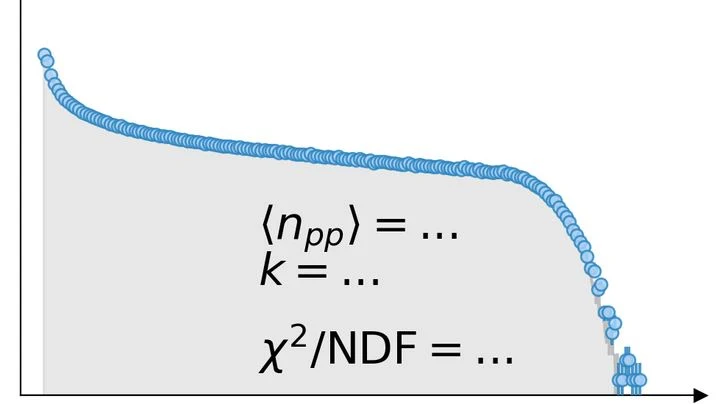
When two heavy nuclei smash into each other at enormous speeds, they don't collide as whole objects like billiard balls. Only part of their matter comes into contact. How many nucleons (protons and neutrons) actually took part in the collision, and how many flew past, is not known in advance. All subsequent measurements depend on this number, but it cannot be observed directly.
A handful of coins drops onto a table — heads and tails land wherever they please. The same goes for an instantaneous snapshot of a quantum chain: in some places a particle is present, in others it is not. But behind the disorder lurks a precise angle.
In this work, a chain of particles closed into a ring was considered. It was divided into four arcs: two were measured, two were left untouched.
Rare species in a large community are like thin branches on a tree: a random gust can easily snap them. Even if conditions are stable, a small population simply lacks enough individuals to survive a bad season. In a new study, scientists added this factor to an ecosystem model and watched the community clean itself out.
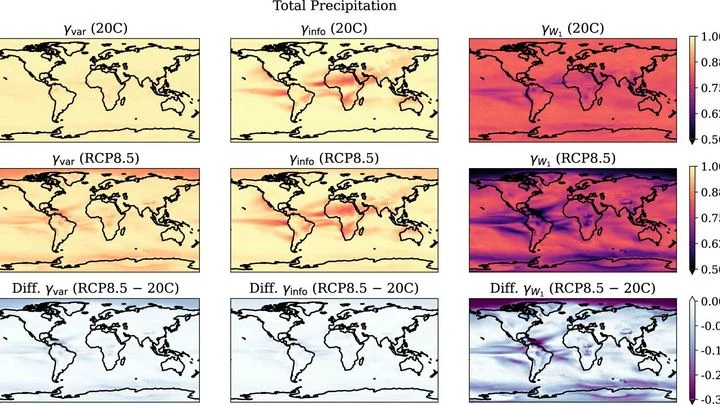
In winter, one part of town gets three times as much snow as the neighborhood next door. One year is a scorcher, the next is a cold snap. That's the whims of weather. But over decades, a different, slow shift emerges: winters, on average, get milder. Telling the two apart is the central challenge for climate scientists.
Rydberg molecules are like a pair of dancers holding hands at arm's length. One partner is an ion, the other is an atom, and the bond between them is as weak as an invisible thread. Such a pair can exist for only an instant, but that instant stretches into microseconds — an eternity by the standards of the microworld.
Two daughter cells receiving equal shares from the mother: that's the familiar picture of division. But what if one gets almost everything and the other just crumbs? Stochastic modeling shows that sometimes unequal division is more advantageous.
Each cell stores a protective reserve that helps it weather hardships. During division, this reserve is distributed between daughters.
Two electrons that leave a metal needle tip almost simultaneously start to repel each other, like two people trying to squeeze through a narrow door at the same time. The closer they are, the more they get in each other's way.
A raindrop falls on glass and flattens into a pancake. Add a bit of polymer to the water, and it becomes elastic, like jelly. You'd think such a jelly would spread differently.
A quantum computer is like an orchestra where each musician, a qubit, plays their part but keeps hitting wrong notes. To keep the music from turning into cacophony, you need a conductor who instantly hears the off-key notes and corrects them.
A washing machine sometimes tears clothes. To get a whole shirt, you wash several and then piece one together from the survivors. A quantum computer treats 'magic states'—special ingredients without which complex computations are impossible — in much the same way.
These states are extremely fragile. The slightest noise, and the magic evaporates.
A drop of ink in a glass of water spreads in intricate swirls. Similarly, a quantum particle exchanging energy with its environment changes its state in a complex and entangled manner. Describing this dance between particle and environment has long baffled scientists.
When an antibody meets a virus, it doesn't latch on with a single death grip. Rather, it's like two bunches of grapes tumbling in water, catching each other with dozens of short tendrils. Each tendril is weak on its own, easily torn by the thermal jitter of water molecules, but together they hold tight.
A light switch clicks, and the light comes on. But imagine a switch that, with the same press, can either turn on the lamp or leave the room dark. It also remembers what it did last time, and sometimes it seems to flip a coin to decide whether to light up.
This kind of behavior was found in a crystal of black phosphorus — a semiconductor just a few atomic layers thick.
A clot grows like a snowball rolling down a mountain: small at first, it picks up new layers, and predicting when it will turn into an avalanche is tricky. In the blood, a long chain of reactions, the coagulation cascade, unfolds, where one substance activates another, and the clot gains mass.
When sugar goes into tea, it dissolves. But why doesn't it just fall back out? It's all about chemical potential — a quantity that shows how 'favorable' it is for a substance to be in a given place and state. For a pure substance, it's easy to calculate, but for a mixture of several components, it's a real puzzle.
Sound enters the ear and hits a thin membrane inside the cochlea, the spiral organ in the inner ear. This membrane doesn't just vibrate like a string; it actively pushes the vibrations when they are weak and stops when they are strong. That's how the ear hears both a whisper and a loud conversation.
Scientists built a model where each piece of the membrane is a tiny pendulum with a spring.
A superfluid gas is like a crowd of people marching in step: each atom knows where to go and doesn't fall out of the common rhythm. But this crowd has three 'valleys'—three different directions it can take. In a new experiment, physicists made one valley slightly more 'favorable' than the others and watched how the crowd darted between them.
A clot grows like a snowball rolling down a mountain: small at first, it picks up new layers, and predicting when it will turn into an avalanche is tricky. In the blood, a long chain of reactions, the coagulation cascade, unfolds, where one substance activates another, and the clot gains mass.
A mail carrier delivers letters along one-way streets. As long as he only drives forward, the route is simple and predictable. But if U-turns are suddenly allowed, he'll start doubling back, crossing his own tracks, and the delivery pattern gets tangled. That's roughly how an infection behaves when people can get sick more than once.
When sugar goes into tea, it dissolves. But why doesn't it just fall back out? It's all about chemical potential — a quantity that shows how 'favorable' it is for a substance to be in a given place and state. For a pure substance, it's easy to calculate, but for a mixture of several components, it's a real puzzle.
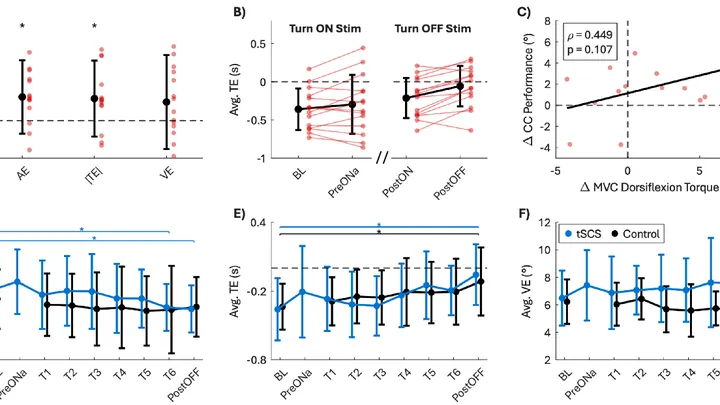
Give your back a mild electric zap, and your leg starts to live its own life. That's exactly what researchers discovered when they tested how transcutaneous spinal cord stimulation affects healthy people. Fourteen volunteers tried to move their ankles precisely while a robotic trainer measured errors. It turned out that after brief stimulation, the sense of foot position worsens — errors increase.
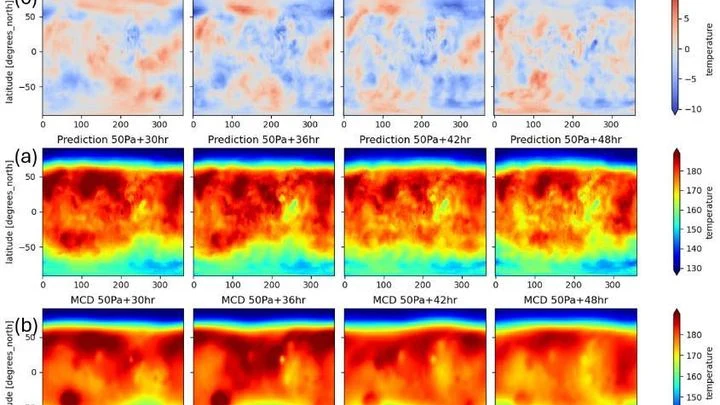
Meteorologists have grown used to trusting neural networks: the GraphCast model predicts Earth's weather days ahead by drawing on global snapshots of the atmosphere. But this 'brain' can be transplanted to another planet — where the air is thin and the Sun warms differently.
Two tiny magnets sit in a piece of metal. Around them is a sea of conduction electrons. Usually, electrons try to "shield" the magnetism of the impurities: they line up around them and quench it. This phenomenon is called the Kondo effect.
A stellarator fusion reactor resembles an intricately twisted magnetic cocoon. Its job is to confine superheated plasma so that hydrogen nuclei fuse and release energy. But the cocoon's three-dimensional shape creates gaps: some particles escape, especially the fastest ones, which carry most of the heat.
A mountain pass connects two valleys. In one, the protein is folded; in the other, it is unfolded. To get from one to the other, you must cross the saddle — the highest point on the path. In protein science, this point is called the transition state, and the coordinate that shows the distance to it is the committor.
Inside every cell, things are constantly meeting and parting. Some pairs hold tight, like Velcro, while others barely touch, like pollen on the wind. These fleeting touches, where the binding strength is comparable to a grain of salt dissolving in a glass of water, govern many of the cell's signals and decisions.
Each year is a new page. From ages 9 to 13, a child's life changes rapidly, and so do their inner experiences. A team of researchers took data from the large ABCD Study survey, in which 11,864 adolescents reported over several consecutive years on their thoughts and actions — whether they had thoughts of suicide, whether they engaged in actions, and whether they harmed themselves without such thoughts.
In an oven, as temperature rises, molecules move faster and disorder increases. With language models like ChatGPT, it's the opposite. When developers increase the 'temperature' parameter, the model gets access to a wider choice of words, but its long texts suddenly start looping.
A team of researchers tested 11 different AIs by generating 12,000 text continuations.
In the long extensions of a neuron, the dendrites, tiny couriers are constantly bustling about. These are messenger RNA molecules carrying instructions for protein assembly. Their journey starts at the cell body and ends at synapses — contacts with other neurons.
A quantum computer based on neutral atoms is like a city where couriers, laser tweezers, physically carry packages between addresses. While one courier drags an atom across the entire chip, the others sit idle. This is slow and error-prone.
The new architecture replaces couriers with a shared radio wave.
A protein chain folds into a working tool in a fraction of a second, and almost never makes a mistake. For a long time, it was thought that evolution specifically polishes amino acid sequences so that a protein not only works but also easily finds its unique shape. New work turns this idea on its head.
The brain doesn't just react to the world: it's constantly guessing what will happen next. This principle is called predictive coding: neurons compare expectations with reality and update their internal picture when an error occurs. But how such a complex system could be wired into the living tissue of the cortex remained unclear.
In a noisy hall, an interpreter tries to catch every word, but rustles and echoes muddle the meaning. That's roughly how conventional computer methods handle complex quantum systems: the more particles and the stronger their correlations, the faster calculations drown in interference.