Infection is the process by which a pathogen — a bacterium, virus, fungus, or parasite — invades a host organism, multiplies, and triggers a response that can range from mild discomfort to severe disease. It is not simply the presence of a microbe; it is an active battle between the invader's ability to reproduce and the host's immune defenses. The outcome depends on a delicate balance: the pathogen's virulence, the host's immunity, and the number of microbes that initially enter the body.
History
The germ theory of disease, established by Louis Pasteur and Robert Koch in the late 19th century, first linked specific microbes to specific illnesses, replacing older ideas of miasma or spontaneous generation.
How it works
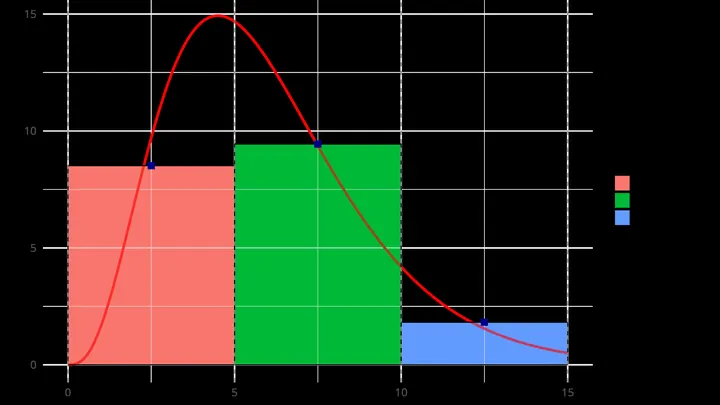
An infection begins when a pathogen breaches a physical barrier like skin or mucous membranes and finds a niche where it can multiply. Once inside, it competes for nutrients, evades or suppresses the immune system, and produces toxins or damages tissues directly. The host responds with inflammation, immune cell recruitment, and sometimes fever, which can either clear the infection or, if overwhelmed, lead to disease. The 'infectious dose' — the number of microbes needed to establish infection — is a key factor: a single bacterium may be harmless, while thousands can overwhelm defenses.
In practice
Understanding infection dynamics guides vaccine development, antibiotic dosing, and public health measures like quarantine and hygiene protocols.
Fun fact
Some pathogens, like the bacterium that causes cholera, can trigger infection with as few as 100 cells, while others, like Salmonella, require thousands.
The skin of an older person is like an orchestra where the musicians are all in place, the instruments are tuned, but the conductor walks onstage later than he should. Infection with Staphylococcus aureus sets off an elaborate concert of immune cells in the skin, and it used to seem that with age the orchestra simply plays more quietly.
The orchestra starts playing, but each musician has their own tempo. If everyone plays at roughly the same speed, the music flows in a continuous stream. But if one group of instruments plays noticeably slower than the rest, the sound gathers into a dense clump that slowly moves forward.
Imagine someone hauling two sacks up a hill. One is stuffed with sugar the body cannot process. The other is filled with the years the body has lived faster than the calendar. While the sacks are light, the climb is manageable. But if both are filled to the brim, the legs give way, and the person collapses not with one disease but with several at once.
A bacterium swims toward food. A chemical signal guides it forward, but with each movement the signal changes. A loop emerges: sensation, action, new sensation. The authors turned this loop into a measurable quantity.
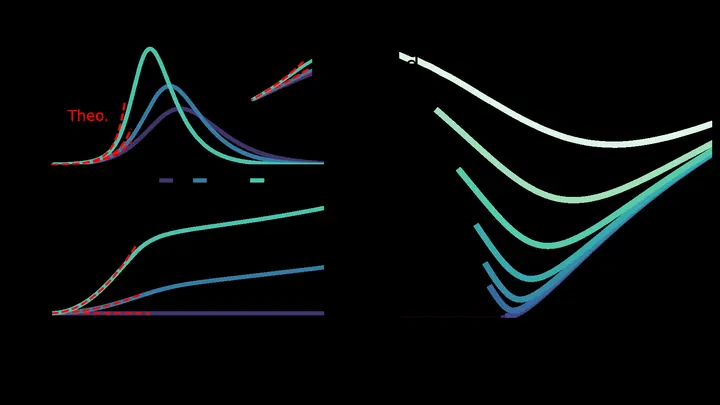
A disease outbreak is like a wildfire: the fire runs through dry grass, and its speed depends on wind and humidity. But an infection has its own 'wind'—how often people infect each other. When this rate changes along with the fraction of already infected, the epidemic wave can behave differently.
Ordinary models assume that infection is like a steady flow of water that washes over everyone equally. In reality, the stream from a sick person fluctuates: right after infection it barely trickles, then turns into a raging downpour, and later subsides. The chance of catching the virus depends on the strength of this flow at the moment of contact.
In the web of life, predators and prey exchange carbon and water, and each act of eating slightly increases the universe's disorder. But the intrusion of disease turns this system into a giant seesaw. When a mid-level predator gets sick, its hunting abilities decline, and it becomes easy prey.
A crowd in a city square behaves differently depending on whether people hold hands. If each person only lightly touches a neighbor's elbow, people easily spread out in all directions — the crowd expands as a smooth carpet. But if they interlock fingers, movement slows down and the crowd breaks into clumps: dense clusters form here and there, with empty corridors between them.
The microbial community in the gut is like an orchestra: what matters is not only the musicians but how they play together. When disease strikes, it's not just the lineup of microbes that changes: their interconnections shift too. Researchers built interaction networks of microbial genes in healthy and sick individuals.
Every group has its unspoken trios: three friends who are always together. And there are pairs that exist on their own. It turns out that how much trios "contain" pairs determines how everything, from a virus to a new idea, spreads through the group.
Scientists introduced a measure they call the nesting coefficient.
A pot of water sits on the stove. The temperature drops: plus one degree, zero, minus one — the water stays liquid. But at some point, a light breath is enough to make the whole mass instantly freeze into ice. Physicists call such jumps first-order phase transitions.
In a hospital, blood from a finger prick usually goes to the lab, and the result comes back the next day. The new method promises to cut that wait to a few minutes. Instead of catching light reflected off a sample, it reads the electrical voltage that arises at the boundary between two media, like the faint tingle you feel when you touch a battery with wet fingers.
An epidemic is like a fire in a dry forest: a spark flares up, the flames leap from tree to tree, and within a week the whole area is burning. A hundred years ago, scientists devised a simple mathematical model for such a fire: they divided people into those who had not yet fallen ill, those who were ill, and those who had already recovered.
A tumor doesn't stay put. Individual cells or whole groups break off and set off on a journey through the body. Some crawl solo, like scouts; others stick together, like a flock. Scientists built a computer model to understand how these cells pick a direction.
In the model, cells respond to two signals.
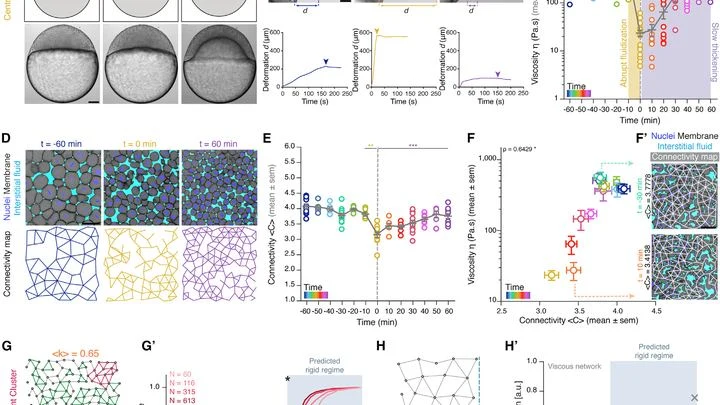
As an embryo grows, its cells don't just divide: they constantly touch their neighbors, like people in a crowded bus. The strength of these contacts determines where a cell moves and what shape the tissue takes. Scientists studied how cell 'stickiness' changes during the earliest stages of development.