A virus is a nanoscale infectiousagent that parasitizes cells. Its genetic material – DNA or RNA – is packed into a protein capsid; some viruses have a lipid envelope. The virus is incapable of independent metabolism and reproduction – it necessarily uses the resources of the host cell. After penetration, viral genes integrate into the cellular machinery, forcing it to synthesize viral proteins and replicate the viral genome. Assembly of new virions occurs in the cytoplasm or nucleus, after which they exit, destroying the cell or budding off.
History
The history of virus discovery begins with the work of Dmitry Ivanovsky (1892), who demonstrated that the causative agent of tobacco mosaic passes through bacterial filters. Later, Martinus Beijerinck (1898) confirmed this and introduced the term 'virus' (liquid living poison). In 1935, Wendell Stanley crystallized the tobacco mosaic virus, proving its particulate nature. With the development of electron microscopy and molecular biology, the structure and replication mechanisms of viruses were established.
How it works
Viral parasitism at the molecular level is based on molecular mimicry and the use of cellular receptors. For example, the influenza virus binds via hemagglutinin to sialic acid on the cell surface, enters the endosome, where low pH activates membrane fusion. RNA-genome viruses replicate using RNA-dependent RNA polymerase, which they either encode or carry with them. Retroviruses (HIV) use reverse transcriptase to synthesize DNA from an RNA template, which then integrates into the host chromosome via integrase. Virus release can occur by lysis (cell destruction) or budding, when the virus captures a portion of the cell membrane as an envelope.
In practice
Viruses cause diseases (influenza, COVID-19) but are also used as vectors for gene delivery in gene therapy.
Fun fact
Some viruses can integrate their genetic material into the host DNA and remain there for years without causing symptoms (like the herpes virus).
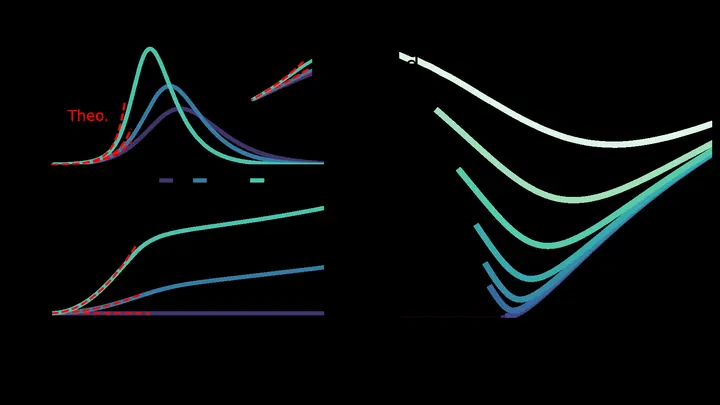
Picture a long thread trapped inside a sphere with charged walls. The thread is the virus's RNA; the sphere is its protein shell. The thread tries to settle so that its charges sit as close as possible to opposite charges on the wall.
Picture a long thread trapped inside a sphere with charged walls. The thread is the virus's RNA; the sphere is its protein shell. The thread tries to settle so that its charges sit as close as possible to opposite charges on the wall.
A mail carrier delivers letters along one-way streets. As long as he only drives forward, the route is simple and predictable. But if U-turns are suddenly allowed, he'll start doubling back, crossing his own tracks, and the delivery pattern gets tangled. That's roughly how an infection behaves when people can get sick more than once.
By 2025, large language models like GPT are no longer just chatting: they're helping scientists run experiments. But the same tool could fall into the wrong hands. A team of researchers built a digital proving ground to find out.
Ordinary models assume that infection is like a steady flow of water that washes over everyone equally. In reality, the stream from a sick person fluctuates: right after infection it barely trickles, then turns into a raging downpour, and later subsides. The chance of catching the virus depends on the strength of this flow at the moment of contact.
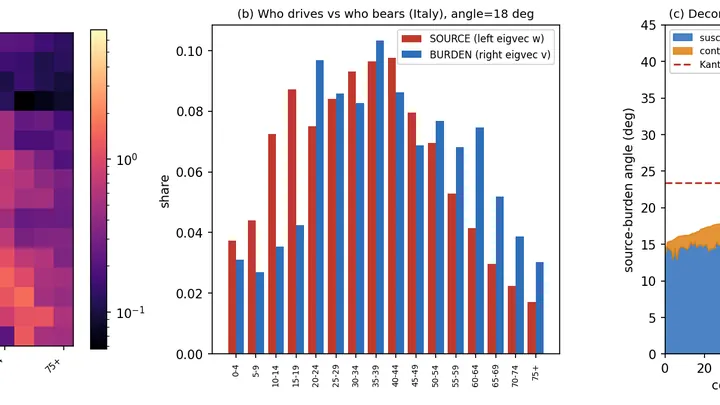
The orchestra plays without a conductor. We know the overall volume: that's the basic reproduction number R0, the spectral radius of the epidemic. But the score itself, the contact matrix between people of different ages, holds the melody: who spreads the infection and who takes the main blow.
An ordinary microscope is powerless when you need to examine a single virus in detail. It's too small. But there's a tool that fires flashes billions of times brighter than sunlight — an X-ray free-electron laser. It's designed to 'photograph' a particle before the beam vaporizes it.
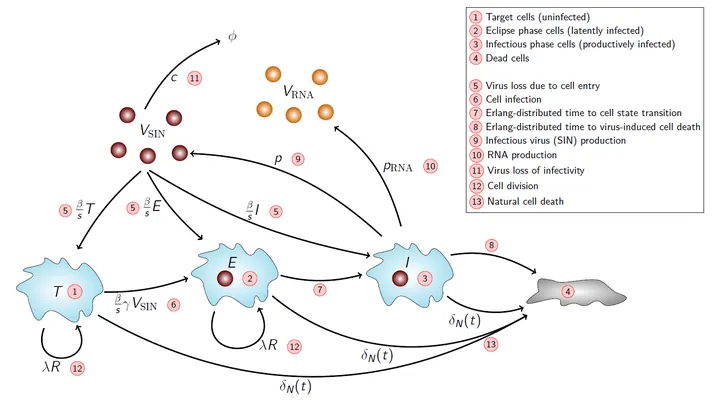
A cell gets infected by a virus, and an invisible timer starts ticking inside. At first, the virus seems to vanish: you can't find it; it's gathering resources. This latent period (the time from virus entry to the appearance of new particles) is unique to each strain. For Bunyamwera virus, it turned out to be noticeably longer than for Batai virus.
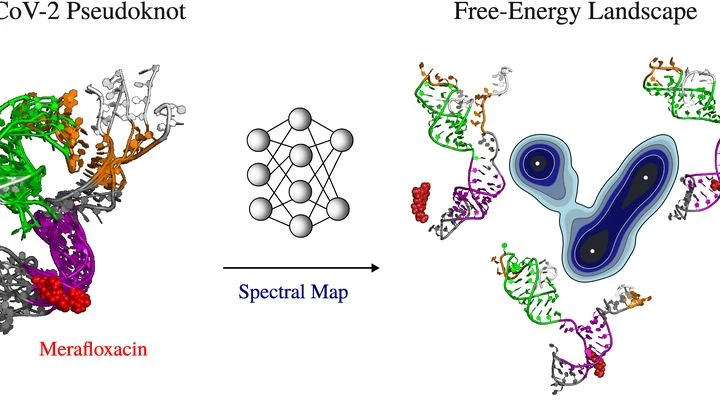
The RNA of SARS-CoV-2 is not just a chain but a complex structure. It contains a region that ties itself into a knot, much like a tangled shoelace. This knot helps the virus produce two proteins from a single stretch of genetic code. Without such a knot, the virus replicates less efficiently, so scientists are hunting for compounds that can undo it.
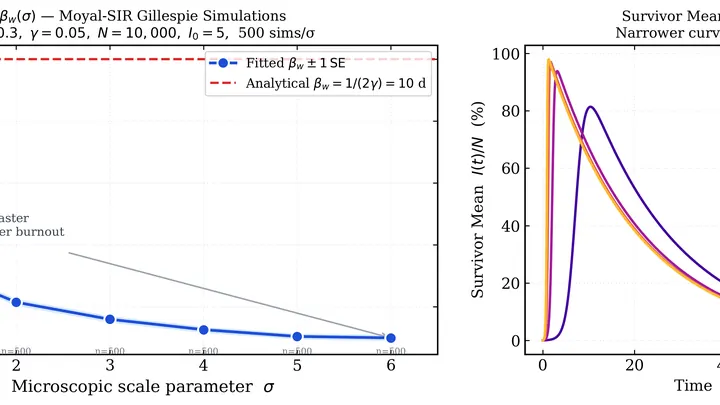
An epidemic is like a fire in a dry forest: a spark flares up, the flames leap from tree to tree, and within a week the whole area is burning. A hundred years ago, scientists devised a simple mathematical model for such a fire: they divided people into those who had not yet fallen ill, those who were ill, and those who had already recovered.
Capsids are protein boxes that viruses use to carry their genetic material. In gene therapy, these boxes serve as couriers: you put a desired gene inside, and the outside retains the ability to enter cells.
The assembly of a virus shell is like fastening a button: protein blocks must interlock in the correct order, and thermal fluctuations act like trembling fingers. With weak binding, the trembling helps find the right position — the shell closes faster.
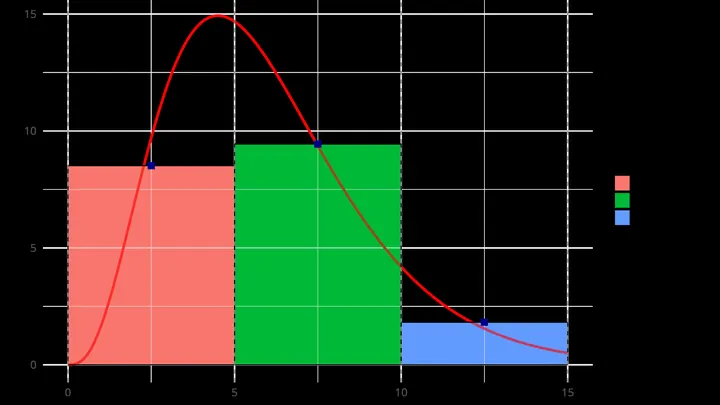
An epidemic is not a steady stream but a series of hits. One carrier may infect no one, while another infects fifty people at once. Such rare but powerful events are called 'dragon kings': they stand out from the overall pattern and determine how severe a disease wave will be.
In the new study, the virus is compared to a billiard ball.
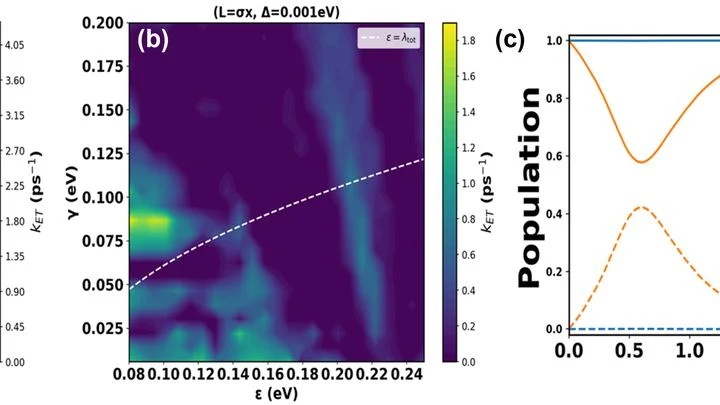
A virus approaches a cell like a key to a lock. But this lock is not ordinary: it vibrates, it trembles, and whether the key matches the rhythm of those tremors determines if the door opens. According to new research, this is exactly how recognition works between the coronavirus spike protein and the ACE2 receptor on the surface of human cells.
A graphene transistor works like a microscopic switch: a molecule lands on its surface, and the current changes. But a bare graphene surface catches nothing. You need a "bait"—antibodies that recognize only viral proteins.
The same set of parts can assemble into different shapes, just as magnetic beads can form a small cube or a large sphere. That's how hepatitis B virus proteins behave: they build two capsids of different sizes. One is made of 90 protein pairs, the other of 120. Both are stable and appear both in living cells and in the test tube.
Primary human cells, taken straight from the body, are the most honest material for studying diseases and testing drugs. But getting foreign genetic material into them is tricky: cells don't like intruders. Standard methods either damage the cell or work unevenly, especially when the sample is heterogeneous — which it almost always is.
The new platform tackles this with a vortex flow.