Dim Architects of Dawn: How Invisible Galaxies Lit Up the Universe
Original: "Tilting at the Turnover: Modeling the Faint-End of the UV Luminosity Function Behind Abell s1063 with JWST"
Deep JWST observations through a gravitational lens prove that the faintest and most numerous galaxies of the early universe provided more than half of the light that scattered the cosmic darkness.
Links in the knowledge graph 1
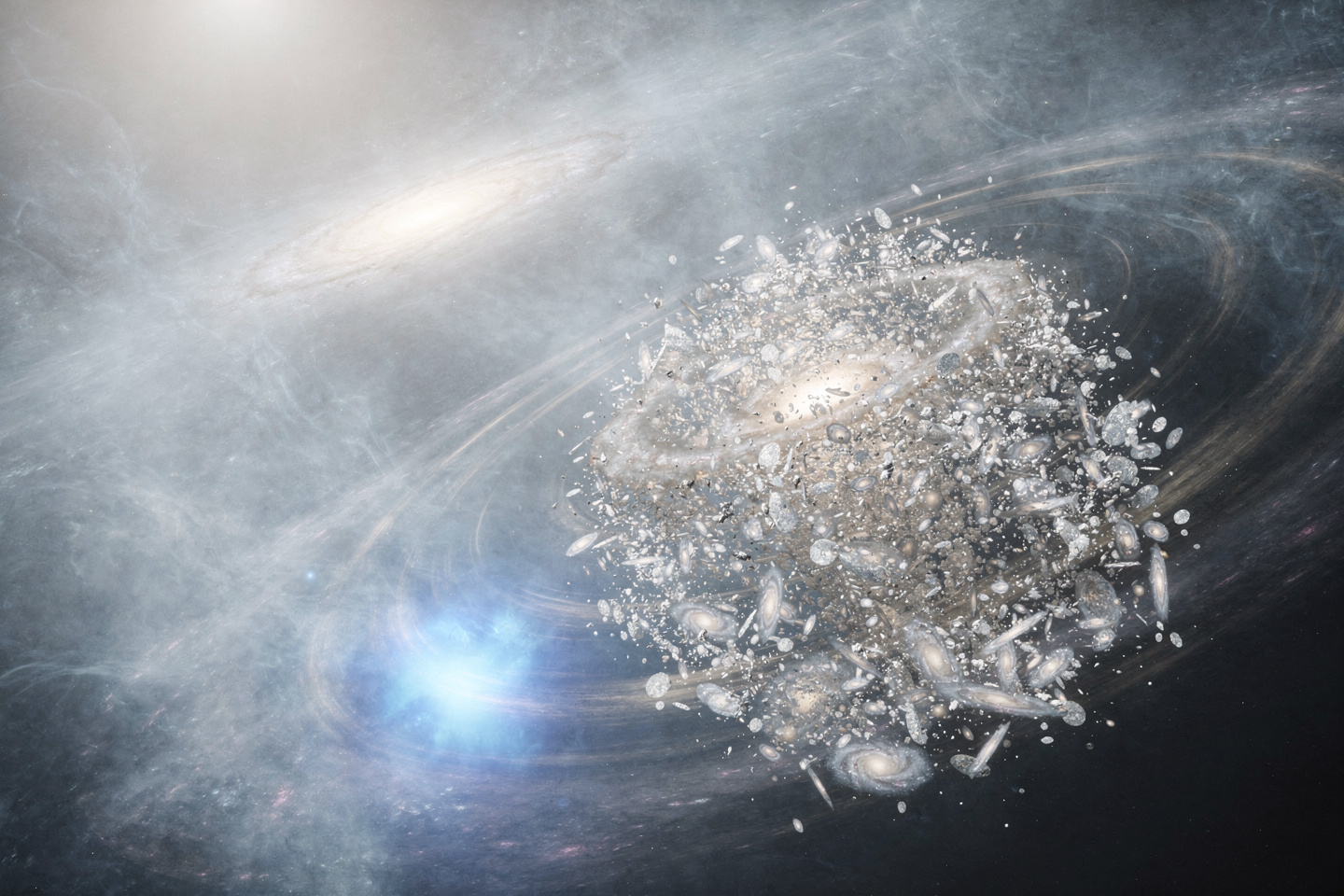
The first dwarf galaxies were fainter than a match flame in a metropolis. But it was their multi-million chorus that burned away the neutral hydrogen fog and made the universe transparent. Astronomers have peered into this chorus thanks to a natural lens of dark matter—and now know that over 60% of the light that tore apart the cosmic darkness came from those we once thought of as extras. Perhaps the flickering of these dim sparks holds the key to the nature of dark matter itself.
🎯 The faintest galaxy in the Abell S1063 field was magnified by the gravitational lens more than 25 times—without such a 'cosmic telescope,' it simply would have been impossible to see.
\phi(M) = \phi_{\text{DPL}}(M) \times \begin{cases} 1, & M \leq M_t \\ 10^{-0.4\delta(M - M_t)^2}, & M > M_t \end{cases}
Modified luminosity function with quadratic suppression: the parameter δ describes how steeply the number of galaxies fainter than the threshold M_t declines, modeling the possible quenching of star formation in small halos.
Scientists
Alan GuthAndrei LindeGeorges LemaîtreJames PeeblesAdam RiessBrian Schmidtgalaxy
gravitational lensing
JWST
Hubble Space Telescope
spectroscopy
dark matter
big bang
hydrogen
Time dilation
Standard ModelLaws
Friedmann equationsHubble's lawDoppler effectgravitational lensingNoether's theoremCoulomb's law