Earthquake Swarm: How Granite Comes Alive express
In 2019, residents of Palghar district in western India felt the ground slip from under their feet — not once, but thousands of times. Over two years, seismographs recorded about 50,000 tremors. This wasn't a typical earthquake with a main shock and aftershocks, but a swarm: a series of events that quiets down and then flares up again, like a smoldering fire fed with twigs.
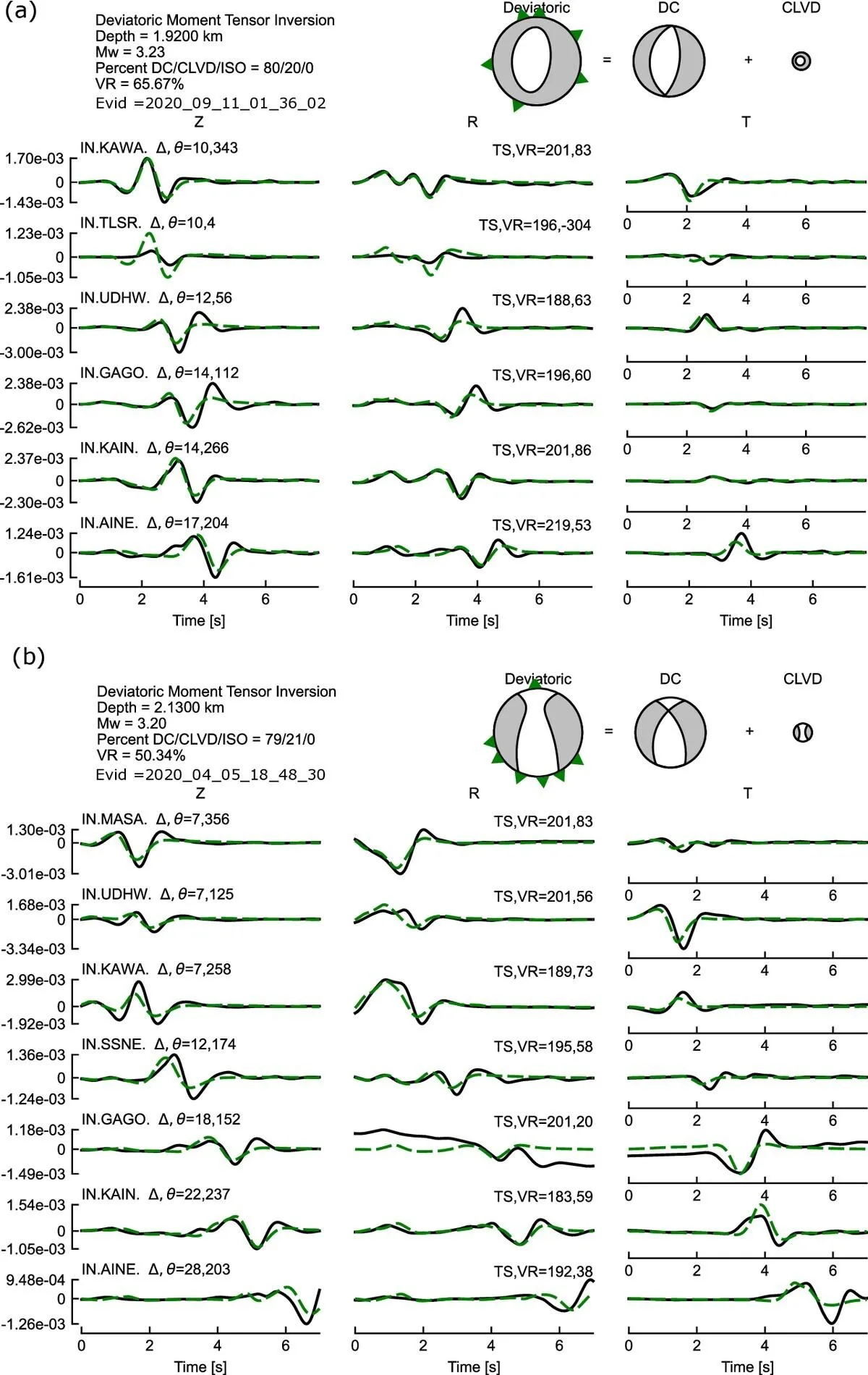
Scientists applied machine learning to catch even weak signals and re-examined every event. It turned out that the tremors originated on two shallow faults in the granite basement — rock that is usually considered strong and quiet. First, the western crack trembled, then activity jumped to the eastern one, and then spread into the damaged zone between them. This sequence resembles a relay race, but instead of runners, it's patches of crust passing the baton.
Usually, swarms are explained either by the movement of underground water that lubricates faults, or by slow slip without strong tremors. But in Palghar, neither mechanism works alone. Observations showed a mix: water aided deformation, and stress transferred from one fault to another, as if neighboring gears were catching each other. This discovery changes our view of how stable continental crust behaves and helps us better understand when and why the ground decides to remind us it's there.
Original abstract
as written by the authors arXiv:2608.16317v1
Earthquake swarms provide a natural window into fault response to transient perturbations, yet their driving processes are commonly interpreted using fluid-driven and aseismic-slip-driven end-member models. Intraplate swarms offer a unique setting to test these models because low secular tectonic loading heightens the sensitivity of faults to transient, non-tectonic forcing. We use a machine-learning-enhanced catalog of $$\sim$$50,000 earthquakes from the 2019--2020 Palghar earthquake swarm in western India to test this end-member framework. High-resolution relocations, together with moment tensor solutions, reveal two shallow normal faults in a granitic basement, with seismicity sequentially migrating from the western to the eastern fault before expanding into the intervening damage zone. Although the swarm exhibits an overall diffusion-like expansion, the relocated seismicity reveals a persistent $$\sim$$5-km-deep localized seismicity band and repeated migration fronts sometimes propagating faster than expected from fluid diffusion alone. The velocity--duration scalings of these intermittent episodes span both fluid- and slow-slip-driven regimes. Sequential fault activation and contrasting migration styles throughout the swarm duration reveal dynamics that cannot be explained by either end-member mechanism alone. Instead, the Palghar swarm evolved through coupled fluid-assisted deformation and transient stress transfer within an interacting fault network, with migration episodes consistent with aseismic deformation. These observations reveal that high-resolution catalogs can disentangle transient processes hidden within apparently diffusive swarm behavior. More broadly, intraplate earthquake swarms provide powerful natural laboratories for resolving how coupled transient processes govern earthquake triggering and fault interaction in stable continental crust.
During the Palghar swarm, locals reported a low rumble like thunder, even though the epicenters were about 5 kilometers deep.