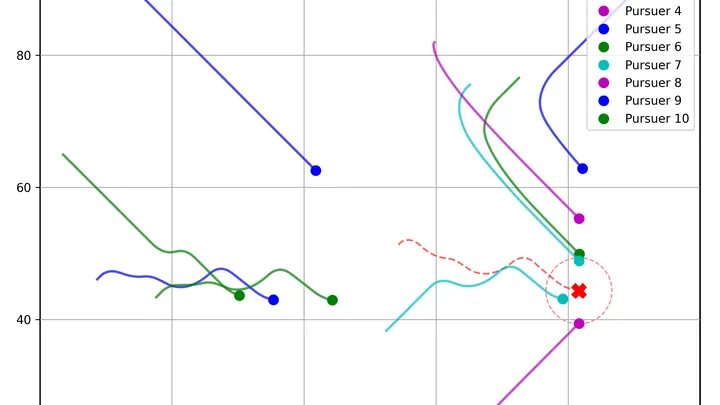
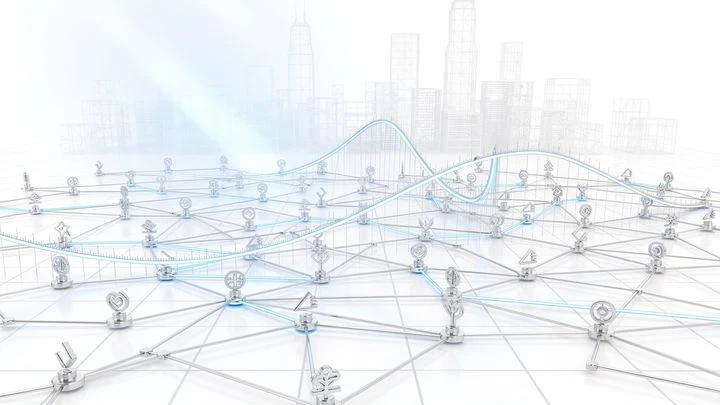
Emergent collective learning refers to the phenomenon where a group of simple agents, each following basic rules, collectively adapts or learns to solve problems without any central controller. This is observed in natural systems like ant colonies, bird flocks, and even in artificial systems like robot swarms. The group's behavior is more complex than the sum of its parts, and the learning emerges from local interactions.
History
The concept gained traction in the 1980s and 1990s with the advent of swarm intelligence research, notably through the work on ant colony optimization by Marco Dorigo and on flocking behavior by Craig Reynolds.
How it works
Each agent in the group follows simple rules based on local information, such as the positions or states of its neighbors. Through repeated interactions, the group as a whole can exhibit adaptive behaviors, like finding the shortest path to a food source or avoiding obstacles. This is often modeled using reinforcement learning or evolutionary algorithms, where the group's collective performance improves over time without any individual agent having a global view.
In practice
Emergent collective learning is used in robotics to create swarms of drones that can search for survivors in disaster zones or map unknown environments without a central command.
Fun fact
In a swarm of robots, if one robot learns a new behavior, it can spread through the group like a 'meme', even though no robot has a direct connection to all others.
In March 2020, France emptied out: people stopped going to work, school, and cafés, and the streets filled with silence. Epidemiologists stared at the graphs and understood that the virus was not spreading on its own, but through handshakes, conversations, and metro rides. But how could they predict how many contacts a person would keep if the government announced new restrictions?
Imagine a large orchestra without a conductor. Each musician hears everyone else and adjusts to the collective hum. If every instrument amplifies its neighbors, the sound builds to a screech; if some occasionally dampen it, the orchestra may fall into silence or break into cacophony.
Picture a flock of birds gathering around a feeder that no one built. Each bird searches for food on its own, yet they all end up together. Usually, such behavior is explained by social instinct: birds want to be near their kin. But what if the flock is simply a side effect of greed?
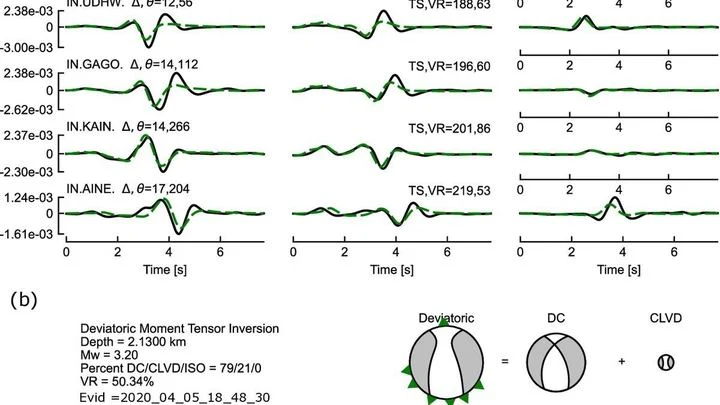
In 2019, residents of Palghar district in western India felt the ground slip from under their feet — not once, but thousands of times. Over two years, seismographs recorded about 50,000 tremors. This wasn't a typical earthquake with a main shock and aftershocks, but a swarm: a series of events that quiets down and then flares up again, like a smoldering fire fed with twigs.
A lone fish sees a shadow overhead. Should it flee? If it's just a leaf, it wastes energy and gives away its position to a predator. If it's a heron, hesitation is fatal. That's the eternal trade-off of the solitary individual: quick reactions mean many false alarms, while caution means risking being eaten.
In a school, it's different.
The quantum world does not forgive forgetfulness. Throw a stone into a pond — the ripples spread and vanish, the information about the impact dissipates without a trace. In quantum mechanics, everything is different: the evolution of a system is reversible, and the past is never completely erased.
A jazz ensemble: at first, a cacophony of random notes. Then — a catchy riff that plays over and over. Such is the riddle of the origin of life — only in the language of chemistry.
The human mind is like a construction set that builds itself. New ideas don't die with their creators: they are passed on, mixed, and selected. This process is called cultural evolution: useful inventions stick, useless ones are forgotten. That's how a ratchet works — a mechanism that only turns forward.
But what exactly happens in the head when one thought displaces another?
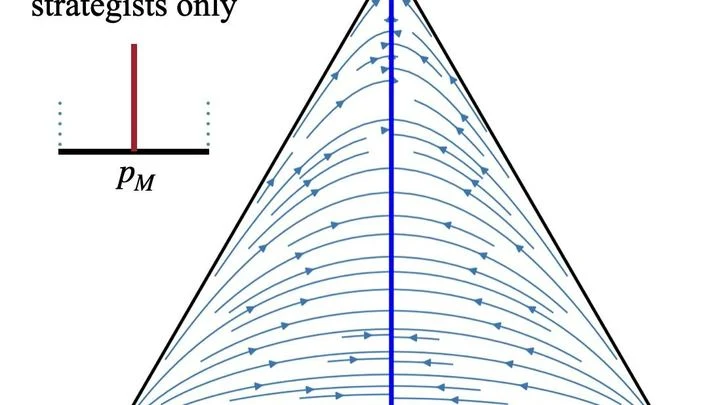
For a long time, biologists argued: if a herd of animals stably maintains a mix of aggressive and peaceful individuals, does each one alternately change behavior, or do some always fight while others always yield? In classical equations, these options are indistinguishable.
A robot swarm is like a cloud of fireflies: each moves on instinct to wherever is freer, and chaos turns into order. For a long time, it was a mystery how coherence emerges without communication or commands. The answer came with the creation of the Response Map — a tool that, like an X-ray, illuminates the hidden logic of the machine brain.
A wolf pack switches from chasing prey to defending its den in an instant. Engineers have instilled this same versatility into an algorithm for a robot swarm. The key is a method proposed by John von Neumann: instead of chasing the target, the robots calculate its future moves and block escape routes, like beaters cutting off trails.
A snowflake grows, an oil slick spreads, a crowd moves — each case has its own equations. But the end result is often the same: shape, speed, and pattern follow a simple scheme that repeats across scales. This is universality — when a common law hides behind the details.
The 120 residents of Montelago are not people but digital characters. Each, besides a name and biography, has three hidden coordinates: trust in municipal authorities, assessment of source credibility, perceived adequacy of information. These numbers are known to the creators but not to the system itself.
A person reaches out to a stranger across town. That stranger will never return the favor: they'll never meet. So why help? Biologists call this indirect reciprocity: kindness comes back not from the person you helped, but from someone else, down the line.
In a new study, two variants of this idea were pitted against each other.
You can think of a political system as a vast galaxy — a gravitationally bound system of stars, gas, and dust. In this analogy, parties are the stars, radiating the light of public activity, while their supporters are dark matter, the invisible substance that emits no electromagnetic radiation but whose mass holds the whole structure…
A living organism is a machine that constantly channels energy through itself and converts it into heat. This internal cycle is called internal entropy production (a measure of energy dissipation). But about 2.5 million years ago, our ancestors switched on a second loop — an external one. They picked up a sharpened stone, and then a burning branch.
In the watery environment, vortices batter the mechanical fish. The AI agent, like an experimental chef, ran simulations, tried out 'recipes' of movements, and improved the program. Each experiment was like spectroscopy: the agent broke down behavior into elements, uncovering patterns. At first, the fish only paddled in one direction.
Picking out a single faulty microchip from a million, without any clue what the fault looks like, is a classic needle-in-a-haystack problem. A classical computer would test each chip one by one.
A neural network learning something new is like a traveler in mountainous terrain. Each piece of learned knowledge is a depression in the landscape into which the traveler rolls and gets stuck. To escape and reach a new basin, energy is needed. But as the traveler gains experience, the walls of their pit become steeper, and each subsequent climb requires more effort.
A physicist analyzing particle collisions typically spends weeks on dull work: cleaning noise from data, estimating how many false signals will slip through, double-checking every number. Now that routine can be handed to a program.
A neuron in the brain is like a person handing out business cards at a crowded conference. At first, making acquaintances is easy, but as the address book fills up, each new contact requires more effort: there's little room left. The authors based their model on this 'crowding' rule: the more incoming connections a neuron already has, the harder it is to form another one.
In the first weeks of an embryo's life, a dense crowd of cells crawls across its body. These cells will later form the facial bones, parts of the heart, and nerves. The crowd doesn't move randomly: a few leader cells take the front, and the rest follow them, like cyclists in a peloton.
For a long time, it was believed that leaders are a special breed of cells, born with a drive to lead.
The Social Laser theory describes society by borrowing the inner workings of a laser. People, like atoms in a crystal, absorb streams of information and become charged by it. When the number of those charged with a single idea outweighs the indifferent, even a weak signal (a post, a call to action) makes everyone act as one.