Three Faces of a Superoutburst: How the Dwarf Nova YZ Cancri Changes Its Profile ✛
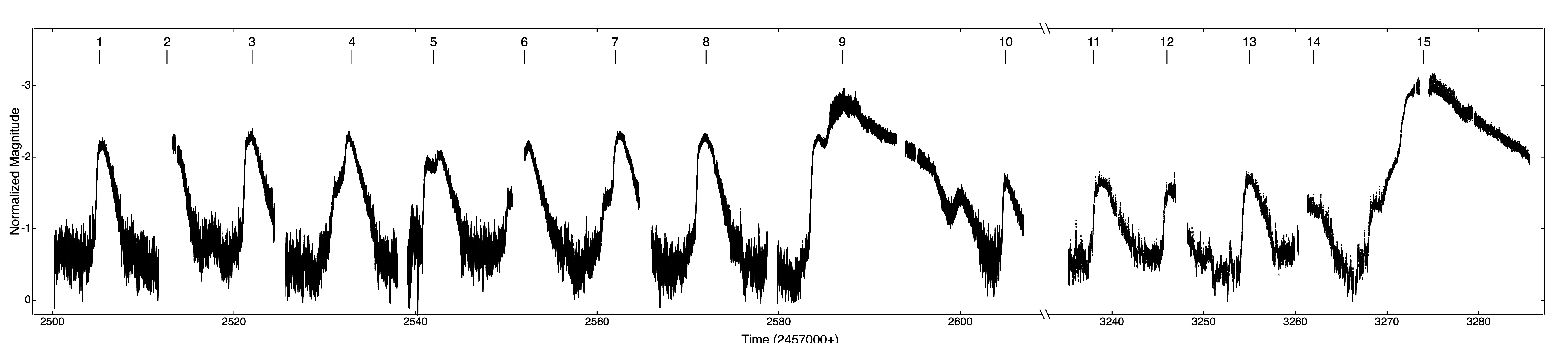
In the constellation Cancer, there is a star that is usually faint but occasionally erupts and becomes dozens of times brighter. This is the dwarf nova YZ Cancri, a binary system where a white dwarf pulls gas from a normal companion star. During an outburst, the gas disk around the white dwarf heats up and begins to glow, and waves with a period of about two hours appear on its light curve. These waves are called superhumps, and it was previously thought that their shape hardly changes from the beginning to the end of an outburst. New data have shown that this is not the case.
Imagine a rotating carousel: it spins at one speed, while the horses on it bob up and down at another. Something similar happens in the disk around the white dwarf: the disk itself orbits in 2.08 hours, while its elongated part slowly rotates, adding an extra 4% to the superhump period. As a result, superhumps do not coincide with the orbital period but are slightly longer. In YZ Cancri, this excess is 4.03%, which for dwarf novae near the lower edge of the period gap has been measured for the first time with such precision. Previously, such systems were a blank spot: they are hard to catch during an outburst, and without long observational runs, the superhump shape cannot be discerned.
When the two outbursts recorded by TESS were compared with five ground-based observations over ten years, a clear sequence of three stages emerged. First, the superhump has a sawtooth shape: a sharp rise and a smooth decline, like the teeth of a saw. Then the peak splits into two, with one hump becoming higher than the other. By the end of the plateau, the two humps are nearly equal in height. This sequence repeats from outburst to outburst, as if the disk each time goes through the same script. Meanwhile, the superhump clock runs irregularly: at the beginning of the outburst, the times of maxima occur sometimes earlier and sometimes later than predicted, while in the middle and end of the plateau the deviations become minimal.
The most regular phase occurs during the double-peaked stages. It is then that superhumps can be used as precise clocks to measure the system's parameters. From the refined period of 0.09043 days and the excess of 4.03%, it was possible to estimate the mass ratio of the components: the white dwarf is about 5.7 times more massive than the donor star. This value is consistent with theoretical models for systems near the lower boundary of the period gap, where the orbital period shrinks to a minimum and then begins to grow.
Previously, astronomers did not know whether the superhump shape changes in dwarf novae near the period gap, nor how stable their clocks are. Now it is clear: the profile goes through three repeating stages, and the most reliable times for measurements are the middle and end of the plateau. This sequence could serve as a template for other dwarf novae: if a system shows the same change in shapes, it means its disk goes through the same stages of instability. There is no practical benefit for everyday life here, but for understanding how matter falls onto white dwarfs, this is an important step. The next time YZ Cancri erupts, astronomers will already know what masks its disk will wear.
Superhumps in YZ Cnc have a period of about 2.17 hours, which is only 4% longer than the orbital period of the system. During a single superoutburst lasting about 10 days, the disk completes more than 100 precession cycles.