Popular

Stellar astro-ph.SR

104 articles

White dwarfs, brown dwarfs, cataclysmic variables. Star formation and protostellar systems, stellar astrobiology, binary and multiple systems of stars, stellar evolution and structure, coronas.

articles

Birth Echo: How Astronomers Found Evidence of a Black Hole

Astronomers have finally found compelling evidence that black holes are indeed born in supernovae. Around the black hole SS 433, a shell of hot gas is visible — like cooling steam from a massive star explosion that thundered 20,000–30,000 years ago.
arXiv:2410.06510 · 2024-10-09

Fast stars reveal the Sun’s galactic path

Astronomers used 1,200 high-speed stars to compute the Sun's motion. By measuring their full 3D velocities, scientists refined the trajectory of our star and the gravity map of the Milky Way. This helped better understand the distribution of invisible dark matter in the outskirts.
arXiv:2501.12478 · 2025-01-21

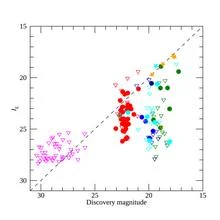
Euclid Accidentally Discovers 164 Cosmic Flashes

The Euclid space telescope, designed to study dark energy, accidentally detected 164 transient flashes. Astronomers measured brightness in different wavelengths to understand the nature of stellar explosions and discovered hidden galaxies.
arXiv:2503.15334 · 2025-03-19

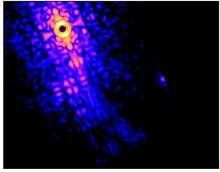
Caught by a Stellar Kick: Webb Finds a Neutron Star

Astronomers have searched for decades for the object left behind by supernova 1987A. Webb finally saw it: a neutron star that is accelerating gas and flying sideways. By measuring its displacement, scientists determined its speed — 500 km/s, as if someone gave it a stellar 'kick'.
arXiv:2508.03395 · 2025-08-05

Cosmic Hide-and-Seek: Webb Spots a Planet Near a Neighboring Star

At Alpha Centauri A, the nearest Sun-like star, Webb briefly picked up a dot called S1 — a planet candidate the size of Jupiter but with a temperature around –20°C. The object hid behind the star — its orbit lasts just 2–3 years, and there’s remarkably little dust around.
arXiv:2508.03814 · 2025-08-05

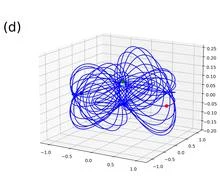
The Dance of Three Bodies: New Orbits in Chaos

What the work is about: searching for periodic orbits in the three-body problem. What's new: over 10,000 three-dimensional orbits, many of them stable, including round dances and duets with a solo. Why it matters: these refined movements explain the stability of triple star systems and offer a glimp
arXiv:2508.08568 · 2025-08-12

Interstellar Visitor with Carbonated Breath

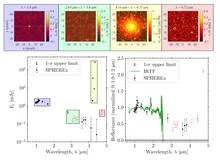
The SPHEREx telescope split the light of the interstellar wanderer 3I ATLAS into colors. It revealed that it's actively emitting carbon dioxide, while water ice absorbs some of the rays like tinted glass. All visible glow is a dusty shell, with the solid core inside being hundreds of times smaller.
arXiv:2508.15469 · 2025-08-21

White Dwarf Plays Hide-and-Seek with Cosmic Dust

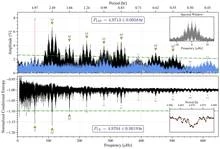
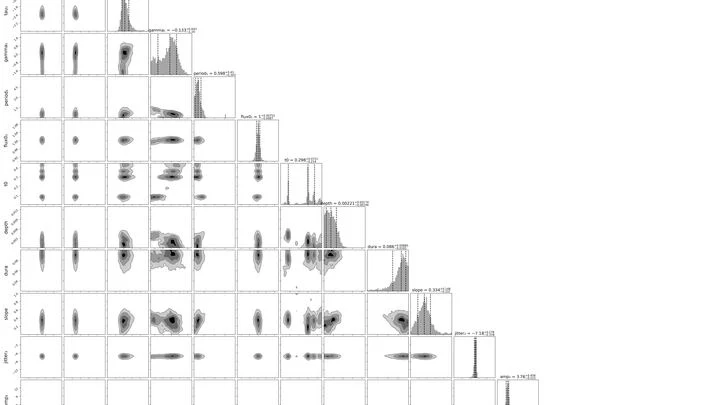
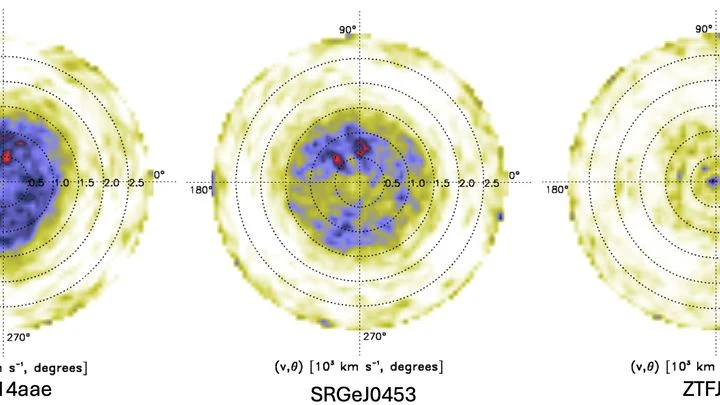
The white dwarf ZTF J1944+4557 plays hide-and-seek: its light dims by 30% every 4 hours 58 minutes. The dust particles here are no smaller than 0.2 microns and they dim all colors of the spectrum equally. But the strangest twist: the pattern of eclipses changes faster than the orbit, and sometimes a
arXiv:2508.18348 · 2025-08-25

Carbon Giant by a Dead Star

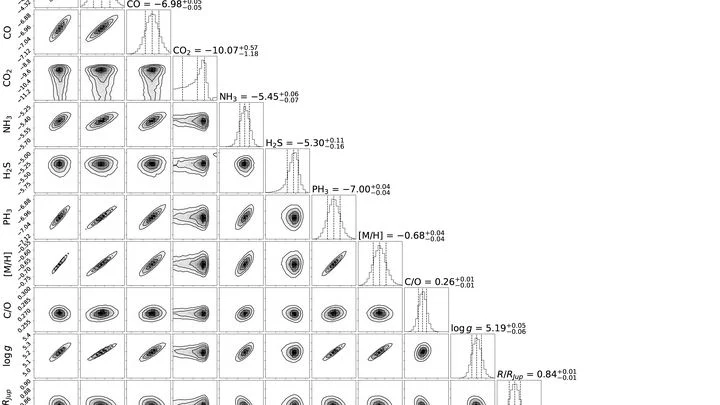
A gas giant the size of Jupiter orbits the pulsar PSR J2322-2650b, heated to 1900°C. Its atmosphere is thick soot of carbon chains, not the usual water vapor. Carbon is a hundred times more abundant than oxygen compared to normal, and ten thousand times more than nitrogen. This doesn't fit the 'blac
arXiv:2509.04558 · 2025-09-04

Seven Stars from One Dough

In the nebula NGC 6334I, a system of seven protostars was discovered in a common gas disk. The disk, like fragile dough, tore apart under its own weight into pieces, and each condensed into a star. Previously, such a mechanism was thought to be common only for binary stars. The discovery proves that
arXiv:2509.06787 · 2025-09-08

Solar Eruption's Magnetic Field 'Heard' for the First Time

By the frequency of radio waves from a cloud of solar gas, scientists directly measured its magnetic field. It turns out that the invisible force is hidden in tangled clumps, not evenly smeared across the cloud.
arXiv:2509.16453 · 2025-09-19

Star Soup from an Ancient Cluster

In cluster M15, the first generation of stars shows a spread in heavy elements, while the second does not. This means the gas for the first stars was poorly mixed. This helps us understand where elements like gold are born: most likely in neutron star mergers, which happen quickly.
arXiv:2509.16840 · 2025-09-20

Failed Star Shakes Up a Phosphine Cocktail

Using Webb, astronomers peered into the atmosphere of the brown dwarf Wolf 1130C and found phosphine — a gas familiar from Jupiter. Its abundance is ten times higher than expected, pointing to vigorous mixing of layers, like in a planetary mixer. Now the boundary between giant planets and brown dwar
arXiv:2510.03916 · 2025-10-04

Comets around an alien star reveal their sizes

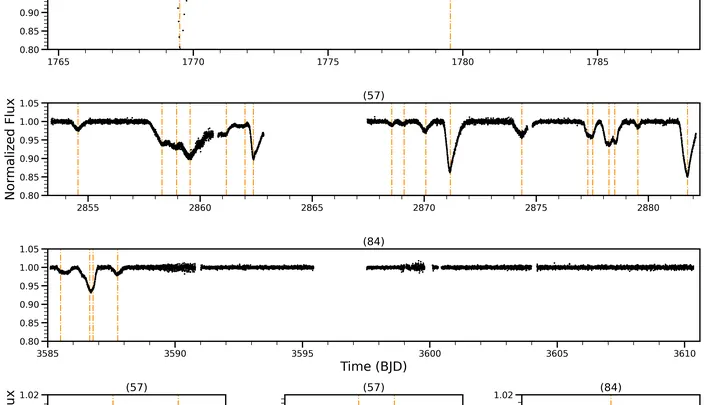
A swarm of comets around RZ Psc briefly dimmed the star's light as they passed in front of it. The TESS telescope caught these dimmings, allowing astronomers to estimate the sizes of these icy bodies—between one and seven kilometers. The size distribution resembled the belt of icy boulders beyond Ne
arXiv:2510.09920 · 2025-10-10

Black Holes Where You'd Least Expect Them: Solving the Mass Gap Mystery

It was thought that the most massive stars explode completely, leaving no black holes, so none exist in the 50 to 130 solar mass range. New observations found several such anomalies with low spin. The reason lies in the nuclear reaction rate inside stars, which shifts the boundaries of what's possib
arXiv:2510.22698 · 2025-10-26

The Hunt for Moons of Rogue Planets

Astronomers analyzed data on the orphan planet WISE 0855 — a dim, cold ball not far away. For 11 hours, Webb watched its light, trying to spot the shadow of a moon. No direct discovery happened, but the method proved its worth. If many rogue planets have Titan-sized moons, we will soon find them.
arXiv:2510.24575 · 2025-10-28

Warm Moons of Rogue Planets

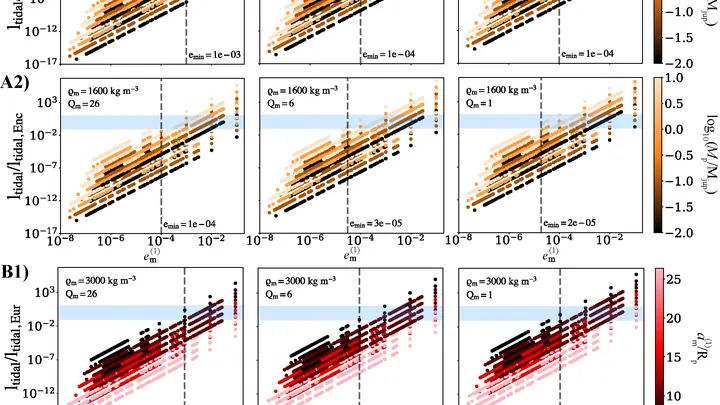
Simulations show that after a planet is ejected by a supernova explosion, all its moons are left on slightly elongated orbits. This triggers constant internal heating — as if the planet endlessly kneads its moons. In 12–15% of cases, the heat is enough for subsurface oceans, like those on Europa and
arXiv:2511.03392 · 2025-11-05

Tiny Black Holes: A New Key to Dark Matter

Dark matter—the universe's invisible mass—might be a swarm of primordial black holes. Scientists have found a way to spot them: a hole with the mass of an asteroid would disrupt the precise ticking of pulsars; a more massive one, crashing into an icy body beyond Pluto, would light up like a searchli
arXiv:2511.04895 · 2025-11-07

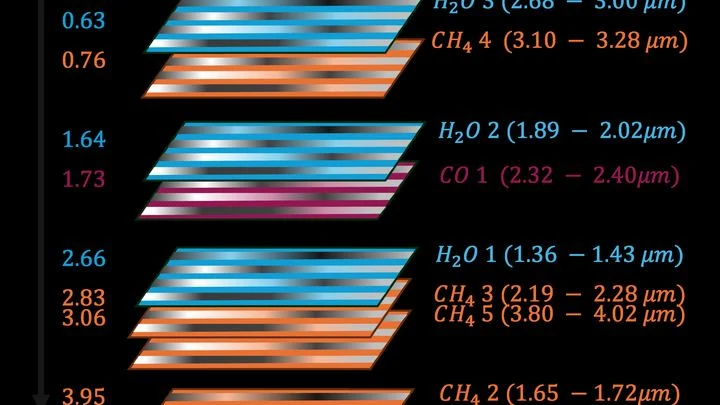
Webb Spots Chemical Weather on Brown Dwarfs

Astronomers studied the twinkling of the binary brown dwarf system WISE 1049AB. For the warmer component, light from methane and carbon monoxide fluctuated more than from water, which can't be explained by clouds. A new mechanism—chemical instability—has been discovered. A 3D map of atmospheric wave
arXiv:2511.15667 · 2025-11-19

Rusty Heart of an Interstellar Comet Makes It Shine

The second known interstellar object, comet 3I/ATLAS, is rich in water and metals. As it approaches the Sun, its ice melts and water triggers the corrosion of metallic dust. Chemical reactions create a luminous envelope unique in composition. Such visitors from other stars help us study the far reac
arXiv:2511.19112 · 2025-11-24

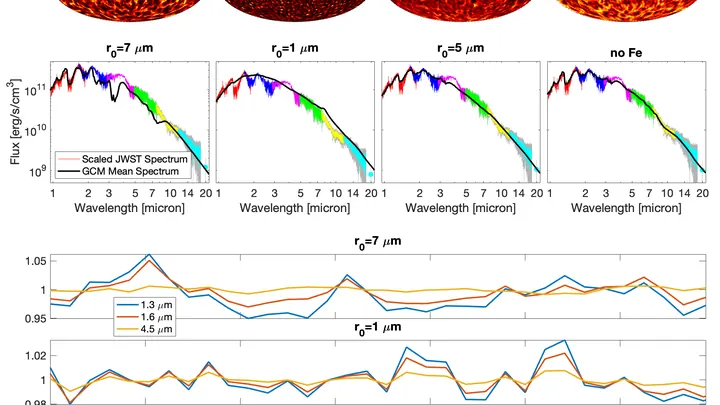
Dust Storms on a Rogue Planet

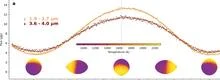
VHS 1256B is a giant planet, drifting alone in the dark. Its brightness swings by 40% due to global storms of scorching sand. Data from the James Webb telescope and computer models showed that dust clouds blanket the planet entirely, explaining the strange changes in its light and color. This discov
arXiv:2511.23163 · 2025-11-28

Solar Magnetic Poles: First Shots from Beyond the Equator

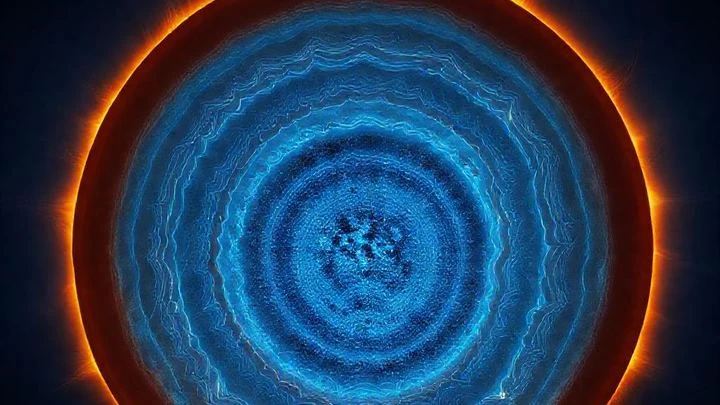
The probe has measured the magnetic field at the Sun's poles for the first time. Previously, a flat view from Earth's orbit hindered observations. Now, climbing higher, it has shown that the north and south poles behave differently. This will help understand solar cycles.
arXiv:2512.03611 · 2025-12-03

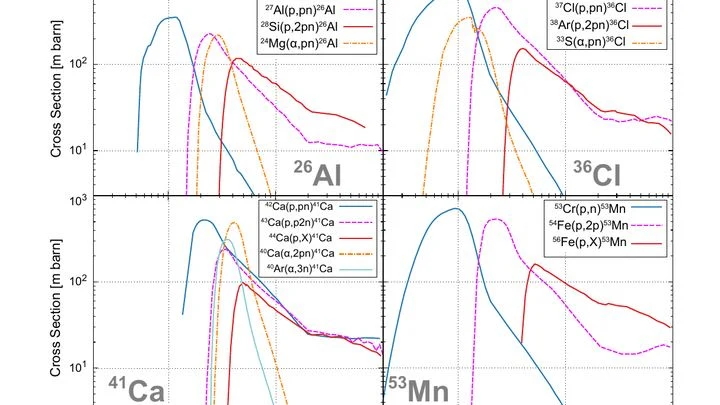
A Nearby Supernova: Recipe for Rocky Planets

Astronomers have found an elegant mechanism: the supernova doesn't destroy the planetary cradle but sends rays that create the necessary radioactive atoms right inside the disk. At a distance of one parsec, it works perfectly. This discovery makes rocky planets common.
arXiv:2512.09660 · 2025-12-10

Mixer Waves of the Solar Wind: How the Corona Heats Up

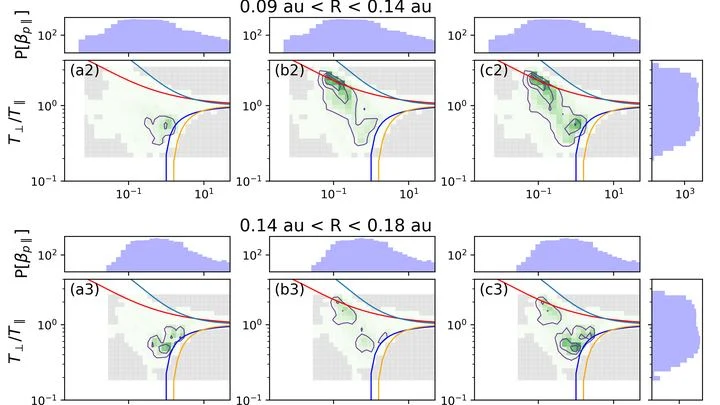
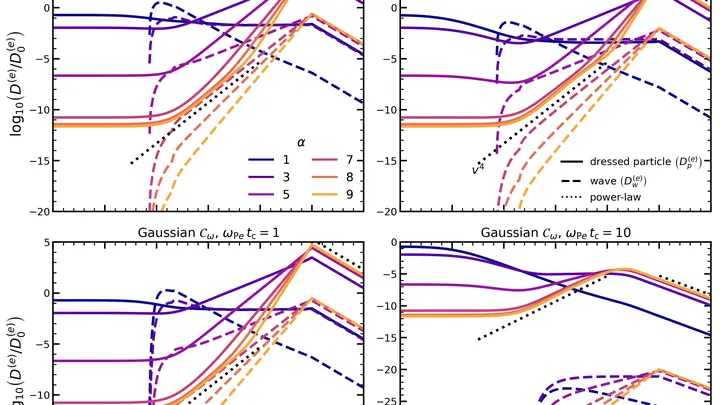
Near the Sun, left-handed mixer waves rage, making the energy spectrum steeper. Right-handed waves are quieter close by but intensify farther out thanks to hot proton streams. This discovery helps predict space weather and understand why the corona is hundreds of times hotter than the surface.
arXiv:2512.11182 · 2025-12-12

A Cosmic Wanderer Steps on the Scales for the First Time

Free-floating planets, untethered to stars, long remained a mystery: without an exact distance, their mass couldn't be measured. By combining telescopes on Earth and in space, scientists calculated the distance to object KMT-2024-BLG-0792 and found its mass—just 0.22 Jupiter masses. It turned out to
arXiv:2601.00057 · 2025-12-31

Giant Star Betelgeuse Gains a Companion

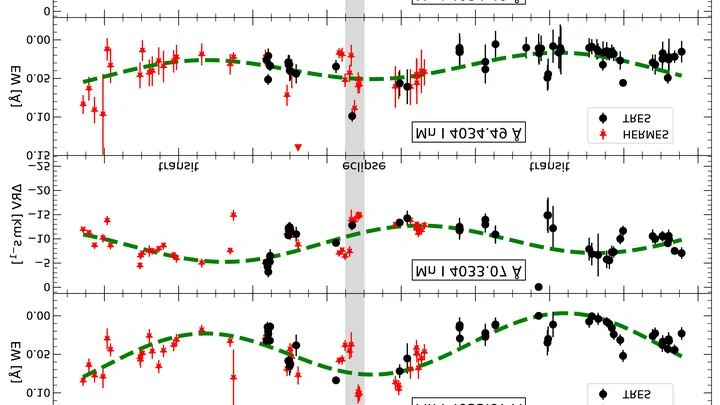
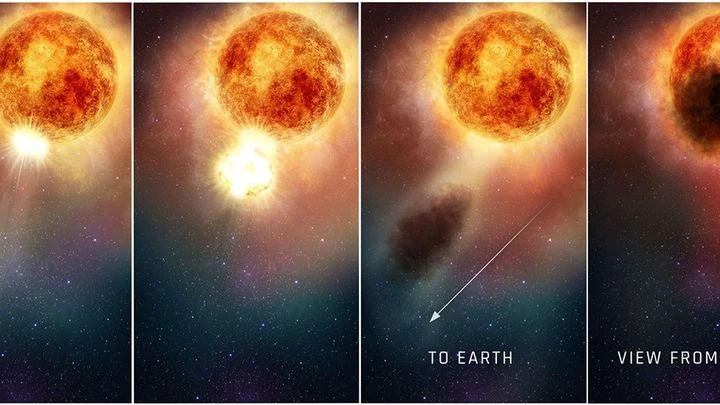
The giant star Betelgeuse may have a companion that dives straight into its outer layers. Every 2000 days, it leaves a gaseous wake, like a boat on water. Amazingly, the giant’s outer shell is cooler than the Sun, so the companion survives. This discovery reshapes our view of how stars behave before
arXiv:2601.00470v1 · 2026-01-01

A Solar Trap for Dark Matter

The Sun’s gravity creates an invisible funnel where dark matter particles not only accumulate but occupy strictly defined energy levels — like electrons in an atom. It turns out that over long observations, some of this matter regains wave synchrony, greatly amplifying the potential signal in detect
arXiv:2601.00955 · 2026-01-02

Hiding in Plain Sight: A Nearby Neutron Star

The star J2354, a few hundred light-years away, has a hidden companion that heats one side of the star. Observations of the star's wobble and light spectrum suggest the companion is a neutron star, firing winds that create a permanent hotspot. This proximity makes it one of the closest neutron stars
arXiv:2601.01755v1 · 2026-01-05

Betelgeuse Is Not Alone: A Stellar Companion Found

Betelgeuse, the star in Orion’s shoulder, was hiding a secret companion. The Gemini North telescope has for the first time spotted a tiny star orbiting within the giant’s atmosphere. The discovery sheds light on the strange dimming in 2019 and refines predictions of the coming supernova.
arXiv:2601.02012v2 · 2026-01-05

Why Magnetic Fields Make Black Holes Quiet

Researchers found: the thicker the disk around a black hole, the rarer objects collide. Magnetic fields puffing up the disk can cut merger rates by billions of times. Astrophysicists must rethink gravitational wave forecasts.
arXiv:2601.02487v2 · 2026-01-05

Wind for the swift: how turbulence heats the solar corona

The theory discovered: chaotic electric fields in plasma, like a sieve, sift fast particles from slow ones, forming a universal 'tail' of super-fast particles. The reason lies in the shielding effect: slow particles wrap themselves in charge clouds and become invisible to the field, while fast ones
arXiv:2601.03344v2 · 2026-01-06

Dance of the Invisible Giants: Gaia Finds a 'Desert' of Brown Dwarfs

Astronomers are reimagining the map of nearby stellar pairs. The zone of tight orbits around Sun-like stars was once called the 'brown dwarf desert,' thought to hold few objects heavier than planets but lighter than stars. Fresh Gaia data reveal that many stars are dancing with unseen companions — a
arXiv:2601.03539v1 · 2026-01-07

The Secret of Neutron Stars: Sizing Them Up

Neutron stars are the densest objects in the universe. Their internal makeup has long been a mystery. A new approach uses mass and radius to pinpoint what’s inside, without relying on assumptions.
arXiv:2601.04294v1 · 2026-01-07

How Giant Black Holes Are Born in the Early Universe

A computer simulation of the early universe revealed: supermassive black holes are born from plump seeds with a million solar masses and grow into giants in mere hundreds of millions of years, explaining the mysterious 'little red dots' seen by the Webb telescope.
arXiv:2601.04955v1 · 2026-01-08

Why Cold Stars Lead Scientists Astray

The light of TRAPPIST-1 revealed that standard models were wrong: in its cold atmosphere, molecules collide differently, hiding the chemical composition. Refining the rules will help us better understand the star itself and its planets.
arXiv:2601.05313v1 · 2026-01-08

Fireworks Called Off: Star Shrouded in Smoke

Some massive stars die without an explosion, quietly collapsing into a black hole. James Webb Space Telescope observations of the suspicious star M31-2014-DS1 showed it didn't vanish: a dusty cloud glows in its place with no X-rays. Possibly it's not a solo death but the merger of two stars shrouded
arXiv:2601.05317v1 · 2026-01-08

How One Supernova United Different Types of Explosions

Supernova PTF12dam changed its appearance right as it was brightening. This prompted astronomers to think: the entire diversity of superluminous supernovae could be explained by the temperature of the ejected material at peak brightness. It turned out that the slower the light rises, the weaker the
arXiv:2601.05363v1 · 2026-01-08

The Quiet Death of a Star

In the Andromeda galaxy, a star faded away without a flash. James Webb and the Chandra telescope saw a dim object in a dust cocoon. This proves that a black hole can be born in the quiet collapse of a star, not just in the fire of a supernova.
arXiv:2601.05774v2 · 2026-01-09

How Giant Planets Kept Their Rapid Spin

Measurements of 32 celestial bodies revealed that giant planets spin almost at the brink of tearing apart because their gaseous cocoon barely slowed them down in their youth. Brown dwarfs, on the contrary, lost spin due to a denser disk. Moreover, planets don't depend on proximity to a star, while c
arXiv:2601.05976v3 · 2026-01-09

How Young Stars' Rotation Destroys Their Magnetic Field

Computer models show that when a star's inner layers spin faster than its outer ones, its large-scale magnetic field collapses into chaos. This explains the variety of magnetic fields in mature stars.
arXiv:2601.05980v1 · 2026-01-09

A Cosmic Lighthouse Born from a Star's Explosion

Years after a supernova flash, astronomers noticed a growing radio signal. By combining several telescopes into a giant antenna, they spotted a tiny, almost stationary source. Everything points to a young pulsar — a spinning neutron star that, like a lighthouse, beams narrow jets of radiation. If co
arXiv:2601.06278v2 · 2026-01-09

Icy Visitor from Another System

ISO 3I/ATLAS is the second known interstellar object. As it approached the Sun, it bared its interior: its icy shell evaporated, revealing a mix of water, carbon dioxide, and carbon compounds. These findings help us understand the chemical makeup of other planetary systems.
arXiv:2601.06759v2 · 2026-01-11

Star Duet Spawns Ripples in Spacetime

A pair of white dwarfs whirls in a deadly dance: one star steals helium from its neighbor, spinning up a glowing disk. The orbit shrinks, energy leaves as gravitational waves. The rate of approach has been measured — the future LISA detector will catch the signal in four years.
arXiv:2601.07925v4 · 2026-01-12

Stellar Bakeries: Two Suns, One Organic Recipe

The ALMA radio telescope peered into the triple system HOPS-288, where three stars are being born. Around two of them, a chemical kitchen is bubbling: warm clouds where complex molecules assemble from icy dust. Astonishingly, the list of these molecules is almost identical for both stars — as if pre
arXiv:2601.08948v1 · 2026-01-13

How Earthly Atomic Nuclei Reveal the Size of Neutron Stars

Neutron stars are among the densest objects, but their exact size long remained a puzzle. Now physicists have found a universal link: the easier it is to deform a lead nucleus in the lab, the softer the matter inside a neutron star and the smaller its radius. Using lab data, scientists calculated th
arXiv:2601.16894 · 2026-01-23

Webb Reveals the Chemical Secret of a Distant Galaxy

Astronomers used infrared light to peer into the core of galaxy IRAS 07251-0248. They found benzene, acetylene, methane, and other hydrocarbons in amounts inexplicable by ordinary gas chemistry. The key clue is cosmic dust: intense radiation, like a jackhammer, shatters dust grains, releasing comple
arXiv:2602.04967 · 2026-02-04

Lithium Dip Found in Unexpectedly Young Stars

In the 35-million-year-old 'Serpens' star cluster, astronomers discovered a 'lithium dip' — a sharp shortage of lithium in stars. It was previously thought that this only occurs after 150 million years. Fast rotation, like a blender, speeds up the destruction of primordial lithium, forcing a rethink
arXiv:2602.07367 · 2026-02-07

A Waterfall of Planets: The Mystery of the Vanishing Water Worlds

The model divides exoplanets into rocky and water worlds. Water worlds with steam atmospheres nicely account for the size gap, but at three Earth radii, their numbers plummet — like water over a cliff. This points to the inevitable capture of light gases by large planets.
arXiv:2602.11923 · 2026-02-12

Cosmic Kitchen: Nuclear Pasta in the Depths of Stars

By modeling a neutron star's crust, scientists discovered that deep down, atomic nuclei stretch into strands and sheets resembling pasta. These layers occupy only 14% of the thickness but account for nearly half the crust's mass. The star's trembling, caused by this pasta, was matched to actual puls
arXiv:2602.19125 · 2026-02-22

How a Swallowed Planet Spun Up a Star

The star GJ 504, similar to the Sun, spins too fast for its age. After devouring a Jupiter-sized planet, it gained extra angular momentum and regained its magnetic youth. A similar case with HD 75332 shows that stellar cannibalism is not uncommon.
arXiv:2602.22979 · 2026-02-26

Dyson Spheres Around White and Red Dwarfs: Calculating the Search

A Dyson sphere is a cosmic blanket that captures all of a star's energy. Scientists have figured out how such a blanket glows around white and red dwarfs: the bigger it is, the cooler it gets. Surprisingly, the hottest blanket comes from the dimmest star. These clues will aid telescopes in the hunt
arXiv:2602.23270 · 2026-02-26

Star Superflares: Warming Planets and Synthesizing Amino Acids

In the lab, a mix of carbon dioxide and nitrogen was bombarded with particles, mimicking the young Sun's era. This produced nitrous oxide and glycine. Nitrous oxide, like a lid on a pot, trapped heat—so early Earth didn't freeze. The same mechanism could warm distant exoplanets where stellar heat is
arXiv:2603.18206 · 2026-03-18

Quasi-stars: Cocoons with a Black Hole Inside

Astronomers have modeled quasi-stars—objects where a black hole hides inside a gas cocoon. When accreting matter rapidly, such a cocoon shines tens of thousands of times brighter than the Sun and lives for millions of years. Comparisons with telescopes show that these cosmic giants may be lurking in
arXiv:2603.21714 · 2026-03-23

Mystery of Cassiopeia star solved after 50 years

X-rays from Gamma Cassiopeiae moved in sync with an unseen white dwarf. This showed that the energy flares when the dwarf pulls matter from the larger star. One in ten such systems hides such a companion, shaping stellar fates.
arXiv:2603.22938 · 2026-03-24

Supernova Exhaled Carbon Monoxide

62 days after supernova SN 2024rbc exploded, its debris revealed an infrared signal from carbon monoxide—a first. It helps explain how cosmic dust is born in the Universe.
arXiv:2603.23877 · 2026-03-25

How Stellar Flares Change the Atmosphere of Faraway Planets

The study examines how radiation from stellar flares affects the air of young planets. Scientists modeled a year of chemical changes and found that moderate flares have a strong impact. Atmospheres with high water vapor content are particularly vulnerable. This discovery is important for correctly i
arXiv:2604.20325 · 2026-04-22

How a Supernova Shoots Out a Lone Spinning Star

A new study explains the origin of lone spinning stars: in a binary pair, a donor star spins up its companion, then explodes, hurling it into space at enormous speed.
arXiv:2604.21402 · 2026-04-23

Webb Found Giants That Turned Darkness into Light

The Webb telescope caught light from two galaxies from the era when the universe was 600 million years old. In that light, scientists recognized the signature of stellar giants: their powerful winds and ultraviolet heat. Comparison with models confirmed that such heavyweights, hundreds of times more
arXiv:2604.21493 · 2026-04-23

Density Staircases Birth Neutrinos Inside Neutron Stars

Just as a strong electric field rips electron-positron pairs out of the vacuum, steep density "steps" deep inside neutron stars create neutrinos and antineutrinos. By catching these messenger particles, scientists can probe superdense matter beyond the reach of any telescope.
arXiv:2604.21968 · 2026-04-23

The Final Symphony of Neutron Stars

New simulations show: before merging, neutron stars twist magnetic fields like strings, generating gamma-ray bursts and radio signals. These precursors will help astronomers prepare for the event and perhaps unravel the mystery of fast radio bursts.
arXiv:2604.22059 · 2026-04-23

The Universe Sings: Resonance of Dark and Ordinary Matter

Scientists have shown that different speeds of dark and ordinary matter create a gravitational resonance. Like a bow on a string, it amplifies sound waves in ordinary matter, explaining the longevity of spiral arms and gas heating. This makes it possible to 'hear' dark matter by its seismic imprint.
arXiv:2604.22665 · 2026-04-24

How Comets Revealed Dark Matter's Secret

When invisible black holes pass through the Oort Cloud, they leave a trail: comets fly off in all directions, some even falling toward Earth. By comparing the actual frequency of comet appearances with calculations, scientists found that black holes a thousand times the mass of the Sun make up only
arXiv:2604.22961 · 2026-04-24

Nuclear Reaction Defines the Abyss for Black Holes

Stellar-mass black holes are almost absent between 60 and 120 solar masses—there yawns an abyss from pair-instability explosions. These blasts completely destroy the star. Where the edge lies is determined by the reaction of carbon with helium. New data: the abyss begins at 61–75 solar masses.
arXiv:2605.07027v1 · 2026-05-07

How Antennas on Earth Hear Solar Flares

Ground-based radio receivers monitor the reflection of very low frequency waves from the ionosphere. A flare changes the ionosphere—and the signal distorts. The method is reliable, cheap, and fast, helping protect power grids and communications.
arXiv:2605.11822 · 2026-05-12

How to Hear a Planet Near a Dead Star

Simulations show that a planet buffeted by a pulsar's wind generates radio waves. This means exoplanets around neutron stars can be detected by their radio glow. The method has been tested on the system PSR J0636+5129 b.
arXiv:2605.14077 · 2026-05-13

The Comet That Wanted to Ignite the Sun

In 2011, Comet Lovejoy passed through the solar corona. Almost immediately, instruments recorded a bright flare. Scientists calculated that the comet's energy was 10–1000 times less than needed for such a flare. Probably, comets don't cause explosions themselves, but can trigger ones that are alread
arXiv:2605.18280 · 2026-05-18

The Kilometer Barrier: Why Tidal Disruption of Asteroids Leaves Only Boulders

When a white dwarf tears apart a passing asteroid, we expect a dust cloud. But new analysis flips the picture: particle cohesion — those very van der Waals forces that hold sand grains in your palm — erects a kilometer barrier. Fragments smaller than hundreds of meters simply cannot be born during t
arXiv:2606.02457v1 · 2026-06-01

Smoldering Ember in a Star’s Heart: Two Apocalypse Scenarios

These objects are one of the biggest mysteries and a possible key to dark matter. New modeling has revealed a rare but spectacular scenario with two outcomes for capture by a binary system. Without an accretion disk, the star fades unnoticed; with a disk, it is torn apart by relativistic jets in min
arXiv:2606.02700v1 · 2026-06-01

Molecular Rope in the Cradle of Planets

In the disk of TW Hydrae, resembling the early Solar System, HC5N has been detected — the longest carbon chain in such an object. The ALMA discovery shows that prebiotic compounds are not destroyed in the planetary forge. Models point to an excess of carbon, linking the disk's chemistry with interst
arXiv:2606.02815v1 · 2026-06-01

Erythrulose: The First Sugar Baked in an Interstellar Furnace

Spectral lines of erythrulose (C₄H₈O₄), caught by the Yebes 40m and IRAM 30m radio telescopes, betrayed the presence of this sugar in the cloud G+0.693. For the first time, we see how, in the interstellar medium, on the surface of icy dust grains, components of nucleic acids are born from glycolalde
arXiv:2606.03313v1 · 2026-06-02

Steam from Scorching Rocks: Silicon Gas in the Atmosphere of TWA5B

The CRIRES+ spectrograph on the Very Large Telescope captured the faint light of the young super-Jupiter TWA5B and resolved the SiO lines—the main carrier of gaseous silicon. The detection with a signal-to-noise ratio of 7.5 means: silicon almost entirely floats in the gas phase, not locked in silic
arXiv:2606.03824v1 · 2026-06-02

Cosmic Waltz: How a White Dwarf Became a Radio Beacon

The system ASKAP J1745−5051 is a close binary where a magnetic white dwarf strips material from a red dwarf every 1.37 hours. The resulting radio bursts are so powerful that their brightness temperature exceeds 10^12 K, requiring a coherent emission mechanism — a cosmic analog of a laser. Spectrosco
arXiv:2606.04232v1 · 2026-06-02

Dark mountains of neutron stars: gravitational waves probe dark matter

Researchers combined a two-fluid model of neutron stars with fermionic dark matter and results from the search for continuous gravitational waves by the LIGO detectors. An anisotropic distribution of dark matter can create 'dark mountains' — quadrupole deformations that amplify emission. Comparison
arXiv:2606.05082v1 · 2026-06-03

Ultraviolet Trap: How TRAPPIST-1 Star Fakes Signs of Life

TRAPPIST-1 e is a rocky planet in the habitable zone of a red dwarf, one of astrobiologists' prime targets. But decoding its atmosphere requires a precise ultraviolet 'autograph' of the star. Simulations showed: different UV spectra dramatically alter the chemical portrait, producing deceptive pairs
arXiv:2606.05451v1 · 2026-06-03

Magnetic Thermos of Stars: Birth of a Micronova

In the tight binary system IGR J17014-4306, astronomers recorded an optical flare of a micronova — a localized thermonuclear explosion on a white dwarf. Over 1.56 days, it released 3.25×10³⁸ erg of energy, equivalent to burning a hydrogen column the mass of a small asteroid. This brought the rare cl
arXiv:2606.06305v1 · 2026-06-04

The Flare's Fiery Heart: Ions Race Along Magnetic Lines

Solar flares crank temperatures up to millions of degrees, but iron ions move much faster along magnetic lines than across them. An international team, analyzing nearly 4,600 spectra from the Japanese Hinode satellite, proved for the first time that line broadening is driven not by turbulence but by
arXiv:2606.06577v1 · 2026-06-04

Cosmic Prospector: Sifting Stars in Search of Life

Where to look for intelligent brothers? A new parametric filter of seven criteria rejects stars unable to support complex life. From Gaia DR3's 1.74 million stars, it eliminated 55.4%, retaining 777,835 priority targets — mostly G and K dwarfs. Key rejection factors: low metallicity and youth. Notab
arXiv:2606.06692v2 · 2026-06-04

The Rapids of a Black Hole: The Birth and Death of Blanets

In the turbulent disks of active galactic nuclei, blanets form—giant planets of incredible density. Drifting toward the central black hole, they are torn apart by tidal forces, generating brief but dazzling flares in optical and ultraviolet light. Their density allows them to approach the horizon of
arXiv:2606.06884v1 · 2026-06-05

The Color Key to the Ultraviolet Excess: Ghost Stars from Globular Clusters

The mystery of the ultraviolet 'hump' in the spectra of elliptical galaxies has found an unexpected solution: it's created not by natives, but by immigrant stars from destroyed globular clusters. Analysis of Hubble images in four filters revealed radial color gradients sensitive to helium and nitrog
arXiv:2606.07751v2 · 2026-06-05

The Celestial Forge: How Proton Beams Take the Shape of a Hammer

Data from the Parker probe, plunging into the very furnace of the solar wind, brought a mystery: proton beams there often have a hammer shape. To understand how this happens, scientists ran hybrid simulations, treating protons as particles and electrons as a fluid. By comparing two regimes differing
arXiv:2606.07838v1 · 2026-06-05

Message from the Invisible World: FAST Listens to Axions

Axions are ghostly particles, candidates for dark matter, capable of explaining both the hidden mass of the Universe and the violation of strong interaction symmetry. In the monstrous magnetic fields of neutron stars, they can momentarily become light — a radio pulse at a precisely defined frequency
arXiv:2606.17067v1 · 2026-06-05

Heavy water ice found in planet-forming disk

The Webb telescope directly observed heavy water ice for the first time in a planetary disk—the birthplace of planets. There's unexpectedly a lot of it, pointing to a turbulent history of the ice that might explain the origin of Earth's oceans.
arXiv:2606.10888 · 2026-06-09

Twisted Solar Loop Reveals the Secret of Magnetic Explosions

A solar magnetic loop, twisted by 540 degrees, snapped at one end alone, spewing hot gas and hard X-rays. This proves that magnetic reconnection accelerates particles and heats the corona. Scientists found a pattern: the frequency of plasma pulsations directly indicates the strength of the magnetic
arXiv:2606.13953 · 2026-06-11

Solar Neutrinos in a Dark Matter Trap

Scientists from the XENONnT collaboration have shown that ultrasensitive detectors built to hunt dark matter can spot neutrinos born from thermal motion in the Sun's core. The energy of these particles is like a dust speck tossed by the wind, once thought nearly invisible. The method lets us study t
arXiv:2606.15904 · 2026-06-14

The Mystery of Eclipse Shadow Bands Solved

Shadows resembling ripples from a tossed pebble arise from light's wave nature. The edges of the solar crescent act as two sources, creating interference. This discovery lets us measure air turbulence from the bands.
arXiv:2606.28366 · 2026-06-14

Young Stars: Gamma Rays from Jets

It turns out young stars don't just warm their cradles but also emit gamma rays. This happens when their jets, like from a hose, slam into clouds of gas and dust. Now we can peer through the dust into the hidden processes of planet birth.
arXiv:2606.19445 · 2026-06-17

The Earth may survive when the Sun becomes a giant

The main enemy here is not heat, but gravity. If the Sun sheds mass fast enough, Earth will retreat to a more distant orbit. Judging by observations of similar stars, we have a pretty good chance.
arXiv:2606.19575 · 2026-06-17

A Black Hole's Corona Blazes Like the Sun's

X-ray telescopes caught a double flare from the black hole in galaxy NGC 3783: first hard radiation, then soft. On the Sun, that pattern signals magnetic reconnection. The black hole also blasted out a stream of gas, akin to solar eruptions but billions of times stronger. For the first time, it's be
arXiv:2606.25636 · 2026-06-24

Fog Passes Off Tiny Black Holes as Giants

The Webb telescope spotted red dots that look like galactic cores with enormous black holes. But a fresh analysis suggests they might be modest-sized objects wrapped in a dense gas cocoon. Just as fog makes a lantern seem like a huge red ball, the gas distorts our estimates. Inside, there may not be
arXiv:2606.30711 · 2026-06-29

The Chameleon Star: Where Did Theta Eridani's Brightness Go?

Astronomers discovered that the Theta Eridani system contains three stars, with two inner ones locked in a tight dance. One star ran out of hydrogen fuel, swelled up, and wrapped its companion in a gaseous blanket. Friction inside this cloud triggered a bright flash that lasted for centuries. The fi
arXiv:2606.30748 · 2026-06-29

The Universe's Foundry: Kilonova Dust and the Birth of Gold

Astrophysicists have discovered that dust grains of refractory elements—tungsten and osmium—form in the ejecta of a kilonova. Their near-blackbody infrared emission perfectly matches JWST data for kilonova AT2023vfi. Simulations of cluster growth and radiative transfer confirmed the rapid formation
arXiv:2607.00433v1 · 2026-07-01

The Universe Isn't Getting Younger: Ancient Stars Rule Out "Early" Solutions

Astronomers led by Indranil Banik analyzed 155,600 subgiants from the LAMOST and Gaia catalogs. Bayesian age reconstruction revealed the oldest star at 13.73 billion years. Adding 0.2 billion years for the formation of the first stars gives a Universe age of about 13.93 billion years—a perfect match
arXiv:2607.00764v1 · 2026-07-01

The Hourglass of an Ancient Galaxy: JWST Spots Maturity That Arrived Too Soon

Analysis of images from JWST and Hubble with NIRSpec spectroscopy has revealed details of a distant disk galaxy at z=0.92. Multi-component modeling showed that an X-shaped bulge 4.5 kpc long and a bar of about 12 kpc were already present when the Universe was only 6.2 billion years old. A total stel
arXiv:2607.00982v1 · 2026-07-01

Smoldering Giant: Methane and Haze over a Dead Star

The James Webb Space Telescope has peered into a previously unseen world: the atmosphere of the giant planet WD 1856 b, orbiting a white dwarf. The transit spectrum from 0.5 to 5.0 μm revealed hydrocarbons, including methane with a significance of 17:1 to 30:1, thick aerosols, and thermal glow from
arXiv:2607.01316v1 · 2026-07-01

Galactic Recipe: How the Sun Stopped Being Special

Astrophysicists analyzed ultra-precise spectra of 79 solar twins and concluded: most Sun-like stars acquired their chemical makeup naturally—through Galactic evolution. Only a few candidates show signs of exoplanet ingestion. This confirms that our star is not an exception but a typical product of i
arXiv:2607.01699v1 · 2026-07-02

Sulfur Anomaly: B[e] Supergiant as a Photochemical Reactor

Using ALMA radio telescopes, astronomers peered into the vicinity of the extremely rare B[e] supergiant HD 87643 and found a rich array of sulfur-bearing compounds. The anomalously high concentration of SO₂ and the unusual sulfur isotope ratio indicate rapid photochemical processing of gas, as if in
arXiv:2607.02191v1 · 2026-07-02

Cosmic Kick: Warm Orphans Born from Stellar Death

Analytical estimates and numerical simulations show that kicks during white dwarf formation directly liberate only ~1% of known exoplanets, but in multi-planet systems they trigger dynamical instability in 40–47% of cases, leading to planet ejections. These free-floating planets are heated to up to
arXiv:2607.02653v1 · 2026-07-02

Gravitational Infancy: Record Orbits in the Cradle of HD 114082

310 light-years from Earth, astronomers have found a remarkable system: a 15 million-year-old star surrounded by two transiting gas giants with record-long orbits of 225 and 314 days. Observations with TESS, CHEOPS, and ground-based telescopes measured their radii and set upper limits on their masse
arXiv:2607.02685v1 · 2026-07-02

Cosmic Metronome: Binary Stars Search for Axion Dark Matter

Astrophysicists have proposed a method to search for ultralight axions — dark matter candidate particles — using high-precision polarimetric observations of close binary stars. In such systems, light reflected from the companion star's atmosphere creates a weak linear polarization strictly tied to t
arXiv:2607.04550v1 · 2026-07-05

The Unmixed Cocktail: Why Double Diffusion Is Powerless in the Interiors of Giant Planets

A new study has, for the first time, self-consistently incorporated the recipe of double diffusion into an evolutionary code of planets and traced the fate of Jupiter and Saturn from the moment of formation. It turns out that even a thousandfold enhancement of mixing does not lead to significant sme
arXiv:2607.04629v1 · 2026-07-06

Stellar Nurseries in the Jet's Shadow: JWST Explores Centaurus A

Centaurus A is the nearest radio galaxy to us, where an active supermassive black hole lives at its center, shooting out a powerful jet, while a warped dusty disk whirls around it. For a long time, it remained a mystery whether stars could be born under such extreme conditions. New observations with
arXiv:2607.04942v1 · 2026-07-06

Waltz of Invisible Moons: The First Spectroscopic Find

Astronomers have discovered planetary-mass moons around a brown dwarf for the first time using high-precision spectroscopy. Observations with the VLT and the CRIRES+ spectrograph revealed periodic wobbles in the radial velocity of the starlike object CD-35 2722 B, hinting at at least one moon about
arXiv:2607.05193v1 · 2026-07-06

The Arrow Piercing the Disk: Recipe for an X-ray Flare

When a wandering star slams into the accretion disk of a supermassive black hole at immense speed, a quasi-periodic X-ray flare is born — a cosmic firework capable of outshining a galaxy. For the first time, 3D radiation hydrodynamics simulations systematically linked the collision parameters — star
arXiv:2607.05508v1 · 2026-07-06

Globular Clusters: A Palimpsest of Ancient Gas Clouds

For decades astronomers puzzled over mysterious anti-correlations of light elements in globular clusters. New research based on high-resolution cosmological simulations shows: the chemical anomalies could have arisen long before the birth of the cluster's first stars—in giant gas clouds. This scenar
arXiv:2607.05509v1 · 2026-07-06