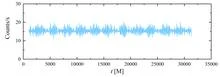
A light curve is a graph showing the brightness of an astronomical object as a function of time. It is a fundamental tool in astrophysics for studying variability, revealing the periodic or irregular changes in luminosity that arise from rotation, pulsation, eclipses, or explosive events. The research titles highlight its use in diverse contexts: from the chaotic flickering of black holes ('Мелодия беспорядка: как свет чёрной дыры выдаёт хаос') to the heartbeat-like pulsations of stars ('Ковёр из сердцебиений') and the mysterious dimming of quasars ('Почему квазары мерцают не так, как мы думали').
History
The first light curves were produced in the 19th century for variable stars like Algol, whose periodic dimming was correctly attributed to eclipses by a companion star. The development of photography and later electronic detectors allowed for more precise and continuous measurements, leading to the discovery of many classes of variable objects.
How it works
To construct a light curve, astronomers repeatedly measure the flux of an object over time, often using photometric observations in different wavelength bands. The resulting data points are plotted, and analysis techniques such as periodograms or machine learning algorithms (as in 'Мелодия, гармония, ритм: как ИИ учится слушать звёздную музыку') are used to identify periodicities, trends, or sudden changes. The shape of the light curve encodes physical information: for example, a periodic dip might indicate a transiting exoplanet, while a sharp spike could signal a supernova or gamma-ray burst.
In practice
Light curves are essential for discovering and characterizing exoplanets via the transit method, for classifying supernovae, and for monitoring active galactic nuclei. They also underpin the study of stellar pulsations in asteroseismology, which helps determine the internal structure of stars.
Fun fact
The light curve of a black hole can exhibit chaotic behavior, and analyzing its 'melody' can reveal the presence of a singularity, as suggested by the title 'Пульс чёрной дыры: как сингулярность раскрывает её состояние'.
Think of a merry-go-round: the farther you sit from the center, the faster you're carried around. For a long time, astronomers assumed galaxies work the same way — stars at the edges should orbit more slowly than those near the center. But back in the 1970s, it turned out that in many spiral galaxies, the speed of stars barely drops with distance from the center.
The depths of space are not silent — they are full of encrypted messages. Every star, every quasar sends its flickering light code: rhythmic like the Morse of a Cepheid, or chaotic like a cracked cipher of a supernova. Astronomers intercept these signals by the millions each night — but how to read them without a key?
For centuries, astronomers gazed at the night sky, catching the slightest changes in stellar brightness. These uneven sequences, light curves, are like musical staves: each star performs its own unique melody.
A candle flame in a draft dances: now it flares up, now it almost goes out. Quasars behave much the same way — supermassive black holes in the centers of distant galaxies, surrounded by a scorching disk of infalling matter. Only they flicker not over seconds, but over months and years.
A flashlight doesn't cast a uniform circle of light; it has a bright spot in the center and a blurred halo at the edges. If you switch it off quickly, the edges are the last to fade, and by how the light dies, you can guess the shape of the reflector.
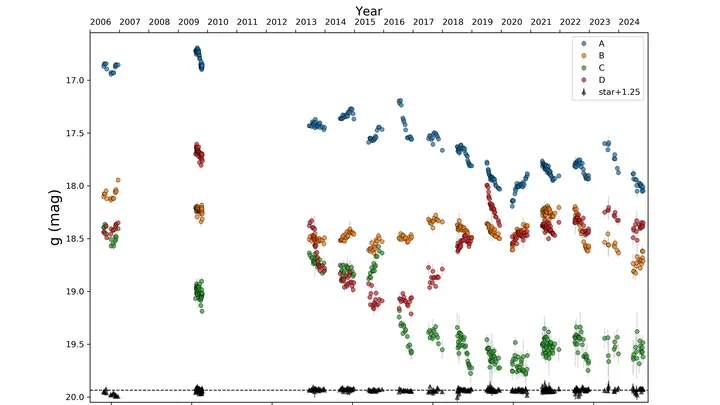
A distant quasar appears as four points of light arranged in a cross. This is how the gravity of a galaxy lying along our line of sight distorts the view: it acts like imperfect glass, multiplying the image. Each point is the same object, but its light travels different paths.
If a supermassive black hole lives at the center of a galaxy, it heats the infalling gas to incredible temperatures. That gas glows, and we see it as a quasar — the brightest beacon in the universe. But how do you measure the size of the light source itself?
Long before stars appeared, the universe was filled with cold hydrogen. This gas can 'sing'—emitting radio waves with a wavelength of 21 centimeters. When the first stars and galaxies ignited, their ultraviolet light began to strip electrons from hydrogen atoms, turning neutral gas into ionized gas.
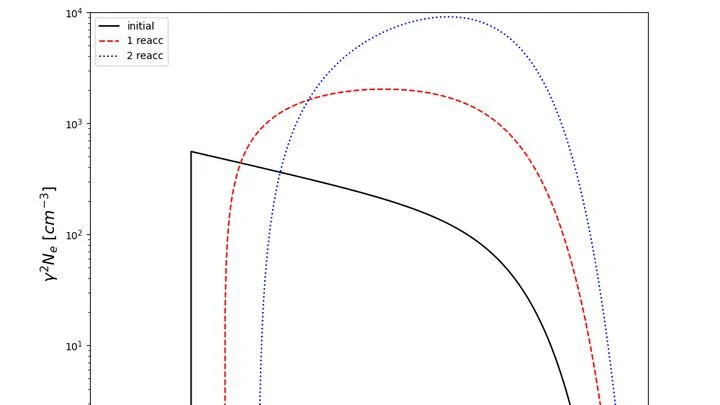
A blazar is a distant galaxy with a plasma jet shooting from its center, aimed almost directly at us. Inside this jet, particles are accelerated to near-light speeds and emit powerful radiation.
A quantum walk is like a drunk person who turns randomly at every intersection. Except instead of streets, there are graph nodes, and instead of steps, there are quantum transitions. Scientists have discovered that such a walk has a hidden measure — Krylov complexity.
Gamma-ray bursts are the most powerful explosions in the Universe: a dying star collapses into a black hole, ejecting streams of energy. Often this happens after a supernova flare. But astronomers caught a strange rhythm — in the emission of 34 such bursts, clear pulsations appeared, like beats of a cosmic heart.
In 2019, the Event Horizon Telescope gave humanity the first image of a black hole's shadow. Since then, astrophysicists have dreamed of more: seeing how matter moves in the very funnel of spacetime. One of the mysteries is chaos.
The galaxy NGC 1560 is a modest island of stars and gas ten million light-years away. Its rotation curve, first measured in 1991, became an icon for those seeking an alternative to dark matter. The plot of rotation speed versus radius shows bends that seem to exactly mirror the bends in the distribution of ordinary matter.