The orbital period is the time taken for a celestial body, such as a planet or moon, to complete one full orbit around another body, typically a star or planet. This fundamental quantity is governed by Kepler's laws of planetary motion and Newton's law of universal gravitation. The orbital period is not constant for all bodies; it depends on the mass of the central object and the distance of the orbiting body, with closer objects orbiting faster. In exoplanetary science, measuring orbital periods is crucial for understanding planetary system architecture, stability, and the presence of resonances.
History
The concept of orbital period was formalized by Johannes Kepler in the early 17th century, who derived his third law relating the period to the semi-major axis of an orbit. Isaac Newton later provided a theoretical foundation with his law of gravitation.
How it works
The orbital period is determined by observing the periodic motion of a body. For exoplanets, this is often done via the transit method, where a planet passes in front of its star, causing a periodic dip in brightness. The time between successive transits gives the orbital period. Alternatively, radial velocity measurements detect periodic shifts in a star's spectrum due to the gravitational tug of an orbiting planet. These observations, combined with Kepler's third law, allow astronomers to calculate the orbital distance and infer the planet's properties.
In some binary star systems, the orbital period can be as short as a few hours, while planets around distant stars can have periods lasting hundreds of years, such as the hypothesized companion to Betelgeuse.
Cepheids are stars that pulsate with remarkable regularity: their brightness changes like a lighthouse beam, and the pulsation period is linked to the star's average density. In binary systems where a Cepheid is eclipsed by its companion, astronomers can precisely measure the star's radius and mass.
Tabby's Star, a beacon in the cosmic sea, has baffled astronomers since 2015. Its light flickered not in the rhythm of planets, but as if scattered by a storm — deep dips, sharp spikes. But amid this chaos, a smooth, nearly perfect dip was found. The eye of the storm.
The spiral of water draining into a sink spins faster and faster toward the center. In an ordinary black hole, that funnel ends in an infinitely sharp point — a singularity where the laws of physics break down. But this new work considers a different picture: the funnel doesn't taper to a needle but ends in a smooth, swelling bubble.
In 2022, astronomers began discovering strange cosmic beacons — long-period radio transients. Unlike fast pulsars, discovered by Jocelyn Bell Burnell in 1967, these objects flared with periods of tens of minutes and hours.
A research probe is planned for the nearest black hole — a region of spacetime whose gravity traps even light. After a hundred years of flight, the spacecraft will enter orbit around the mysterious object to answer a key question: are we looking at a black hole or a neutron star — the ultra-dense remnant of a massive star, compressed to nuclear…
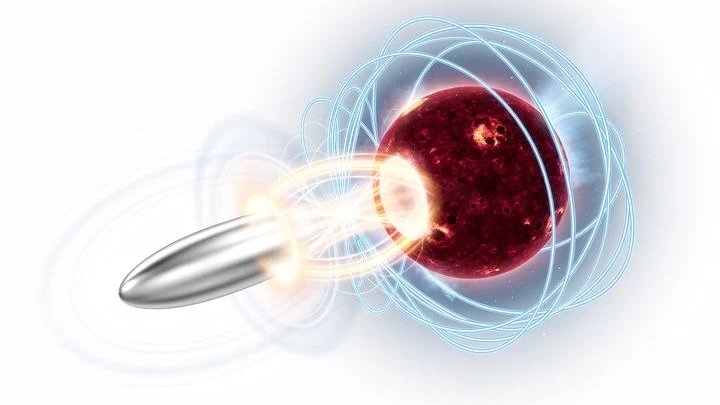
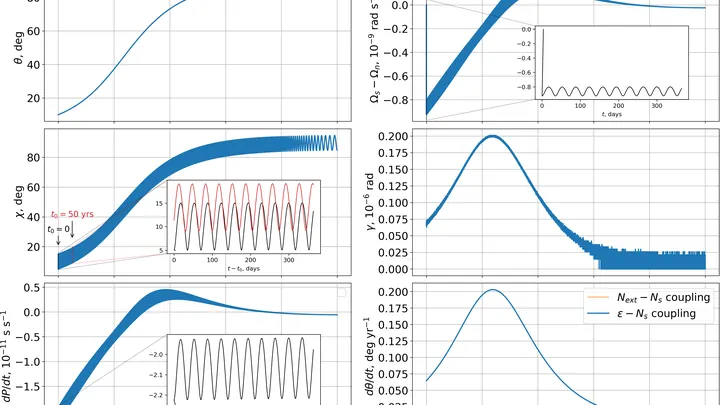
A spinning top that wobbles as it rotates: that's roughly how astronomers picture the neutron star in the binary system Hercules X-1. It completes one full turn on its axis every second, but its axis slowly traces a cone with a period of 35 days.
At the edge of the solar system, far beyond Neptune, hundreds of icy chunks circle the Sun. Some of them move as if an invisible hand had aligned their orbits like compass needles. Ten years ago, this led astronomers to suspect that a massive planet, about ten times heavier than Earth, is hiding there.
The carousel spins all the horses in one direction, but one stubbornly gallops against the flow. That's exactly how the planet TOI-1710 b behaves around its star. Using the HARPS-N and GIANO-B instruments, astronomers measured its tilt at 149 degrees. That's nearly a 180-degree flip, meaning the planet orbits "backward" relative to the star's rotation.
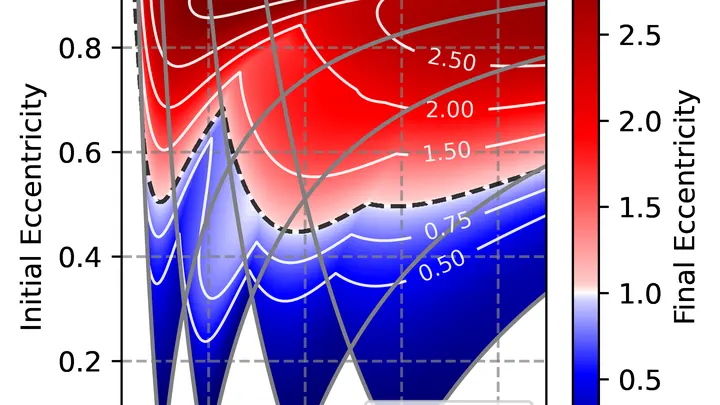
The Kepler telescope spent years watching thousands of stars, spotting planets by the tiny dips in starlight when a planet passes in front of its star. Such a passage, or transit, lets us measure the planet's size but not the shape of its path.
Interstellar wanderers are rocks and icy chunks that have broken free from their home planetary systems and now drift through the Galaxy. The first such visitor, 'Oumuamua, zipped past the Sun in 2017, followed by Comet Borisov and the ATLAS object. Where do they come from?
Astronomers have discovered a close pair of stars whose orbital dance is speeding up year after year. These are white dwarfs — superdense, cooled remnants of stars, roughly the size of Earth, where matter is compressed to a degenerate state.
Two stars, drawing together in a cosmic dance, experience an extra wobble — a consequence of spacetime curvature (an effect predicted by Einstein). A planet orbiting them also wobbles. Sometimes the rhythms align: the gravitational tugs from the stars fall in step with the planet’s orbit, like hands pushing a swing.
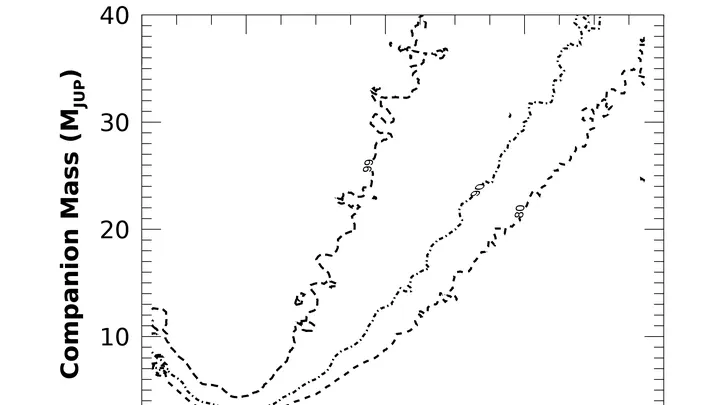
The hunt for exomoons — the search for satellites around planets of other stars — resembles watching shadows in a theater where the spotlight keeps fading and flaring. The planet Kepler-167e, a gas giant near a scorching star, was discovered by William Borucki and his team.
The three planets in the Kepler-51 system have long intrigued astronomers: they are Saturn-sized but less dense than water. These 'super-puff' worlds, with masses no more than ten Earths, are like cosmic dandelions — massive yet almost weightless. Their orbits are arranged like musicians in an orchestra, each playing its part, beating the rhythm with transits.