A telescope is an instrument that collects and focuses electromagnetic radiation to observe distant objects. While the word often evokes optical instruments, modern telescopes operate across the entire electromagnetic spectrum — from radio waves to gamma rays — and even detect gravitational waves and particles. The key function is always the same: gather more radiation than the naked eye can, concentrate it, and form an image or a spectrum.
History
The first telescopes were built in the early 17th century, with Hans Lippershey applying for a patent in 1608 and Galileo Galilei making his own in 1609. Isaac Newton built the first practical reflecting telescope in 1668.
How it works
Optical telescopes use lenses or mirrors to collect light and bring it to a focus. Refracting telescopes use lenses; reflecting telescopes use curved mirrors, which avoid chromatic aberration and can be made much larger. For other wavelengths, the design changes: radio telescopes use large dish antennas, X-ray telescopes use grazing-incidence mirrors, and gamma-ray telescopes rely on particle detectors. The larger the collecting area, the fainter the objects that can be seen, and the sharper the resolution.
In practice
Telescopes are used in astronomy to study planets, stars, galaxies, and cosmic phenomena, as well as in Earth observation, satellite tracking, and even in some laser communication systems.
Fun fact
The largest optical telescope mirrors are over 8 meters in diameter, but the largest radio telescope, FAST in China, spans 500 meters — bigger than 30 football fields.
In a benzene molecule, electrons buzz around the nuclei like a swarm of bees around a hive. But this swarm doesn't just hum: it pulses: every 856 attoseconds, the electron cloud completes a full oscillation cycle. The hive itself, the carbon nuclei, rocks more slowly, with a period of 36 femtoseconds.
A flashlight beam in a dark room can hold a dust mote almost still: that's how optical tweezers work. But light doesn't just push the particle; it also jostles it with random kicks. Each absorbed photon strikes it like an invisible hammer. The authors of the new study have devised a light trap of a special shape.
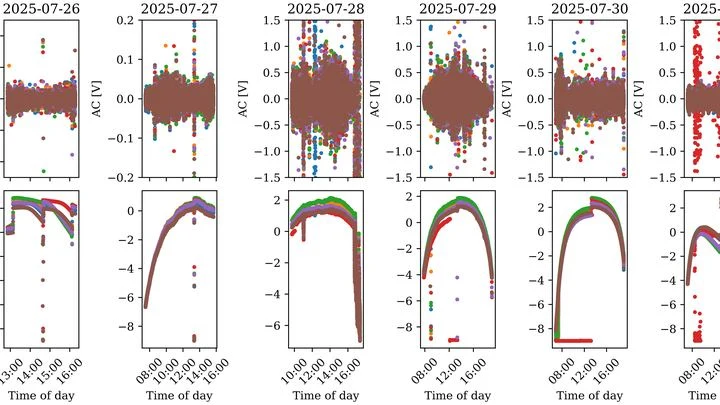
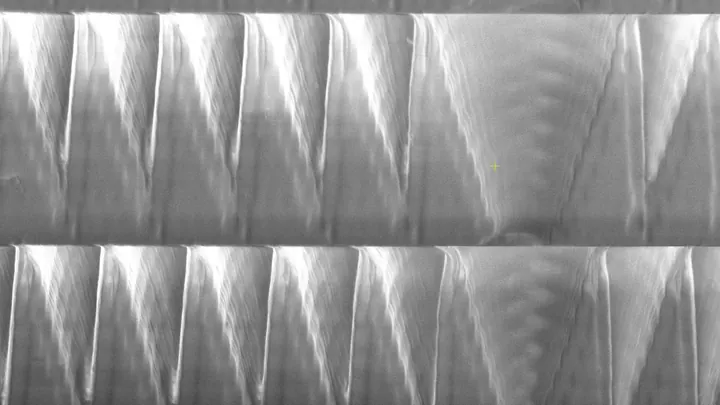
By day in Chile's Atacama Desert, the air shimmers with heat like the haze above a hot skillet. Sunlight passing through this shimmer begins to dance and flicker. Astronomers call this airy trembling "seeing" — and it keeps telescopes from getting a sharp view of the stars.
To fight this nuisance, engineers have built a special instrument — a solar seeing monitor.
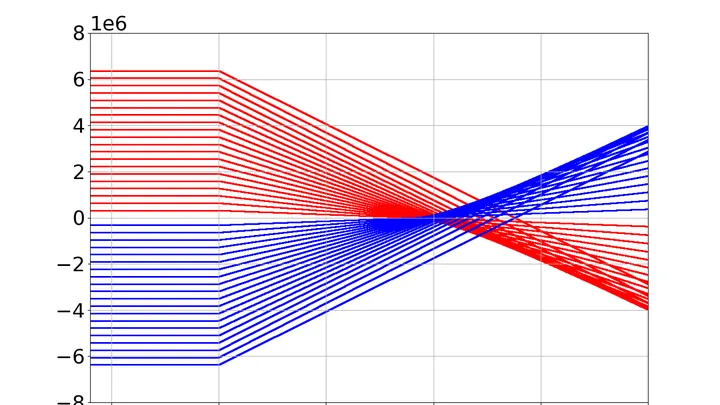
Light from distant stars travels for millions of years, but X-rays can't be caught with ordinary glass: they pass right through it like a bullet through paper. That's why X-ray telescopes need special lenses: stacks of tiny prisms that gently deflect the rays and focus them to a single point.
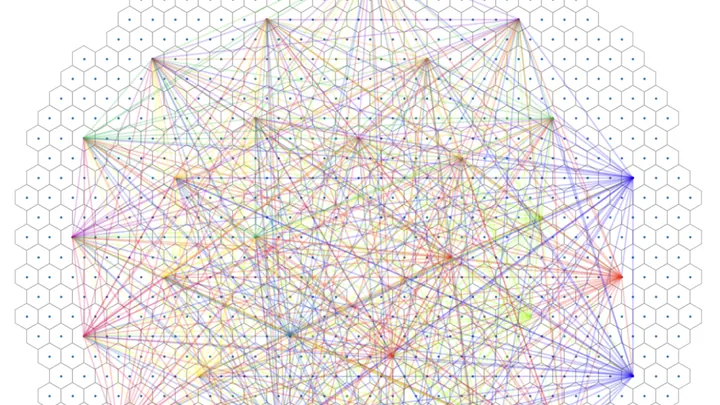
Light from a star travels for millions of years, yet in a telescope it still appears as a point: it's just too far away. To see a star's surface, you need an instrument the size of a city. In Chile, such a giant is already under construction: ELT with a 39-meter mirror made of 798 hexagonal segments.
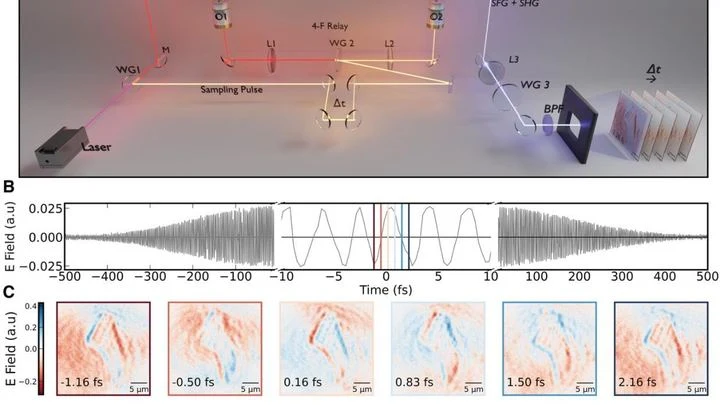
Light is not just a beam but a wave with an electric field that changes at a speed unimaginable to ordinary clocks. Until now, this field could only be measured at a single point, like taking temperature with a single thermometer. Now researchers have created a method that shows the entire field at once, like a thermal imager showing a heat map.
A tiny needle glides over the surface like a finger over a page written in Braille. That's how a scanning tunneling microscope works: it feels the atomic landscape and turns bumps into a picture. But when you need to add a magnetic field, the design hits a wall.
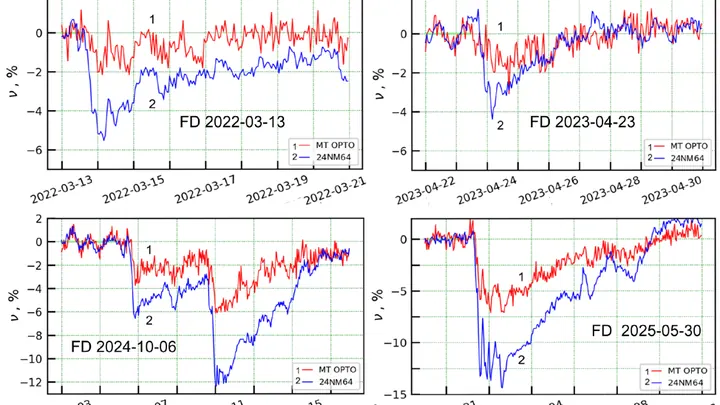
A storm is brewing somewhere far away, and the Geiger counter is already clicking more often. That's how cosmic rays, a stream of charged particles from deep space, make themselves known. When they slam into the atmosphere, they create showers of secondary particles, including muons: heavy cousins of electrons that can reach the ground.
Dark matter is the invisible scaffold of the Universe, revealing itself only through gravity. Vera Rubin, studying the rotation of galaxies, found that stars at the periphery move too fast, as if held by an unseen mass. This became compelling evidence for the existence of dark matter, yet its particles still elude direct detection.