Three Faces of a Superoutburst: How the Dwarf Nova YZ Cnc Changes Its Profile ✛
Context
This work stands alongside studies of neutron stars and quark matter, but is devoted to a different class of compact binaries: cataclysmic variables. Around it lie works on time crystals, supersolids, and magnetic monsters, yet this study is closer to the topic of accretion disks and their instabilities. It fills a niche for systems near the lower edge of the period gap, where superhump behavior had not been studied in detail before.
Methods
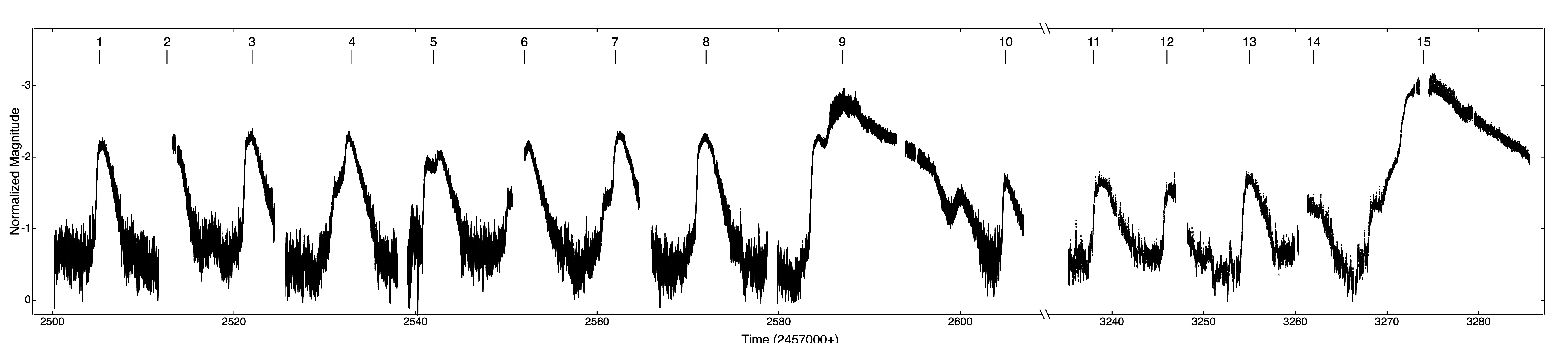
We used nearly continuous photometric time series from the TESS space telescope with 20-second and 120-second cadences, covering two superoutbursts separated by about 688 days. Ground-based data include the AAVSO archive and our own observations with the APO and Xinglong telescopes. After removing the slow outburst trend, we measured the times of superhump maxima and minima by fitting polynomials. For period analysis, we used Lomb–Scargle periodograms, including sliding windows, and for clock stability we constructed O−C diagrams.
Results
We found a repeating sequence of superhump shapes on the plateau: from sawtooth, through double-humped with unequal peaks, to double-humped with nearly equal peaks. This sequence is reproduced in both TESS superoutbursts and in five ground-based events. Periodograms show power concentrated at the superhump frequency and its harmonics only during superoutbursts. Timing analysis revealed that the most regular clock occurs in the middle and late stages of DHs, while the precursor and post-plateau show large deviations. The refined mean superhump period is 0.09043(27) days, corresponding to an excess of 4.03(31)% and a mass ratio estimate of q = 0.175(11).
Implications
Unlike neighboring works that focus on neutron stars and exotic states, this study provides a detailed empirical picture of superhump waveform evolution in a dwarf nova. It shows that the superhump profile is not static but goes through regular stages, which had not been confirmed for systems near the lower edge of the period gap. This links morphology to the dynamics of an eccentric precessing disk and provides observational constraints for future numerical models.
Future development
The topic may develop through observations of additional superoutbursts of YZ Cnc to test the strict repeatability of the sequence. Multicolor photometry or time-resolved spectroscopy would provide an independent phase of the orbital motion or the hot spot, helping to distinguish ordinary superhumps, secondary humps, and possible late superhumps. It is also important to check whether a similar sequence occurs in other SU UMa-type dwarf novae.
Impact
The results will affect modeling of accretion disks in close binary systems and the interpretation of dwarf nova light curves. They are also useful for calibrating the relations between superhump excess and mass ratio.
Next steps
We plan to conduct high-cadence observations of the next superoutbursts of YZ Cnc and apply a similar analysis to other dwarf novae near the period gap. We also need to refine the orbital ephemeris to separate phase effects.
Key open problems
This work connects to the unresolved problem of the exact mechanism of excitation and damping of disk eccentricity in dwarf novae, as well as to the question of the nature of late superhumps and secondary humps. It emphasizes the need to account for waveform evolution when interpreting superhump period changes.
The knowledge machine's view
This section is addressed to the author of the paper and their colleagues. Neighbouring works were found by meaning-based search across our archive, not by word overlap. We do not review: we show the field around the work.
What the work does
The study analyzes nearly continuous TESS photometric series and ground-based observations of the dwarf nova YZ Cancri during superoutbursts. A repeating sequence of superhump shapes was identified: a sawtooth profile, a double-peaked profile with unequal peaks, and a double-peaked profile with nearly equal peaks. The times of maxima and minima were measured, the superhump period was refined to 0.09043 days, and the mass ratio was estimated at q=0.175.
Where its strength is
The strength of this work lies in its detailed empirical picture of how the superhump waveform evolves on the plateau, confirmed across several events. This provides an observational basis for linking morphology to the dynamics of a precessing eccentric disk.
Where it could go next
- It might be interesting to compare changes in the stability of the superhump clock with the behavior of outburst periods in other systems where rhythm disruptions have been observed. In our archive, a study of a cosmic metronome that fell out of rhythm sits right next to this one.based on: The Cosmic Metronome Loses Its Beat: Ansky's Flares Slow to Half Tempo arXiv:2509.16304
- To test the hypothesis that superhump shape is linked to disk eccentricity, one could consider models describing X-ray flares from a compact object passing through the disk. This approach was proposed in the analysis of a work about an arrow piercing the disk.based on: The Arrow Piercing the Disk: Recipe for an X-ray Flare arXiv:2607.05508v1
Worth trying
- Test whether the sequence of shapes is reproduced in numerical models of the 3:1 tidal instability for the parameters of YZ Cancri.
- Look for a correlation between the duration of stages and system parameters, using literature data on other dwarf novae near the lower edge of the period gap.
- Apply wavelet coherence analysis to the TESS data to track the evolution of harmonic amplitudes within each stage.
Nearby works in our archive
- The Cosmic Metronome Loses Its Beat: Ansky's Flares Slow to Half Temposimilarity 0.52
- Black Hole with Double Flashessimilarity 0.50
- The Invisible Star: How a Total Eclipse Revealed a White Dwarf's Secretsimilarity 0.49
- X-ray Scream of a Black Hole: Astronomers Capture Ultraviolet Echo for the First Timesimilarity 0.49
- A Neutron Star Dances on the Edgesimilarity 0.49
- Warm Moons of Rogue Planetssimilarity 0.48
- The Arrow Piercing the Disk: Recipe for an X-ray Flaresimilarity 0.47
The archive is sparse around this work: the closest review is only 0.52, against a usual 0.64. It looks like few have drilled nearby.
Superhumps in YZ Cnc have a period of about 2.17 hours, which is only 4% longer than the orbital period of the system. During a single superoutburst lasting about 10 days, the disk completes more than 100 precession cycles.
Key numbers
- superhump period: 0.09043 days (about 2.17 hours)
- period excess: 4.03%
- mass ratio: 0.175
- plateau duration: about 10 days
- superhump amplitude: up to 0.5 magnitudes