Why a Pear-Shaped Nucleus Has Almost No Electric Charge
Take a pear and rub it against wool: one end picks up a charge of one sign, the other end the opposite sign. That creates an electric dipole moment. Many atomic nuclei that are pear-shaped have such a moment. But radium-224 has almost none, even though its shape is about as pear-like as it gets.
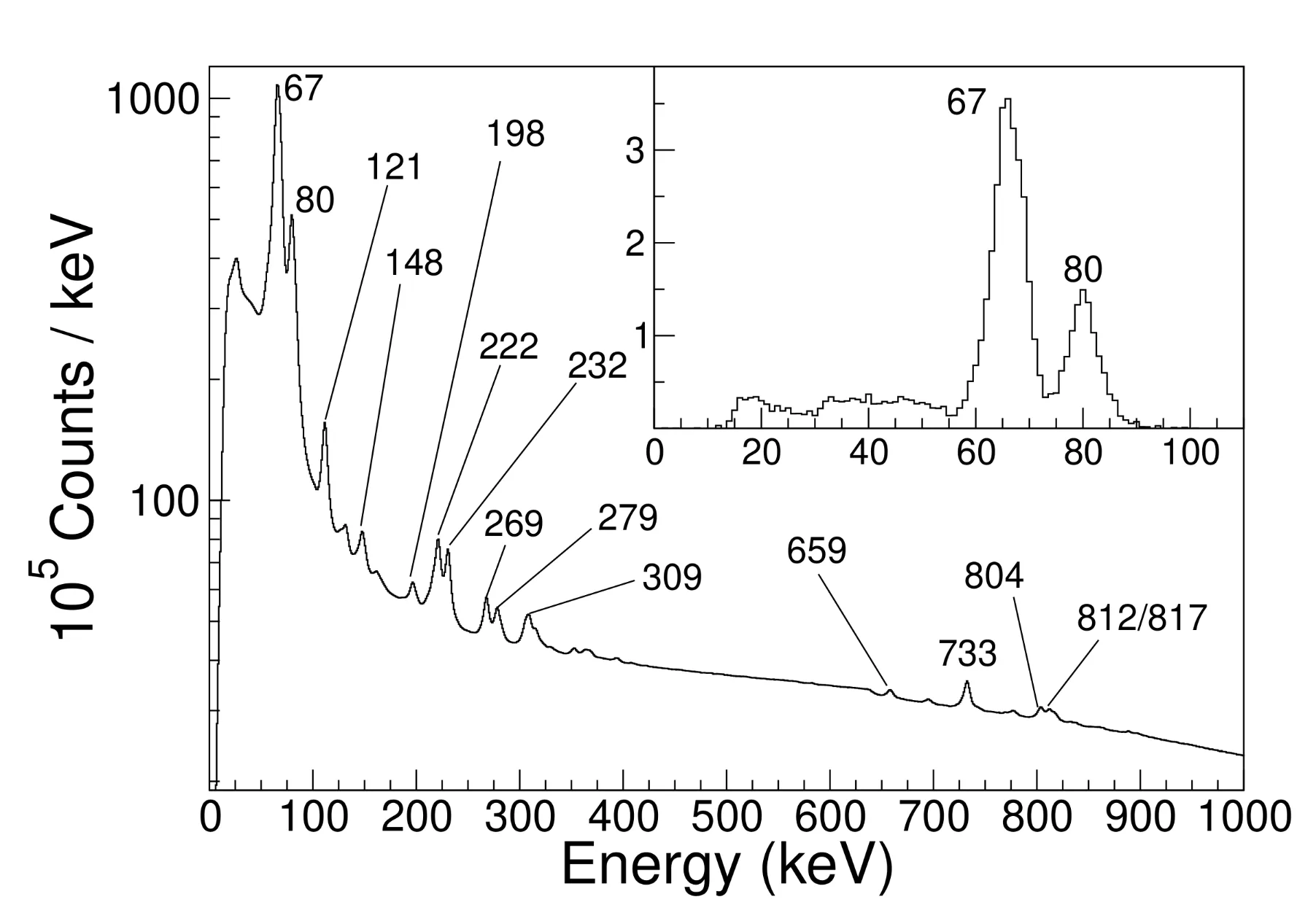
Scientists measured how quickly the excited states of this nucleus decay. To do that, they produced francium-224, which turned into radium-224, and tracked the gamma rays emitted by the nucleus. The lifetime turned out to be about 450 picoseconds. That is incredibly short: one picosecond is one trillionth of a second. If a second lasted 30,000 years, a picosecond would be a single instant.
From these measurements, they calculated the dipole moment. It turned out to be tens of times smaller than in other pear-shaped nuclei. This means a delicate cancellation is happening inside the nucleus: the contribution from the shape is almost completely canceled by the contribution from the motion of the particles. This test matters because pear-shaped nuclei are used to search for new physics beyond the Standard Model. Now the models that describe this have gained a solid footing.
The 224Ra nucleus is shaped like a pear, yet its electric dipole moment is almost zero, even though pear-shaped nuclei usually possess a noticeable dipole moment. It is as if the pear had perfectly balanced electric polarization despite its obvious shape asymmetry.