The electric dipole moment (EDM) of a particle is a measure of how its positive and negative charge distributions are separated, even when the particle is at rest. For a perfect sphere of charge, the EDM would be zero, but any asymmetry—like a slight 'pear shape'—produces a nonzero EDM. In the Standard Model of particle physics, EDMs are predicted to be extremely tiny, but many theories beyond the Standard Model (such as supersymmetry) predict much larger values. Therefore, measuring an EDM is a powerful 'smoking gun' for new physics, because any significant deviation from the Standard Model prediction would indicate undiscovered particles or forces.
History
The concept was introduced by Purcell and Ramsey in 1950, who proposed measuring the neutron's EDM. The first limits were set in the 1960s, and ever since, experiments have pushed the upper bound lower, with no detection yet—but each null result constrains theories of new physics.
How it works
To measure an EDM, physicists place particles (like protons, neutrons, or deuterons) in a strong electric field and look for a tiny precession of their spin, analogous to how a spinning top wobbles in a gravitational field. The challenge is that the effect is minuscule, so experiments use ultra-cold atoms, trapped ions, or molecular beams to maximize sensitivity. The corpus titles mention specific systems: the EDM of the tantalum-181 nucleus, the deuteron (a proton-neutron pair), and 'crooked electron' experiments. These measurements require extreme precision and control over magnetic fields, which is why they are often performed in dedicated laboratories.
In practice
EDM searches are used to test CP violation (the asymmetry between matter and antimatter) and to constrain models of particle physics beyond the Standard Model, which is essential for explaining why the universe has more matter than antimatter.
Fun fact
The current best limit on the electron's EDM, from the ACME experiment, is so precise that if the electron were scaled up to the size of the Earth, the charge separation would be less than the size of a single atom.
The night sky looks serene, but it is actually pierced by an invisible rain of charged particles: cosmic rays. Scientists have long tried to figure out where the most energetic ones are born. Until recently, it was thought that our Galaxy supplies particles up to about 4 EeV, the so-called "ankle" in the spectrum.
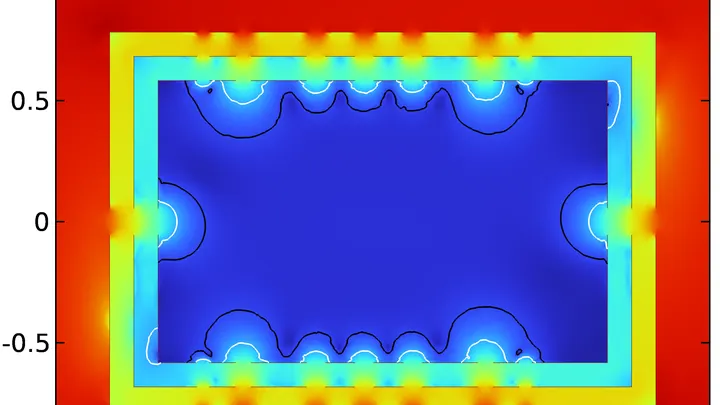
The magnetic field in this setup must be as smooth as glass: the slightest ripple would blur the signal. The engineers built two coils that cancel each other's field externally and packed them in three layers of ferromagnetic plates.
When two atomic nuclei smash together, a tiny fireball is born. It lives for an instant, but inside, entire epochs pass: compression, heating, expansion. Physicists have learned to eavesdrop on this process, and their "microphone" is the pairs of electrons and positrons that fly out of the ball at different stages.
In the new work, two scenarios were compared.
A carousel doesn't just spin you around in a circle — with each revolution, it also slightly screws itself into the ground. This corkscrew-like motion is the essence of the NUT charge, a special property of spacetime that physicists have been studying since the mid-20th century.
The neutron is one of the most neutral particles in nature. But if you add a special parameter to the laws of physics, called the theta term Standard Model, a tiny charge imbalance appears inside the neutron. One edge becomes slightly positive, the other slightly negative.
Atomic nuclei are rarely perfect spheres. More often, they resemble a slightly squashed ball — the electric charge inside is unevenly distributed, and protons may shift a bit, creating a tiny 'pear-shaped' bulge.
Electrons and muons are tiny magnets. Their magnetism is slightly more than two (in special units), and this 'excess fraction' (anomalous magnetic moment) arises from constant ripples in the vacuum: particle pairs momentarily pop into existence and vanish.
Two electrically charged spheres attract each other with a certain force. If you replace their charges with magnetic poles, a spring scale shows exactly the same force. Black holes, it turns out, behave the same way — except instead of springs, the fabric of spacetime itself does the work.
Hot syrup cools quickly: crystals solidify at different points simultaneously, and the boundaries between them become thin walls. A similar process may have occurred in the first moments after the Big Bang — a special field permeating the cosmos cracked, creating domain walls. These walls separated regions with different properties, like invisible partitions.
A drop of water stretches in a strong electric field. The deuterium nucleus, a bound pair of a proton and a neutron, behaves the same way, except here the field comes from a passing gamma ray, and instead of just stretching, the nucleus can simply fall apart.
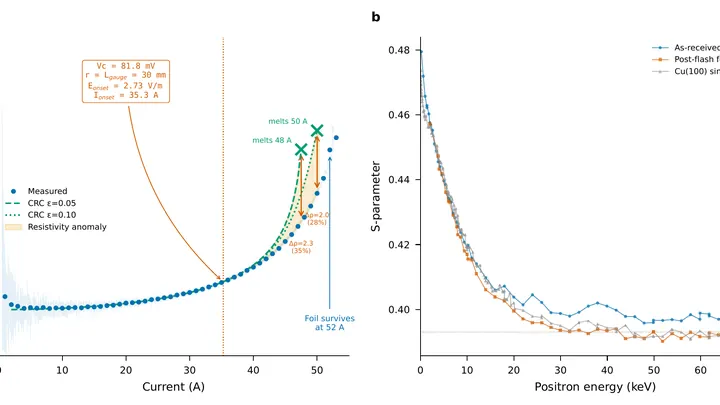
A copper wire under current is a familiar sight, but inside it something unexpected is happening. A strong electric current doesn't just heat the metal: it knocks atoms out of their rightful places, leaving behind tiny voids, as if a few balls were suddenly removed from a tightly packed arrangement.
Light twisted in one direction hits a proton. The particle can absorb the photon or deflect it — depending on how its own spin, a tiny internal top, is oriented. In the experiment at the MAMI accelerator in Mainz, a beam of polarized photons struck targets of polarized protons and deuterons (nuclei of heavy hydrogen).
When heavy nuclei collide in accelerators, a multitude of particles is produced, and physicists want to understand how electric charge moves through this chaos. Two trains crash into each other: the passengers (quarks) scatter, but their luggage (charge) may end up far from the crash site.
During a thunderstorm, the sky acts like a giant battery: charge builds up in the cloud, and a lightning bolt discharges it. That charge is invisible, but cosmic particles (muons, which constantly rain down on Earth from space) can sense it. As a muon flies through a charged cloud, it speeds up or slows down slightly, and these changes reveal the voltage inside the cloud.
Neutrinos are tiny particles that zip through Earth, barely noticing it. In the MicroBooNE experiment, they are caught in a tank of liquid argon. When a neutrino strikes an argon nucleus, it produces an electron and protons, like splashes from a stone thrown into water.
Two tiny emitters, each about the size of an atom, can together do what neither can do alone. We're talking about light scattering — when light hits particles and bounces off in all directions. Usually, a pair of particles scatters light only slightly more than a single one.
The nucleus of deuterium, or the deuteron, can be pictured as a microscopic spinning top. If its charge distribution is not perfectly symmetric, then in an external electric field this top experiences a minuscule tilt of its spin axis.
When you press your finger on a piece of soft putty, it obediently dents and then slowly returns to its original shape. But if you press on a window pane, it either holds or cracks — no smooth deformation. Both materials are amorphous: their atoms are not arranged in a strict crystal lattice like in metal. Yet they behave completely differently.
The hydrogen atom is like a tiny clock, ticking with a precision engineers can only dream of. When an electron jumps between orbits, it absorbs or emits light at a strictly defined frequency: that's the 'tick.' In the new work, physicists caught one such transition, between the 2S and 6P states, and measured its frequency with an…
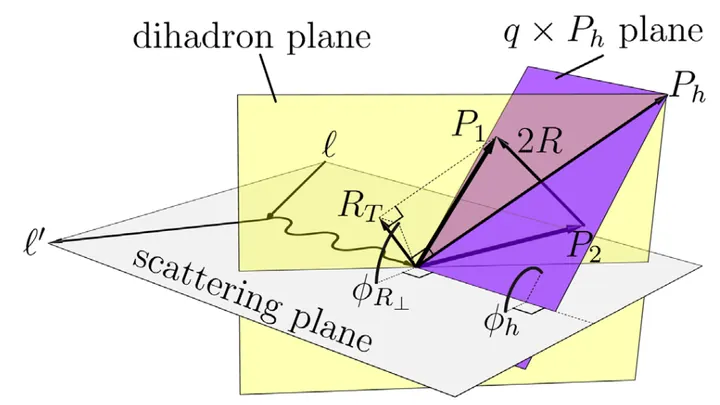
A beam of electrons, twisted like a corkscrew, slams into a proton. From the collision point, pairs of particles, a positive and a neutral pion, fly out. For the first time, physicists measured how often such pairs scatter at different angles when the electron's spin points left or right.
Twisted layers of atoms in a material form a pattern of tiny regions, domains, each of which can be electrified in one of two directions, like a compass needle pointing north or south. Previously, such materials were studied only as a whole, measuring thousands of domains at once, and their collective behavior was like a choir where individual voices are not heard.
Inside the Large Hadron Collider, protons are accelerated to nearly the speed of light and smashed head-on. At the collision point, a burst of energy is born for an instant, from which new particles can emerge. One of the heaviest is the top quark.
A tuning fork rings dully when it strikes a crack. That principle scales up in this experiment: physicists turned molecules into an ultrasensitive tuning fork to eavesdrop on the electron's asymmetry.
Measured dipole moment of tantalum-181: 3.39 × 10⁻³² e·cm — like spotting a one-atom shift across the entire Solar System. An ordinary atomic nucleus is perfectly balanced, like a spinning top. In tantalum, that balance is broken: the positive and negative charges are slightly offset from each other.
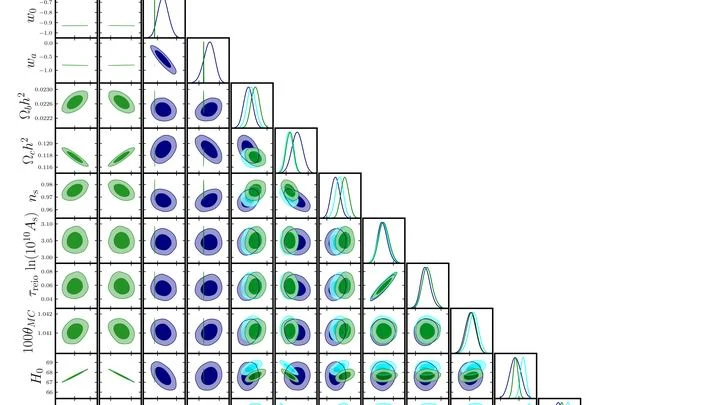
The universe is putting on a show, and the lead role goes to dark energy. For a long time, the actor seemed unchanging: the cosmological constant (the vacuum energy that accelerates cosmic expansion) set the same tone throughout.
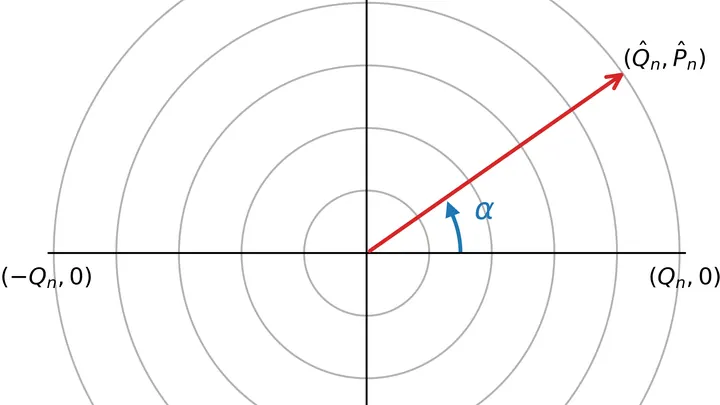
In 1935, Einstein, Podolsky, and Rosen proposed a thought experiment that, in their view, exposed the incompleteness of quantum mechanics. Two particles fly apart after interacting, and measuring the momentum of one instantly gives exact knowledge of the other's momentum.
Two telescopes look at the same Universe and see different expansion rates. Local measurements from supernovae give 73.04 ± 1.04 km/s/Mpc, while cosmic microwave background data within the standard model predict 67.36 ± 0.54.