A pear with almost no electric charge
A pear lies on the table, and if it had an electric charge, that charge would gather at one end. Many nuclei are built this way: the displacement of protons and neutrons creates an intrinsic dipole moment. But radium-224, which is indeed pear-shaped, has a dipole moment that is almost zero. It is as if the pear's electric polarization were perfectly balanced despite its obvious shape asymmetry.
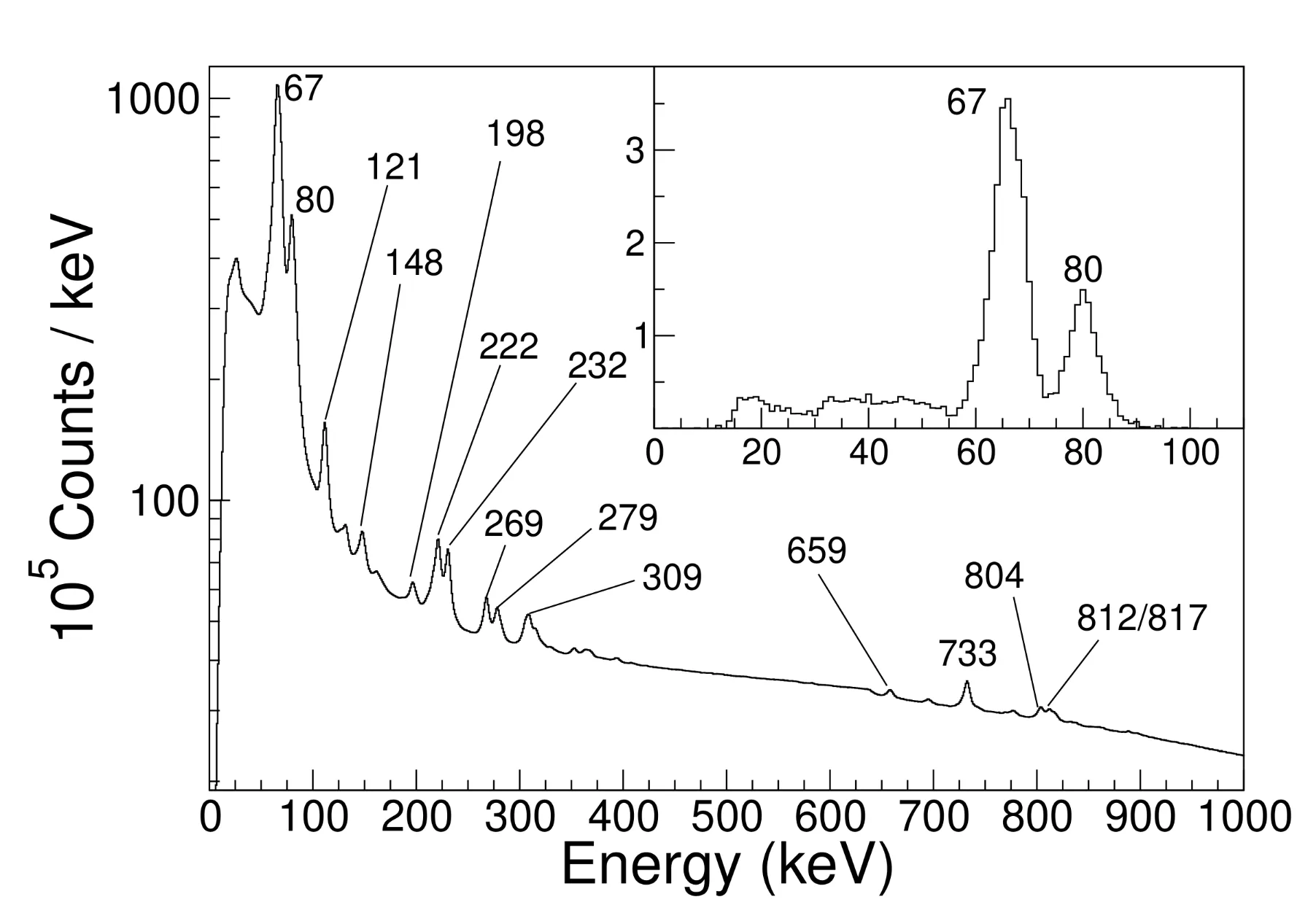
To test this, physicists measured how quickly the excited states of the nucleus decay. At the TRIUMF accelerator in Canada, francium-224 was produced, which then turned into radium-224 by emitting an electron and a neutrino. The excited states of radium emitted gamma rays, and the delay between them gave the lifetime. The result was 444 picoseconds for the 1− state and 460 picoseconds for the 3− state. This is several times more precise than previous data from Coulomb excitation.
From the lifetimes, the probabilities of electric dipole transitions were calculated. The intrinsic dipole moment turned out to be 0.032 elementary charges times a femtometer. This is very small: for a typical pear-shaped nucleus it would be tens of times larger. At the same time, the ratio of transition probabilities from the 1− state is close to the value of 2 expected for a rigid rotor, but for the transition from the 3− state it is noticeably lower. This indicates that the strength of dipole transitions may depend on spin.
Now theorists have a strict benchmark. Models that describe excitation energies must also reproduce the fine compensation between protons and neutrons that determines the strength of dipole transitions. This is important for calculating Schiff moments in pear-shaped nuclei. And it is these moments that enhance sensitivity to symmetry violations that are sought in experiments searching for atomic electric dipole moments. A pear with almost zero charge turned out to be an ideal testing ground for theories.
The 224Ra nucleus is shaped like a pear, yet its electric dipole moment is almost zero, even though pear-shaped nuclei usually possess a noticeable dipole moment. It is as if the pear had perfectly balanced electric polarization despite its obvious shape asymmetry.