The Standard Model is the theoretical framework describing fundamental particles and forces, including protons, magnetic phenomena, and quantum transitions.
8 related articles · 1 formulas · 6 who worked here
The Standard Model is a quantum field theory that unifies electromagnetic, weak, and strong interactions. Particles are divided into fermions (building blocks of matter) and bosons (force carriers). Fermions include 6 quarks and 6 leptons, including the electron and neutrino. Bosons are the photon, W/Z bosons, gluons, and the Higgs boson. The mathematical foundation is gauge symmetries. Despite its predictive accuracy, the model is incomplete: it does not include gravity and does not explain dark matter.
History
The roots of the SM go back to quantum electrodynamics (Dirac, Feynman, Schwinger, Tomonaga). The principles of gauge invariance were proposed by Weyl and developed by Yang and Mills. Key contributions: Pauli (exclusion principle, 1925), Dirac (equation for fermions, 1928), Bose and Einstein (statistics of bosons, 1924). In the 1960s, Glashow, Weinberg, and Salam created the electroweak theory. Quantum chromodynamics was formulated by Gross, Politzer, and Wilczek. Key experimental milestones: discovery of W/Z bosons (CERN, 1983), top quark (Tevatron, 1995), Higgs boson (LHC, 2012).
How it works
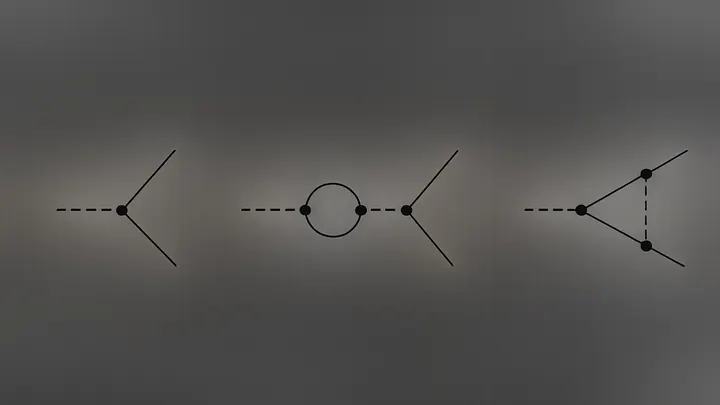
Interactions are encoded in the Lagrangian: kinetic terms for fermions and gauge bosons, Yukawa terms, and the Higgs potential V(φ)=μ²|φ|²+λ|φ|⁴. The Higgs field acquires a nonzero vacuum expectation value, breaking electroweak symmetry. The strong interaction is described by QCD with the property of confinement: quarks are not observed as free particles, instead forming hadrons. In the electroweak sector, the masses of W and Z arise from the kinetic term of the Higgs field. All processes follow quantum rules: Feynman diagrams give amplitudes, and renormalization removes infinities. The Pauli principle (fermions obey Fermi-Dirac statistics) and the Dirac equation for describing free fermions are used.
In practice
It underpins the operation of all particle accelerators and detectors, including the search for new physics at the Large Hadron Collider.
Fun fact
Despite its success, the Standard Model has a serious gap — the so-called 'hierarchy problem': gravity is 10^32 times weaker than the other forces, and the theory does not explain why.
Among the debris of particle collisions, short-lived 'guests' sometimes appear — hyperons. One of them, Σ0, lives for less than one ten-billionth of a second and decays on the fly. Catching it directly is nearly impossible, but its traces can be spotted: it leaves behind another particle, Λ, and an electron-positron pair.
When a proton is smashed apart in an accelerator, quarks and gluons fly out. But you never see them free: almost immediately they stick together into new particles, like droplets of mercury merging into spheres.
In 1994–1995, the LEP accelerator collided electrons and positrons, producing Z bosons that promptly decayed into showers of particles. The DELPHI detector recorded these events, and now, decades later, a new pattern has been found in that data: the electric charge within particle jets is not distributed randomly but follows a simple sine curve.
Quarks, the building blocks of protons and neutrons, usually pair up or form trios. But sometimes they assemble into larger, unstable combinations that live for mere fractions of a second. Two such particles, Bs0* and Bs1, have long been a puzzle: calculations hinted they should be bound, but the precision wasn't enough to say so with confidence.
Earth's magnetic field is not constant: it trembles from the solar wind, from distant thunderstorms, and from the subway running nearby. To notice these tremors, you need an instrument that doesn't tremble itself. Physicists have built such an instrument from ytterbium atoms cooled to nearly absolute zero.
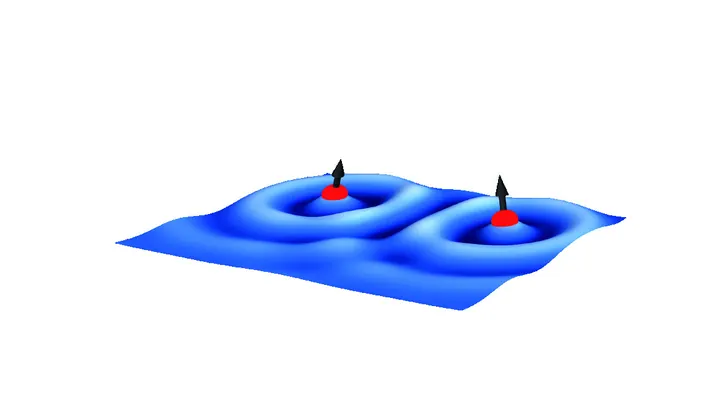
The quantum world is full of surprises: swap two electrons, and their combined wavefunction just changes sign; swap two photons, and nothing happens at all. But there are particles that behave very differently when exchanged, as if they remember being swapped. These particles are called anyons, and they can only exist in a two-dimensional world.
A shipping container is a steel safe the size of a room, packed with goods. X-rays struggle to see through it: thick walls and dense cargo block the rays. Enter muons — particles born high in the sky that constantly rain down on Earth. They can pass through even lead, but they veer slightly off course when they encounter something heavy.
When a heavy atomic nucleus splits into two fragments, an invisible quantum thread remains between them. This thread is entanglement: the state of one fragment is instantly linked to the state of the other, as if they were still a single whole. For the first time, physicists have precisely calculated how long and strong such a thread can be, tracing the fission process step by step.
An invisible stream of particles passes through your body every second. These are neutrinos — tiny messengers from distant stars and earthly reactors. Catching them is nearly impossible: they fly through matter like a bullet through fog. But physicists have learned to set traps for them.
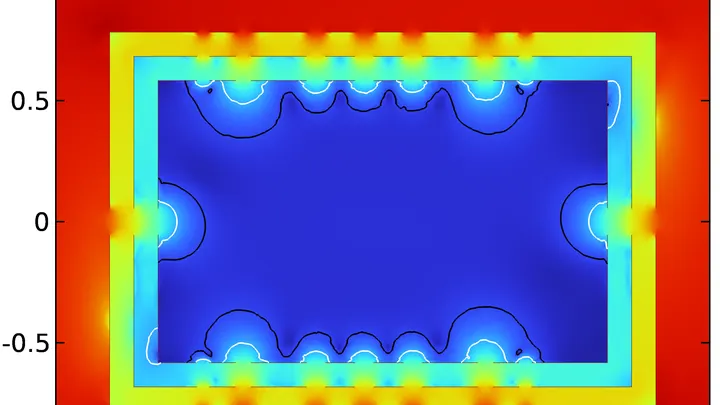
The magnetic field in this setup must be as smooth as glass: the slightest ripple would blur the signal. The engineers built two coils that cancel each other's field externally and packed them in three layers of ferromagnetic plates.
At the Jefferson Lab accelerator, a beam of light strikes protons, and the collisions give birth to short-lived particles — omega mesons. They live for less than a billionth of a second, but they still manage to tell us about the forces inside the atomic nucleus.
The atomic nucleus isn't always round like a billiard ball. Some nuclei stretch out like a rugby ball, while others become pear-shaped — with one end thicker than the other.
The quantum world is often compared to a musical instrument. Electronic bands in a crystal are like strings, each with its own pitch. Usually, if the strings are tuned simply, without tricky interlacing, then the sound produced by their combined motion remains simple.
A stone thrown at a wall bounces off. In the quantum world, a particle can pass right through, as if the wall were woven from mist. This is quantum tunneling: it lights up stars, works in microchips, and even operates in the cells of our bodies. But most particles have spin — an intrinsic rotation, like a spinning top.
A laser beam is like a swift vortex that briefly captures a passing electron. As the particle moves through the pulse, its spin (the intrinsic rotation, like a tiny top) experiences a weak kick. After leaving the beam, the top no longer points in the same direction; it has turned a little.
Ultra-sensitive scales try to detect the difference between two nearly identical grains of sand. One is a perfect mirror reflection of the other. In the world of elementary particles, such mirror reflection is called P-parity, and its violation is one of the great mysteries of physics.
In the quantum world, particles fall into two irreconcilable camps: bosons love to pile into the same state (like light in a laser), while fermions are individualists that never occupy the same spot. You'd think one neural network couldn't learn both personalities at once.
Ordinary ice turns into water at zero degrees. And matter at nuclear density, quark-gluon plasma, undergoes something similar at about 155 MeV (roughly two trillion degrees).
In the quantum world, particles sometimes behave like acrobats on invisible tightropes. An instanton field is a brief vortex that appears and vanishes in an instant. When a fermion (a particle like an electron) enters such a vortex, its energy does not stay put. Instead, it smoothly slides from one level to another, like a ball rolling down a hill.
When two atomic nuclei smash together, a tiny fireball is born. It lives for an instant, but inside, entire epochs pass: compression, heating, expansion. Physicists have learned to eavesdrop on this process, and their "microphone" is the pairs of electrons and positrons that fly out of the ball at different stages.
In the new work, two scenarios were compared.
To probe deeper into the workings of the universe, physicists accelerate electrons and smash them together. An ordinary electron is like a spinning top that wobbles randomly. For delicate experiments, you need particles whose spins all point in the same direction: this is called polarization.
In the first moments after the Big Bang, matter and antimatter were almost equally abundant. But something tipped the balance, leaving only a tiny excess of ordinary particles — the very excess that makes up stars, planets, and ourselves.
A quantum spin liquid is a state of matter in which the magnetic moments of atoms behave like a fluid: they constantly fluctuate and never settle into a rigid order, even at extremely low temperatures. One of the most famous theoretical models of such a liquid was proposed by Alexei Kitaev.
In some quantum theories, symmetries intertwine in an unusual way, as if a lock had two keys, but turning one slightly shifted the other. Such intertwined symmetries are called 2-groups. One is an ordinary symmetry acting on point particles (0-form), and the other is a 'linear' symmetry (1-form) governing extended objects like strings or lines.
The uranium-arsenic crystal UAs2 under pressure behaves like a house with two rooms. In one room, electrons sit still; in the other, they roam freely. Under normal conditions, it's a classic "lattice Kondo" system: heavy, almost immobile electrons on 5f5/2 orbitals are surrounded by a sea of fast conduction electrons.
Imagine a postal service where couriers suddenly stop moving. It would seem that letters would stop arriving and communication between cities would break down. But what if the envelopes themselves suddenly gained the ability to change shape and transmit messages through a shared web without moving an inch?
Inside the atomic nucleus, protons and neutrons are packed so tightly that the forces between them resemble tightly coiled springs. Some springs compress and expand equally in all directions: these are the familiar central forces.
Electric charge is a slippery thing. You can measure how much there is in the entire universe or in a single particle, but try to point your finger and say, 'Right here, in this cubic centimeter, there is exactly this much charge right now,' and you hit a fundamental wall.
The issue is that total charge, which physicists denote by the letter Q, is nonlocal.
In 1998, mathematician David Boyd noticed something strange. He was studying the Mahler measure of polynomials, a quantity that gauges the "complexity" of their roots, and found that for a family of curves, it always equals a special rational number times the derivative of an L-function.
In nuclear physics, a puzzle has long been nagging: why among elements lighter than bismuth, only technetium (No. 43) and promethium (No. 61) have no stable isotope at all? All their neighbors in the periodic table can boast at least one long-lived variant, but these two seem to fall out of the general pattern.
A fraction of a second after the big bang, the universe was a searing hot soup of particles and antiparticles. By all rights, they should have annihilated each other completely, leaving only emptiness. But for some unknown reason, one "extra" matter particle survived for every billion pairs. It was from these surviving scraps that galaxies, stars, and people eventually formed.
The standard cosmological model ΛCDM (which includes dark energy and cold dark matter) is the score of a cosmic symphony. It describes how space expanded after the big bang. How dark matter clumped together. How galaxies ignited. For a long time, everything played flawlessly.
A phase transition is like the moment water turns into ice. In the quantum world, such transitions occur at absolute zero, and seeing them directly is nearly impossible. Usually, this requires building extremely complex computer models that demand enormous resources.
The Delta-VQE method offers a workaround.
A quantum chain is like a string of lights, where the bulbs are the spins of particles. Ideally, all bulbs glow in sync, following a common rhythm: that's symmetry. But if you cut off a piece of the string, the rhythm can get out of step: within that segment, symmetry is broken.
Physicists study a chain of strongly interacting particles (the XYZ model).
A massive star exhausts its fuel, and its core collapses in a fraction of a second. A supernova is born, along with a brief but powerful shower of neutrinos. These particles barely interact with matter, so they fly away freely, carrying information about the catastrophe.
The river splits in two. One branch is wide and fast, with water flowing smoothly, but as temperature rises, the flow slows: eddies and waves appear. The second branch is narrow, with rapids, where water leaps from rock to rock. This flow, on the contrary, becomes more lively with warming.
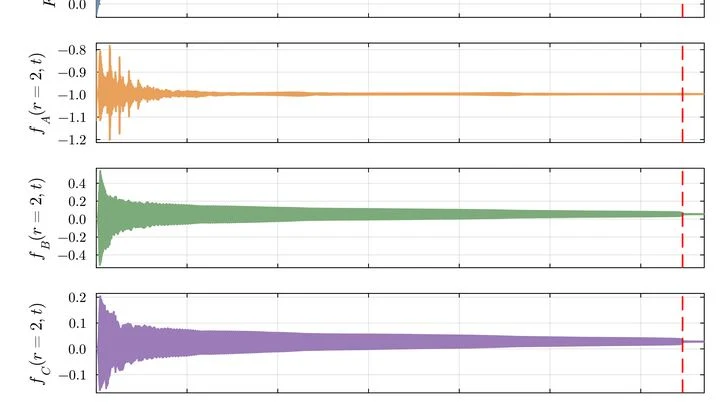
A tightly stretched string keeps vibrating after being plucked. In particle physics, there is a similar object — the oscillon. It is a clump of energy that pulses like a heart without spreading out in space. Such structures arise in the Higgs field — the very field responsible for particle masses.
The quantum world is tricky: sometimes particles confined to a flat layer and pierced by a strong magnetic field start behaving like a liquid made not of whole electrons but of their fractions — fractional charges. This is the fractional quantum Hall effect.
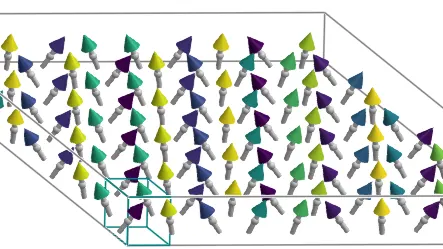
A row of soldiers turns in unison at the command. In magnetic materials, the soldiers are the spins of atoms — tiny magnetic arrows. In an ordinary magnet, they all point the same way, but in a triangular lattice, things are trickier: neighbors interfere with each other, leading to an intricate dance.
Quantum calculations often resemble assembling a complex mechanism: a physicist knows a part will fit, but can't always explain why. One favorite trick is to insert a 'unity' into the middle of a formula — not an ordinary one, but one built from an infinite set of all possible states of the system. This turns a cumbersome expression into a chain of simple integrals.