Independent verification of octupole collectivity in radium-224
Context
In science, independent verification of results is a cornerstone of credibility, yet in nuclear physics it is rarely performed due to limited access to unique beams of radioactive isotopes. The 224Ra nucleus became a key object after Coulomb excitation experiments provided evidence for stable octupole deformation, that is, a pear-like nuclear shape. Such a shape enhances sensitivity to violations of spatial and temporal parity, making these nuclei promising for searches for permanent electric dipole moments. However, theoretical calculations indicate anomalously weak electric dipole transitions in 224Ra due to a delicate compensation of contributions, so a direct measurement of lifetimes of low-lying negative-parity states became an important independent check.
Methods
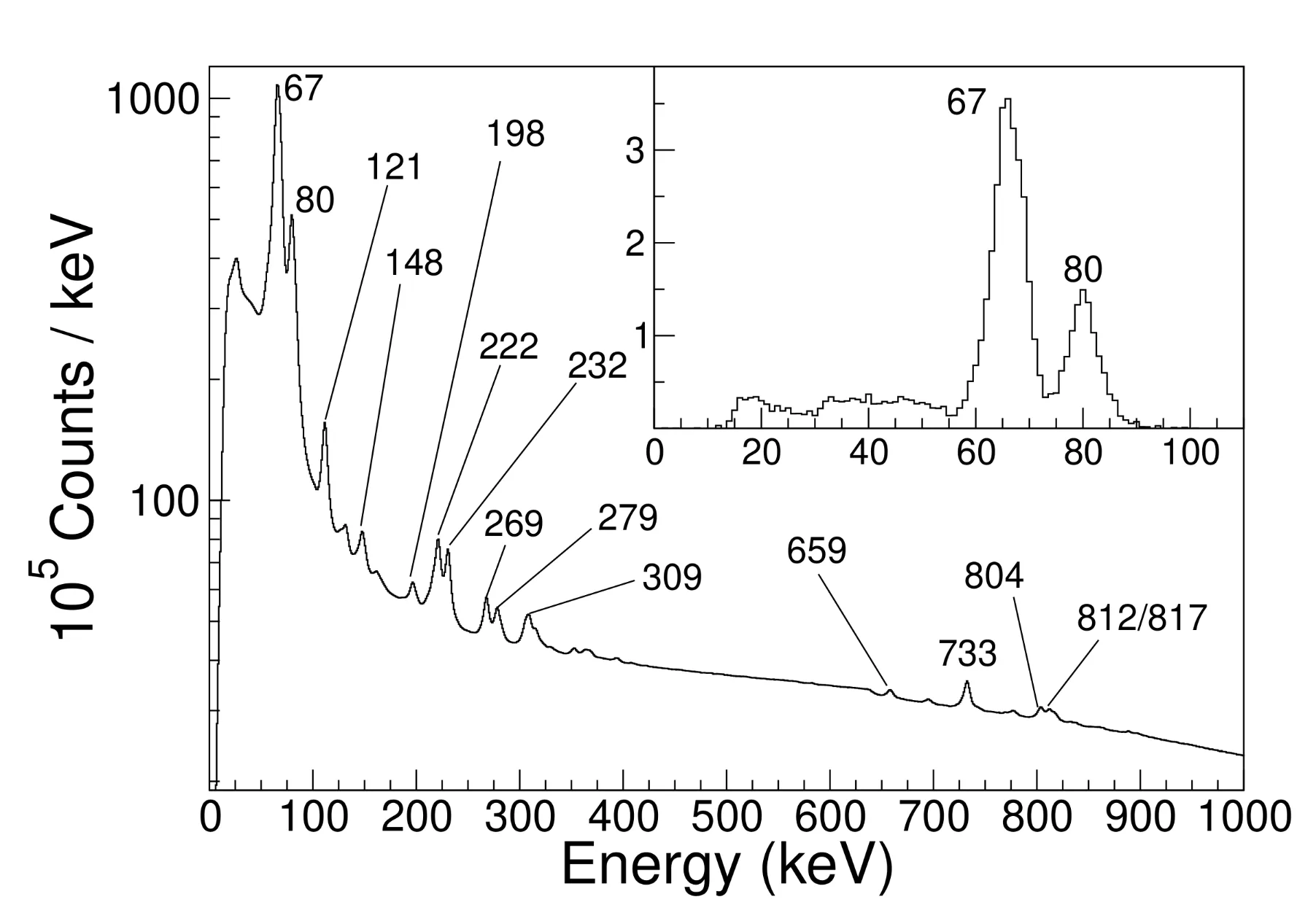
The experiment was performed at the TRIUMF accelerator complex in Canada. A 520 MeV proton beam was directed at a uranium carbide target, from which 224Fr ions were extracted using online isotope separation. These ions were implanted into a thin Mylar tape at the center of the GRIFFIN detector array, where beta decay populated excited states of 224Ra. For lifetime measurements, LaBr3(Ce) scintillation detectors with high time resolution were used. Detector signals were split into energy and timing branches: energy was recorded by digitizers, while time intervals between cascade gamma rays were converted to pulse amplitudes using time-to-amplitude converters. Delay histograms were built for two configurations (forward and reverse), then summed and fitted with a convolution of a Gaussian function with an exponential decay, allowing extraction of the mean lifetime.
Results
The mean lifetimes were 444(6) ps for the 1− state and 460(18) ps for the 3− state. These values agree with results from Coulomb excitation but have several times smaller uncertainty. Based on the lifetimes and known branching ratios, reduced electric dipole transition probabilities were calculated: B(E1;1−→0+) = (3.5±0.1)×10−5 W.u., B(E1;1−→2+) = (7.4±0.4)×10−5 W.u., B(E1;3−→2+) = (3.6±0.2)×10−5 W.u. These values correspond to an intrinsic dipole moment D0 ≈ 0.032 e·fm, confirming its strong suppression. The ratio of transition probabilities from the 1− state is close to the value of 2 expected for a rigid rotor, but for the transition from the 3− state the ratio is notably lower than theoretical prediction, indicating a possible spin dependence of the E1 matrix element.
Implications
The results independently confirm that 224Ra possesses strong octupole collectivity yet has an anomalously small intrinsic electric dipole moment. This agrees with the macroscopic-microscopic model, which predicts near-complete cancellation of contributions. Comparison with calculations within energy density functional theory and the interacting boson model shows that reproducing excitation energies is insufficient: one must accurately describe the delicate proton-neutron compensation that determines the strength of E1 transitions. Such a test is important for theoretical models used in estimating Schiff moments in octupole-deformed nuclei, which is directly related to searches for electric dipole moments of atoms and nuclei.
Future development
Further refinement of lifetimes and matrix elements in 224Ra and neighboring radium isotopes will allow a more rigorous picture of the evolution of octupole deformation. Of particular interest is the measurement of similar quantities in 225Ra and 223Rn, where even stronger parity-violation effects are expected. Development of fast timing methods at new facilities, such as FIPPS at ILL or future scintillator arrays, could expand the range of nuclei studied. Furthermore, comparison with improved microscopic models that explicitly include octupole correlations may help uncover the mechanism of dipole moment suppression.
Impact
The results will impact nuclear spectroscopy of actinides, theory of collective excitations, and searches for new physics beyond the Standard Model through electric dipole moment measurements.
Next steps
The next step could be measuring lifetimes of higher-lying negative-parity states in 224Ra, as well as similar studies in 226Ra and 228Th for a systematic investigation of octupole collectivity.
Key open problems
This work is directly connected to the unresolved problem of quantitatively describing octupole deformation and associated electromagnetic properties in actinides. Existing models diverge by orders of magnitude in predictions of E1 transition strengths, and the precise data obtained serve as a stringent benchmark for their improvement. In addition, the question remains open about the nature of the anomalously small dipole moment in 224Ra against the backdrop of strong octupole collectivity, which requires a deeper understanding of microscopic mechanisms.
The 224Ra nucleus is shaped like a pear, yet its electric dipole moment is almost zero, even though pear-shaped nuclei usually possess a noticeable dipole moment. It is as if the pear had perfectly balanced electric polarization despite its obvious shape asymmetry.
Key numbers
- lifetime of the 1− state: 444(6) ps
- lifetime of the 3− state: 460(18) ps
- intrinsic dipole moment: 0.032 e·fm
- transition probability B(E1;1−→0+): 3.5×10⁻⁵ W.u.
- ratio B(E1;1−→2+)/B(E1;1−→0+): 2.11(13)