Caldera de fusión sin sarro: el secreto está en las paredes exprés
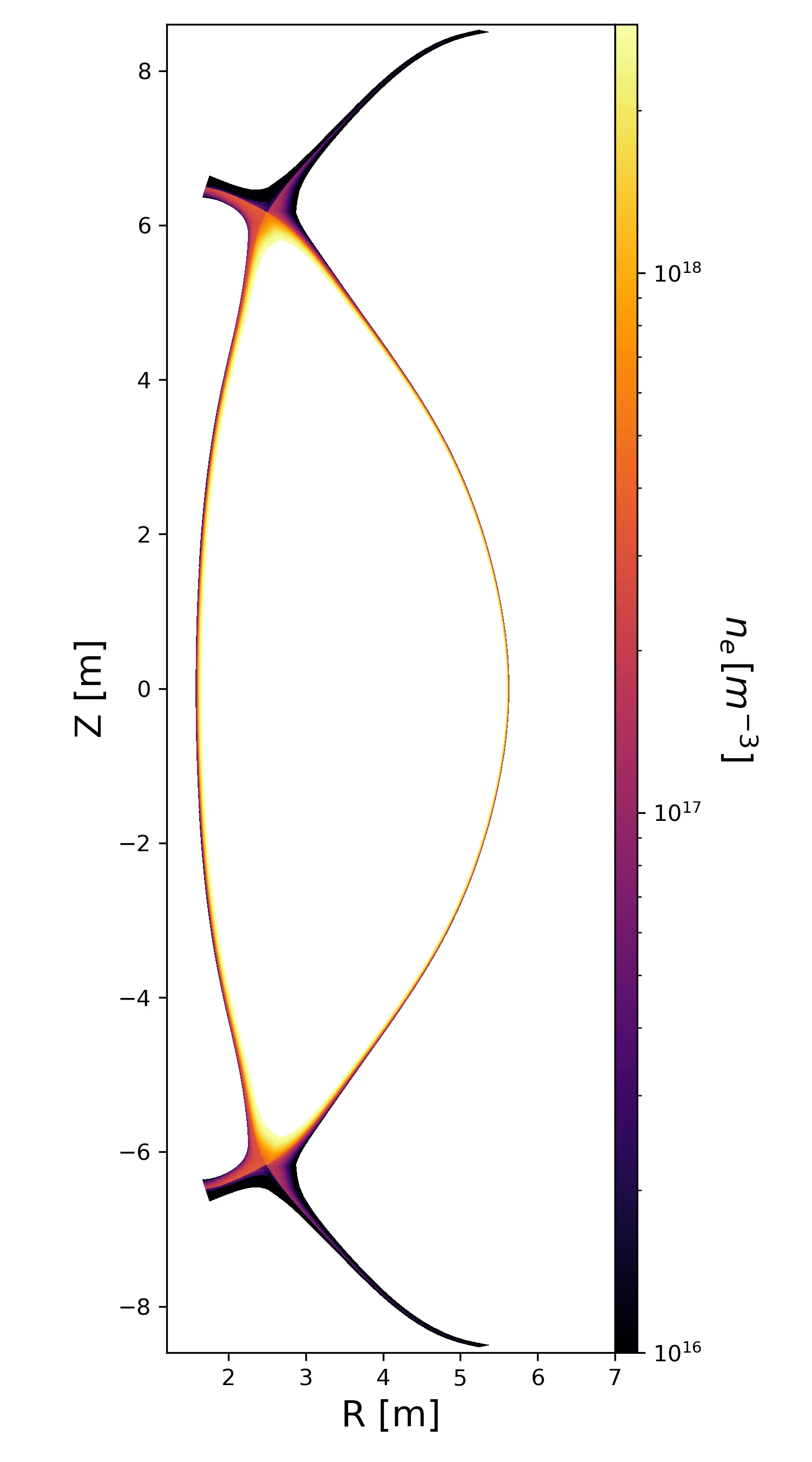
Un reactor de fusión se asemeja a una caldera gigante donde se «cuece» helio a partir de hidrógeno. El plasma en su interior alcanza 150 millones de grados, diez veces más caliente que el núcleo del Sol. Pero como en cualquier caldera, aquí se forma sarro: impurezas dañinas que se depositan en las paredes y apagan el plasma.
Los físicos propusieron fabricar las paredes con material esponjoso que absorba las impurezas y evite que regresen al combustible. Esto conserva el calor, pero provoca un fuerte sobrecalentamiento. Los cálculos por computadora mostraron que, si se sigue el movimiento de cada partícula por separado en lugar de como un flujo continuo, las impurezas pesadas se arrinconan solas en un compartimento llamado divertor. Al mismo tiempo, el calor se distribuye uniformemente, evitando que las paredes se fundan.
Incluso si la «olla» principal devuelve partículas, los paneles absorbentes en otras paredes pueden llevar el reactor a un modo de combustión limpia. Esto acerca las plantas de energía de fusión confiables.
Resumen original
tal como lo escribieron los autores, en inglés arXiv:2511.09437
Low-recycling regimes are appealing because they entail a high edge temperature and low edge density which are good for core confinement. However, due to considerably enhanced heat flux, the exhaust problems become severe. In addition, in the low-recycling regime, the conventional fluid simulations may not capture the physics of the Scrape-Off Layer (SOL) plasma that lies in the long mean free path regime; kinetic calculations become necessary. In this paper, by performing both Kinetic and fluid simulations, we explore the feasibility of a low-recycling regime in the magnetic geometry of the Spherical Tokamak for Energy Production (STEP); kinetic effects come out to be crucial determinants of the SOL dynamics. The simulation results indicate that a high SOL temperature and low SOL density could be achieved even when the divertor target is not made of a low recycling material. This can be done by using a low recycling material as a wall material. This is an important step towards demonstrating the feasibility of a low-recycling scenario. Lithium, a commonly used low recycling material, tends to evaporate at high heat fluxes which counteracts the desired high temperature, low density regime, and materials that can handle high heat fluxes are generally high recycling. Comparisons of gyrokinetic and fluid simulation results indicate that one can take advantage of kinetic effects to address some of the issues associated with a low-recycling SOL. Specifically, kinetic simulations show better confinement of impurities to the divertor region and greater broadening of the heat flux width due to drifts when compared with fluid simulations. Impurity confinement would help prevent core contamination from sputtering, and a broader heat flux width would help reduce the peak heat load at the target in the absence of detachment.
En un vaso de agua se esconde tanta energía de fusión que bastaría para abastecer de calor y electricidad a una casa durante un año.
En la película «Spider-Man 2», el doctor Octavius pone en marcha un sol artificial, un reactor de fusión que se descontrola. El problema de la contención del plasma, que hoy intentan resolver los científicos, se convierte allí en una catástrofe.