Danza oscura: cómo energía y materia intercambian roles exprés
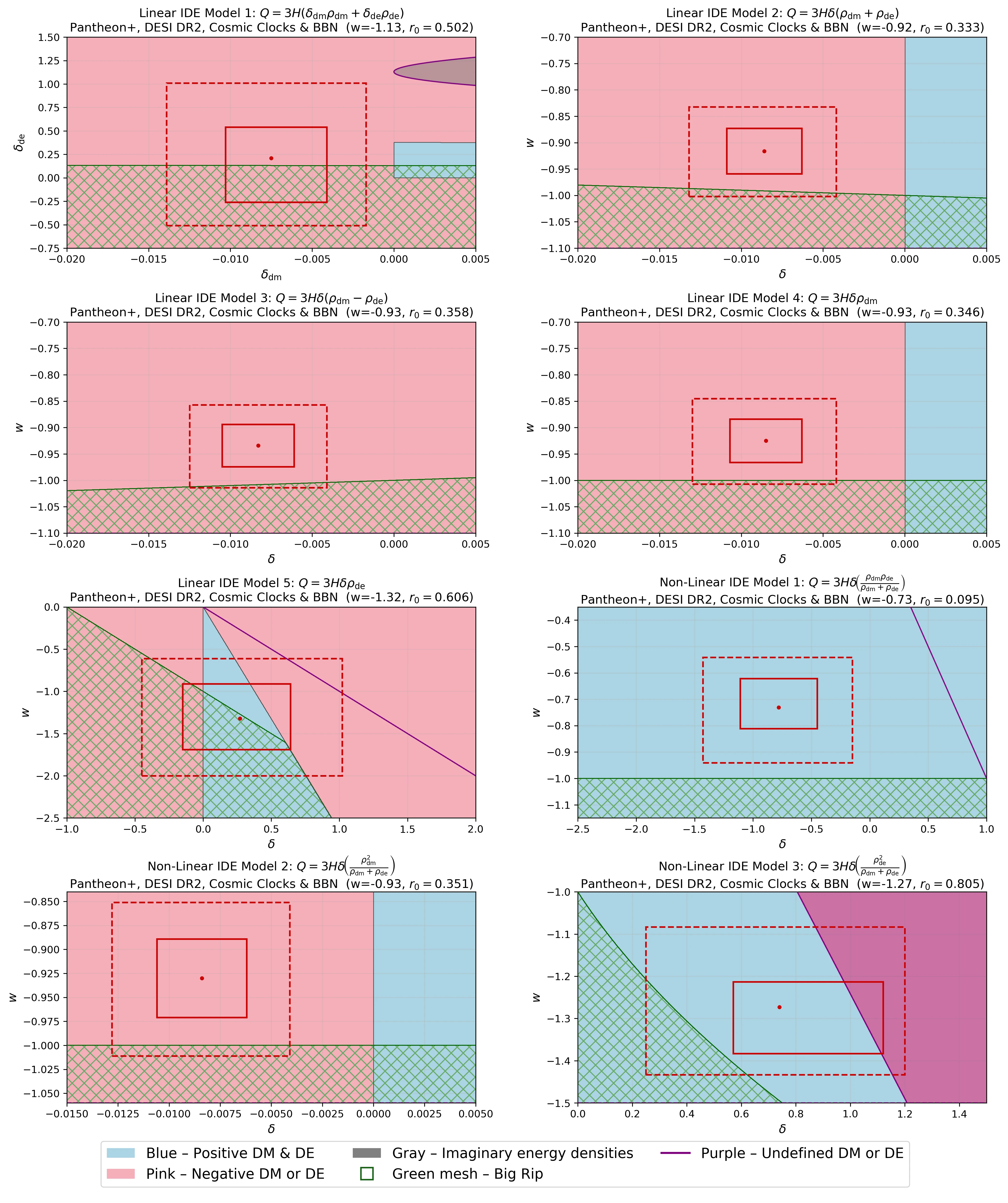
En la danza cósmica, la energía oscura y la materia oscura intercambian energía. Durante mucho tiempo, se pensó que la energía oscura era una fuerza constante que aceleraba el Universo, un descubrimiento por el cual Riess, Perlmutter y Schmidt recibieron el Premio Nobel. Pero nuevos datos muestran que la danza es cambiante.
Los científicos probaron ocho modelos de interacción. Resultó que actualmente la energía oscura cede energía a la materia oscura, mientras que en el pasado era al revés. Pero en algunas versiones, la densidad de la energía oscura se volvía negativa, como si un bailarín gastara más de lo que tiene.
Resumen original
tal como lo escribieron los autores, en inglés arXiv:2601.03122v1
In this study, we present observational constraints on a class of phenomenological interacting dark energy (IDE) models that admit analytical solutions for the Hubble parameter $$H(z)$$. We consider a set of five linear and three non-linear IDE scenarios, encompassing both interactions proportional to the dark matter and/or dark energy densities, as well as non-linear combinations of the two. For all eight IDE models, we find a better fit than $$\Lambda$$CDM from a $$\Delta\chi^2$$ analysis for both combinations of datasets considered. When using the Akaike Information Criterion ($$\Delta$$AIC), we find a similarly improved fit in all cases, except for one dataset combination in $$Q=3H\delta\rho_{\rm de}$$. Our analysis also shows a preference for sign-switching interactions, with energy transfer from dark energy to dark matter at low redshift, reversing direction at higher redshift. These results should be interpreted with caution, as the latter direction of energy transfer is accompanied by negative dark energy densities in the past, which may be unphysical. Models that do not allow sign-changing behaviour instead show a preference for energy flow from dark matter to dark energy, and hence negative dark energy densities. The only exceptions are $$Q=3H\delta\rho_{\rm de}$$ and $$Q=3H\delta\left(\tfrac{\rho_{\rm de}^2}{\rho_{\rm dm}+\rho_{\rm de}}\right)$$, which exhibit energy flow in the opposite direction. Furthermore, for all interactions considered, we find a phantom-divide crossing in the effective dark energy equation of state $$w^{\rm eff}_{\rm de}$$, with the dark energy density decreasing ($$w^{\rm eff}_{\rm de}>-1$$) at present and at low redshift, while increasing ($$w^{\rm eff}_{\rm de}<-1$$) in the past at high redshift. These results highlight the promising, but problematic, nature of dark sector interactions, as well as the need to extend the analysis using early-time physics and datasets.
En algunos modelos, la densidad de la energía oscura fue negativa en el pasado, como si el bailarín tomara energía prestada. Esto desconcierta a los físicos.