Cómo encontrar agua en una roca marciana sin romperla exprés
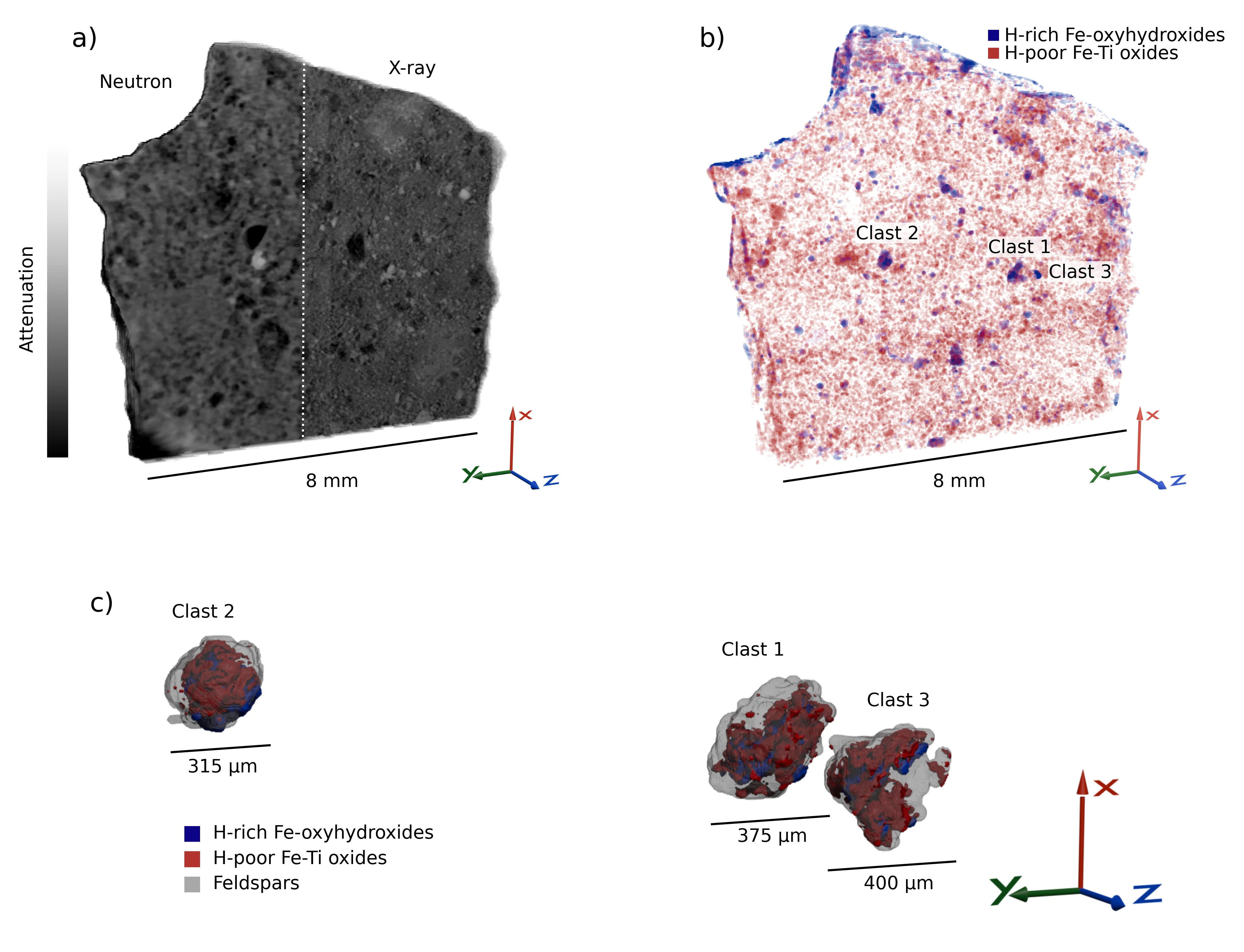
Para saber si hay agua en una roca de Marte sin romperla, los científicos usaron la exploración con neutrones y rayos X, similar a como se toman radiografías en un hospital. Los neutrones detectan el hidrógeno, base del agua, y permiten construir un mapa de humedad dentro de la muestra. En el meteorito NWA 7034, un pedazo de corteza marciana, se encontraron minerales parecidos al óxido pero impregnados de agua. Estos óxidos de hierro con hidrógeno actúan como una esponja de piedra: absorbieron el agua antigua cuando se filtró en la lava solidificada. Incluso hoy, después de miles de millones de años, retienen la humedad a temperaturas superiores a 100°C: el agua está atrapada no solo como hielo, sino también dentro de las rocas. El rover Perseverance encuentra rastros similares en el cráter Jezero, lo que sugiere que el Marte primitivo estaba plagado de bolsas de agua. Este método algún día ayudará a estudiar muestras marcianas en la Tierra sin dañarlas en lo más mínimo, y a buscar pistas microscópicas de vida antigua.
Resumen original
tal como lo escribieron los autores, en inglés arXiv:2601.08390
The next great leap in Martian exploration will be the return of samples to Earth. To ensure the maximum scientific return from studying these samples, the development and utilisation of nondestructive analytical techniques are essential to enable early three-dimensional characterisation of their interiors. Neutron computed tomography is a powerful method in this context: it is highly sensitive to hydrogen and complements the more conventional X-ray computed tomography. Because the distribution and nature of hydrous phases are central to understanding the habitability, the climatic and geological evolution, and potential biosignatures of Mars, identifying hydrogenbearing phases in Martian crustal rocks is of particular importance. Using the only Martian crustal material available on Earth, the NWA 7034 meteorite and its pairs, we show that combined neutron and X-ray computed tomography enables non-destructive sample-wide mapping of hydrogen and reveals the distribution and petrographic contexts of hydrous phases. We identify hydrogen-rich iron oxyhydroxides within ancient igneous clasts, forming a macroscopic mineralogical water reservoir within the meteorite. These alteration assemblages closely resemble those observed in samples collected by the Perseverance rover in Jezero crater, where hydrated iron oxyhydroxides are also present. This similarity suggests that such phases may represent a widespread near-surface water reservoir on early Mars.
Para 'exprimir' el agua de una esponja de piedra así, se necesita una temperatura superior a 400°C; en la superficie de Marte no hay tanto calor.
Al igual que el héroe de 'El marciano' extrae agua del suelo marciano, los científicos encuentran humedad oculta atrapada en los minerales.