El eco del agujero negro silenciado exprés
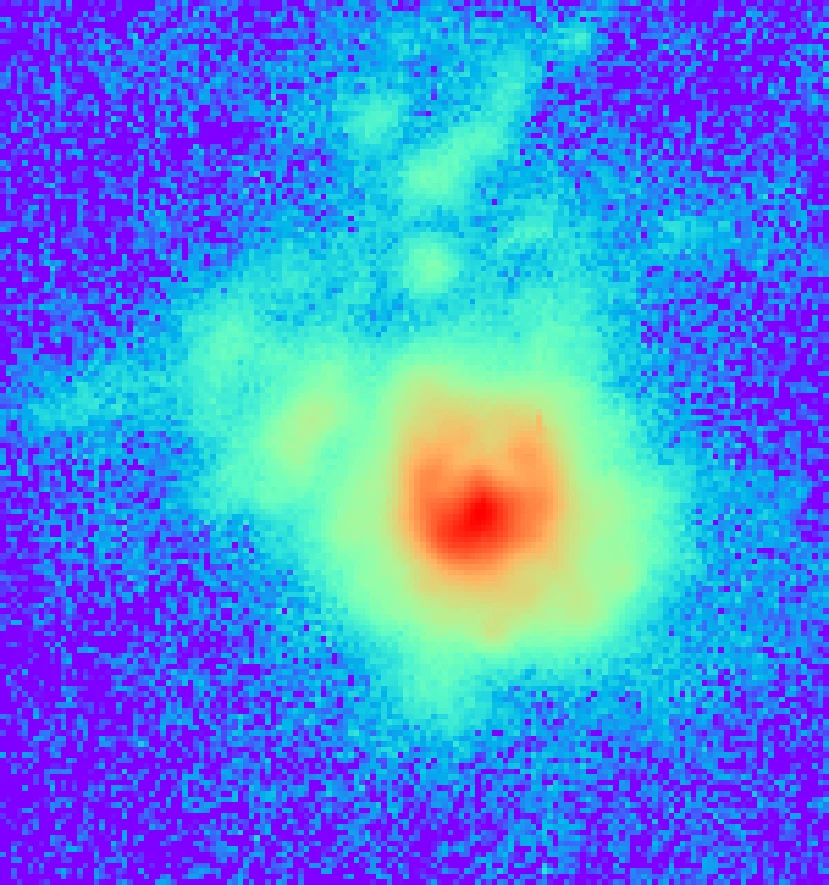
En el corazón de cada galaxia duerme un agujero negro supermasivo. Cuando devora materia, sus alrededores arden — eso es un núcleo activo. ¿Cómo saber de destellos pasados si el agujero calla? La respuesta la da el eco de luz.
Como un eco en una sala vacía, donde los sonidos vagan después de que la fuente se calla, la radiación del núcleo apagado viaja por la galaxia. Los astrónomos la captaron midiendo la polarización — la dirección de las oscilaciones de las ondas de luz. En GSN 069, la polarización aumentaba al alejarse del centro, y casi desaparecía en el núcleo. Eso significa que la fuente de luz se apagó, pero los rayos reflejados aún llevan su historia.
El análisis conjunto de espectroscopía y fotometría mostró que el núcleo de GSN 069 no solo desgarraba estrellas errantes — brillaba estable, rodeado por una rosquilla de gas que dirigía la radiación. Lo más inesperado: el agujero negro se aquietó cuando en la Tierra ya existían civilizaciones antiguas. Su sueño actual es solo una breve pausa en una vida agitada.
Resumen original
tal como lo escribieron los autores, en inglés arXiv:2601.08940v1
Context. X-ray quasi-periodic eruptions (QPEs) are repeating, high-amplitude, soft X-ray bursts observed from the nuclei of a dozen nearby low-mass galaxies. Their origin remains a puzzle in the physics of accretion variability. Observational data indicate that X-ray and/or optical tidal disruption events (TDEs) may precede QPE detections. Although both kinds of outburst are driven by supermassive black holes, they are more frequently detected in faded active galactic nuclei (AGNs), when the TDE is not happening in a dormant galaxy. In the case of the QPE discovery source, GSN 069, it remains debated whether its past activity arose from a previous AGN phase or from an enhanced TDE rate. Aims. We investigated the origin of the past nuclear activity in GSN 069. Methods. Past AGN activity imprints detectable polarization in optical light, due to the expected delay between direct and scattered light. On 6 September 2019, we targeted GSN 069 with VLT/FORS2 in both imaging polarimetry and spectropolarimetry modes so that its optical polarization could be investigated while the first detected QPE phase was still active. Results. We measured a rising polarization, from ~0% to ~1.5%, as moving away from the nucleus of GSN 069. This rise is probed to be intrinsic to the central engine, confirming the already detected extended emission line region (EELR) by integral field unit data. Conclusions. The increasing radial polarization demonstrates a switched-off nucleus. The polarization angle traces an axis aligned with elongated [OIII], [NII], and H{\alpha} gas distributions, revealing an EELR that may be consistent with relic polarization cones, therefore suggesting the presence of a torus-like structure in the past. Thus, optical polarization echoes geometrically favor a faded AGN as the origin of the EELR rather than a past elevated TDE rate, although the latter cannot be excluded.
El eco de luz desnuda eventos cósmicos con retraso, lo que nos convierte en testigos de un pasado lejano — como si viéramos una película filmada hace miles de años.