Películas finas que hacen girar los imanes con más fuerza exprés
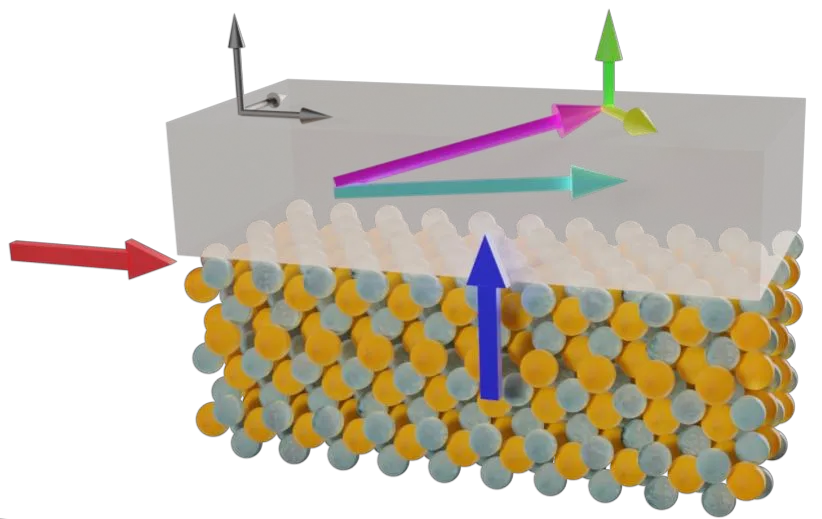
Un imán en un microchip es como la aguja de una brújula que hay que girar sin tocarla. Normalmente se usan metales pesados para ello, pero se calientan y desperdician energía. Los físicos encontraron un sustituto: el material laminado GeTe, parecido a una pila de láminas finísimas.
En el experimento, se hizo pasar corriente a través de la interfaz entre la aleación magnética NiFe y el GeTe. El flujo eléctrico hizo que la magnetización girara con una fuerza que antes se consideraba imposible para estos materiales laminares. El valor resultó incluso mayor que el de los mejores metales pesados: −(1,25 ± 0,11) × $10^5$ (ħ/2e) Ω⁻¹·m⁻¹.
La clave está en la acción conjunta de tres efectos. El espín del electrón (su diminuto momento magnético) y su movimiento orbital actúan en conjunto, y la interfaz entre los materiales ayuda a transmitir el esfuerzo. Los cálculos por ordenador confirmaron que la carga fluye a través de la unión y amplifica el giro.
Ahora los ingenieros pueden fabricar chips de memoria y lógica que consumen menos energía al conmutar. Las películas finas de GeTe abren el camino a dispositivos donde el imán se controla con corriente casi sin pérdidas, y todo ello a temperatura ambiente.
Resumen original
tal como lo escribieron los autores, en inglés arXiv:2601.12581
Recent observations of large unconventional spin-orbit torques in van der Waals (vdW) materials are driving intense interest for energy-efficient spintronic applications. A key limitation of ferromagnet (FM)/vdW heterostructures is their lower value of damping-like torque conductivity ($$\sigma{\rm_{DL}^{y}}$$) compared to the conventional heavy metal-based systems, limiting their prospects for commercial spintronic devices. Here, we report both a giant $$\sigma{\rm_{DL}^{y}}$$ of $$-(1.25 \pm 0.11)\times 10^{5}~\hbar/ 2e~\Omega^{-1}$$m$$^{-1}$$ and an unconventional spin-orbit torque in a heterostructure comprising an FM (Ni$$_{80}$$Fe$$_{20}$$) and the vdW material GeTe. The value of $$\sigma{\rm_{DL}^{y}}$$ represents the highest reported torque conductivity for any FM/vdW interface and is comparable to benchmark heavy metal heterostructures. First-principles calculations reveal that this substantial torque originates from the cooperative interplay of the spin Hall effect, orbital Hall effect, and orbital Rashba effect, assisted by interfacial charge transfer. These findings demonstrate the potential of carefully engineered vdW heterostructures to achieve highly efficient electrical manipulation of magnetization at room temperature, paving the way for next-generation low-power spintronic devices.
El telururo de germanio es el mismo material que se usa en los DVD regrabables: al calentarse cambia su estructura y el láser lee la diferencia.