Cómo nacen los cometas de dos cabezas exprés
El cuerpo helado Arrokoth se parece a un muñeco de nieve: dos esferas unidas entre sí. Hay muchos objetos de dos cabezas más allá de la órbita de Neptuno, en el cinturón de Kuiper. Durante mucho tiempo se pensó que se formaban por la colisión lenta de dos cuerpos separados.
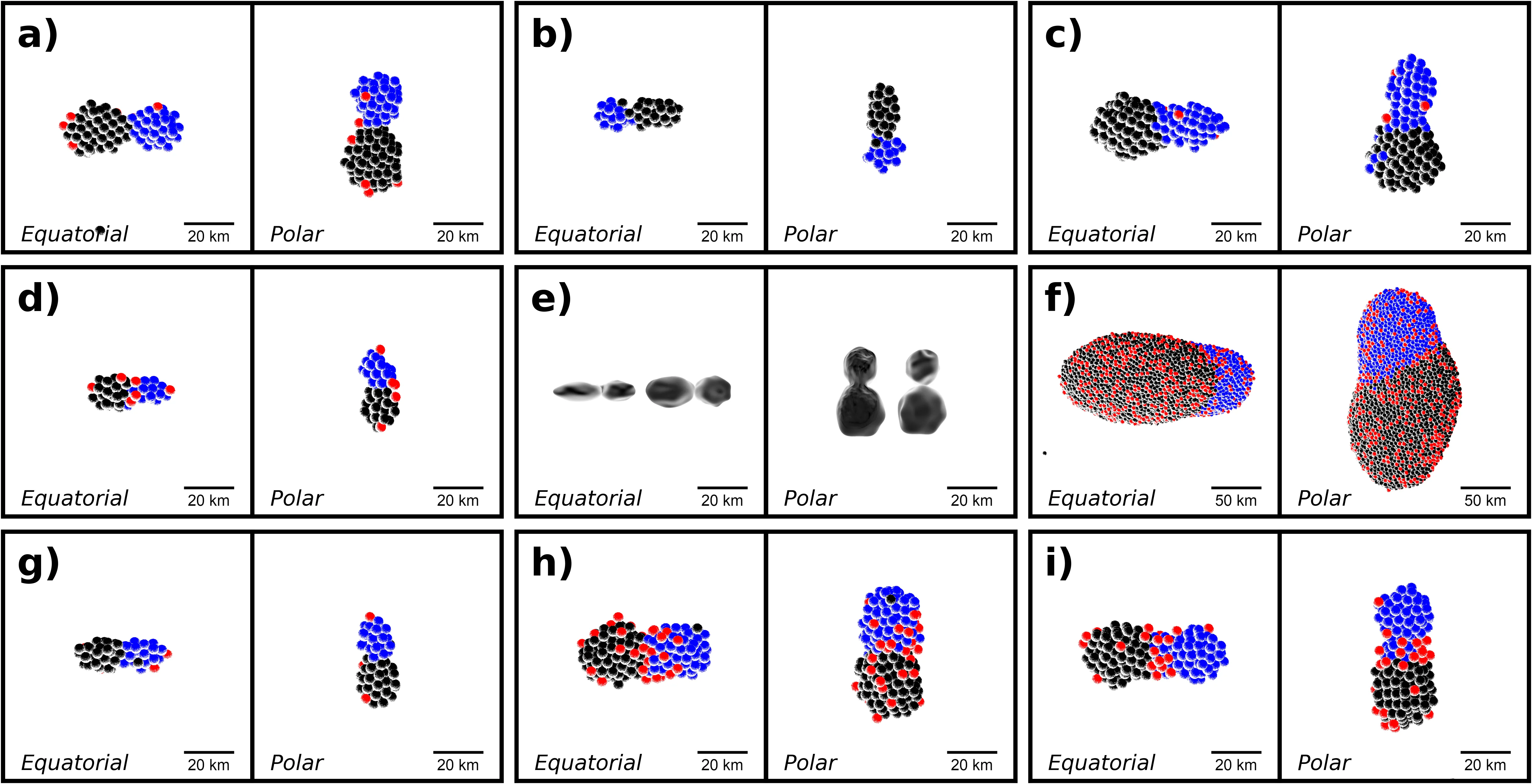
Una nueva simulación muestra otro camino. Una nube de pequeños guijarros alrededor del joven Sol se contrae por su propia gravedad. Los guijarros no se aglutinan en una sola esfera, sino directamente en dos grumos adyacentes que luego se unen suavemente. Así nace un muñeco de nieve sin ningún impacto.
Los cálculos reproducen la forma de Arrokoth y de otros cuerpos de dos cabezas del cinturón de Kuiper. Por lo tanto, su aspecto no es una casualidad, sino un registro de cómo se ensamblaron los primeros embriones planetarios.
Resumen original
tal como lo escribieron los autores, en inglés arXiv:2602.16056
Bilobate contact binaries comprise a significant fraction of the relict Kuiper Belt, which includes the exemplary contact binary (486958) Arrokoth. The surfaces of its lobes contain similar amounts of highly volatile chemical species and few craters, indicating formation in a homogeneous and gentle environment. Arrokoth's bilobate shape was initially hypothesized to have formed via the direct gravitational collapse of a pebble cloud in the solar system's protoplanetary disk. However, alternative hypotheses have proposed that Arrokoth may be the result of binary planetesimal formation and the subsequent dynamical evolution of the binary components into contact through external perturbations over long timescales. Here, we show that contact binary planetesimals like Arrokoth can form directly from the gravitational collapse of pebble clouds. We used a soft-sphere discrete element method (SSDEM) to discover that planetesimals form a wide variety of shapes, including bilobate contact binaries. This method creates planetesimals as particle-aggregates with particles resting upon each other's surfaces via mutual surface penetration. The formation of contact binaries in our simulations strengthens the hypothesis that Arrokoth, and perhaps many other contact binaries in the Kuiper Belt, formed directly as bilobate objects from gravitational collapse, and so their shapes and surfaces record the era of planet formation.
Las dos mitades de Arrokoth tienen casi la misma composición de hielo, como si estuvieran hechas de la misma masa.
En la novela 'Cita con Rama' de Arthur C. Clarke, la nave alienígena también tiene forma de dos cilindros unidos.