Dos hermanos mutantes: por qué un cambio en el gen altera el destino del cáncer de pulmón exprés
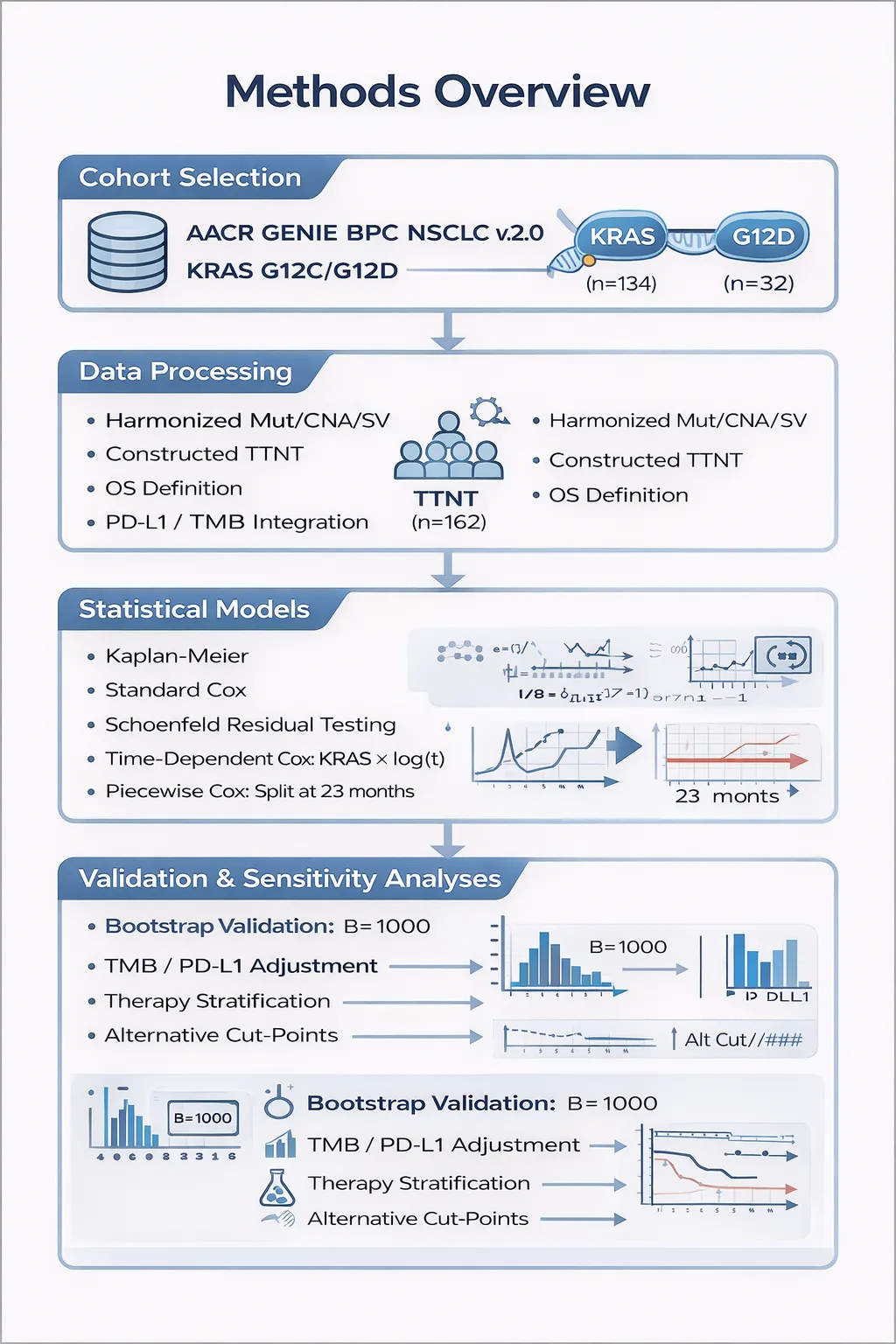
Las células cancerosas se parecen a máquinas averiadas: una sola falla las hace avanzar sin freno. En el gen KRAS, estas fallas son las más comunes. Pero no todas son iguales: en un punto de la proteína puede aparecer un aminoácido incorrecto, y de eso depende cómo se comporte el tumor.
En el nuevo estudio se compararon dos de estas fallas: G12C y G12D. En pacientes con G12D, el tiempo hasta el siguiente tratamiento resultó más largo, sobre todo en los primeros dos años. Pasados los dos años, la diferencia se desvanece, pero la supervivencia global sigue siendo mejor en G12D. En los tumores con G12C, es más frecuente encontrar fallas adicionales en los genes STK11 y KEAP1, que hacen que el cáncer sea más agresivo.
Por ahora, los fármacos aprobados solo actúan contra G12C, y para G12D no hay ninguno. Los resultados sugieren que hay que desarrollar medicamentos específicos para cada mutación. Así, el tratamiento sería más preciso, como una llave para su cerradura.
Resumen original
tal como lo escribieron los autores, en inglés arXiv:2602.19295
Background: KRAS mutations are the largest oncogenic subset in NSCLC. While KRAS G12C is now targetable, no approved therapies exist for G12D. We examined time-to-next-treatment (TTNT) and overall survival (OS) differences between G12C and G12D, allowing for time-varying hazard effects. Methods: De-identified data from AACR Project GENIE BPC NSCLC v2.0-public were analyzed. TTNT served as a real-world surrogate for progression-free survival. Co-mutations (TP53, STK11, KEAP1, SMARCA4, MET), TMB, and PD-L1 were harmonized. Kaplan-Meier, multivariable Cox, and a pre-specified piecewise Cox model (split at median TTNT = 23 months) were applied. Schoenfeld residuals assessed proportional hazards; bootstrap resampling (B=1000) evaluated stability. Results: Among 162 TTNT-evaluable patients (G12C n=130; G12D n=32), median TTNT was 28.6 versus 32.0 months (log-rank p=0.79). Adjusted Cox regression showed no overall hazard difference (HR=0.85; 95% CI 0.53-1.37; p=0.50), but Schoenfeld testing indicated borderline non-proportionality (p=0.053). Piecewise Cox modeling revealed time-varying effects: early TTNT hazard favored G12D (HR=0.41; 95% CI 0.17-0.97; p=0.043) with significant KRAS x period interaction (HR=3.33; p=0.021) and late-period attenuation (HR=1.38; 95% CI 0.77-2.47; p=0.285). Bootstrap resampling confirmed this pattern (median HRearly=0.39; HRlate=1.41). Among 278 OS-evaluable patients (133 deaths), G12D showed improved OS (adjusted HR=0.63; 95% CI 0.39-0.99; p=0.048). G12C tumors exhibited higher TMB (9.79 vs 7.83 mut/Mb; p=0.002) and greater STK11/KEAP1 enrichment. Conclusions: KRAS G12D demonstrated early TTNT advantage and improved OS. Late-period TTNT differences were non-significant (post-hoc power: 12.3%). These exploratory findings require validation in larger cohorts but support allele-specific therapeutic development for G12D.
Las mutaciones G12C y G12D se diferencian en una sola letra del ADN, pero una hace que el tumor sea sensible a un fármaco, mientras que la otra, por ahora, no.