Hielo que se congela y cosmos en expansión exprés
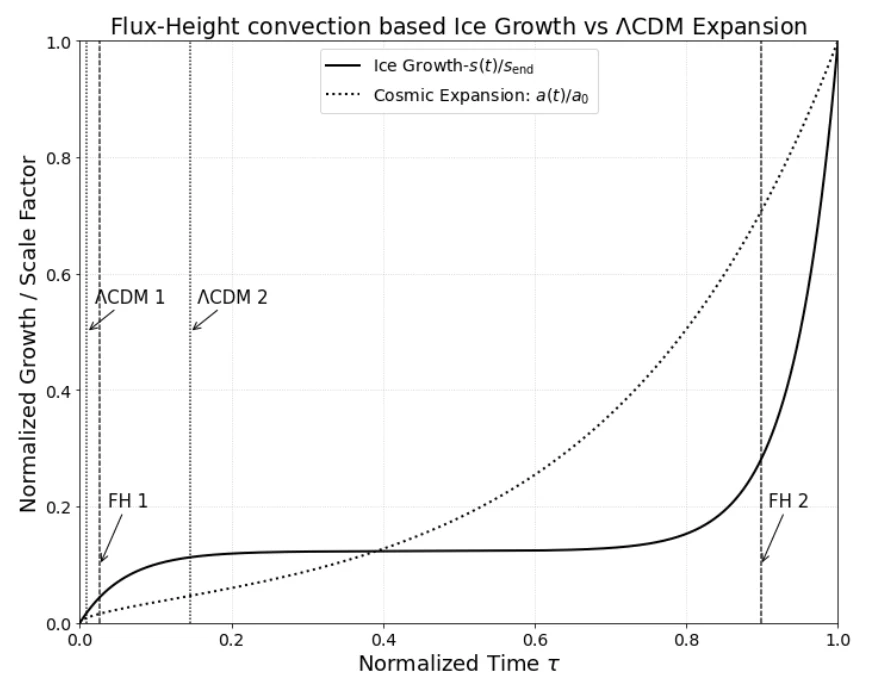
En invierno, el lago se cubre de hielo, y este simple proceso resulta ser un modelo vivo del Universo en expansión. El grosor del hielo aumenta según la misma ley matemática que las distancias entre galaxias lejanas.
El secreto está en el movimiento del agua bajo la costra de hielo. Cuando las capas cálidas ascienden y las frías descienden, esta circulación lleva calor al hielo en crecimiento. En las ecuaciones aparece un término adicional que se comporta exactamente como la energía oscura, una fuerza constante e invisible que hace que las galaxias se alejen aceleradamente. En el lago, esta “energía” ralentiza el crecimiento del hielo, mientras que en el cosmos, lo acelera.
Es sorprendente que la fórmula para este escenario fue escrita por primera vez por el físico Josef Stefan en 1891, mientras estudiaba la formación de hielo en estanques. Ahora, esa misma ecuación es la base de modelos que predicen el destino de todo el universo.
Resumen original
tal como lo escribieron los autores, en inglés arXiv:2602.24019
We extend previous conduction-based analogies between ice growth in a lake and cosmological expansion by incorporating buoyancy-driven heat transport. Reformulating the Stefan problem with both conductive and convective fluxes yields an evolution equation for the ice thickness $$s(t)$$ that is structurally analogous to the Friedmann equations for the cosmological scale factor $$a(t)$$. Beyond reproducing radiation-, matter-, and curvature-like behaviors, we introduce a reduced description of convection in which the vertically integrated heat flux reaching the moving ice-water interface is modeled as a power-law function of the instantaneous liquid-layer thickness, generating two additional effective contributions. The first is a constant term, directly analogous to a cosmological constant, arising from the persistence of buoyancy-driven transport under geometric confinement. The second is a $$s^{-1}$$ contribution originating from the coupling between the moving ice boundary and the convective boundary layer. This term reflects the specific reduced flux-height Ansatz adopted, rather than a universal physical prediction. When expressed in Friedmann-like cosmological form, this term entails a fluid with negative energy density and equation-of-state parameter $$w=-2/3$$. In cosmology this term may be an effective one associated to a network of domain walls made of exotic energy/matter, but it might also arise from an energy exchange between cosmological components. Overall, the results should be interpreted as a structural analogy between evolution equations, showing how nonlinear transport mechanisms in a classical moving-boundary problem can reproduce the hierarchy of scaling terms familiar from cosmology within a reduced and analytically tractable framework.
La ecuación de Stefan, derivada para el simple hielo, hoy se utiliza incluso para calcular el enfriamiento de la superficie de Marte.