Campos magnéticos en los núcleos de las gigantes rojas exprés
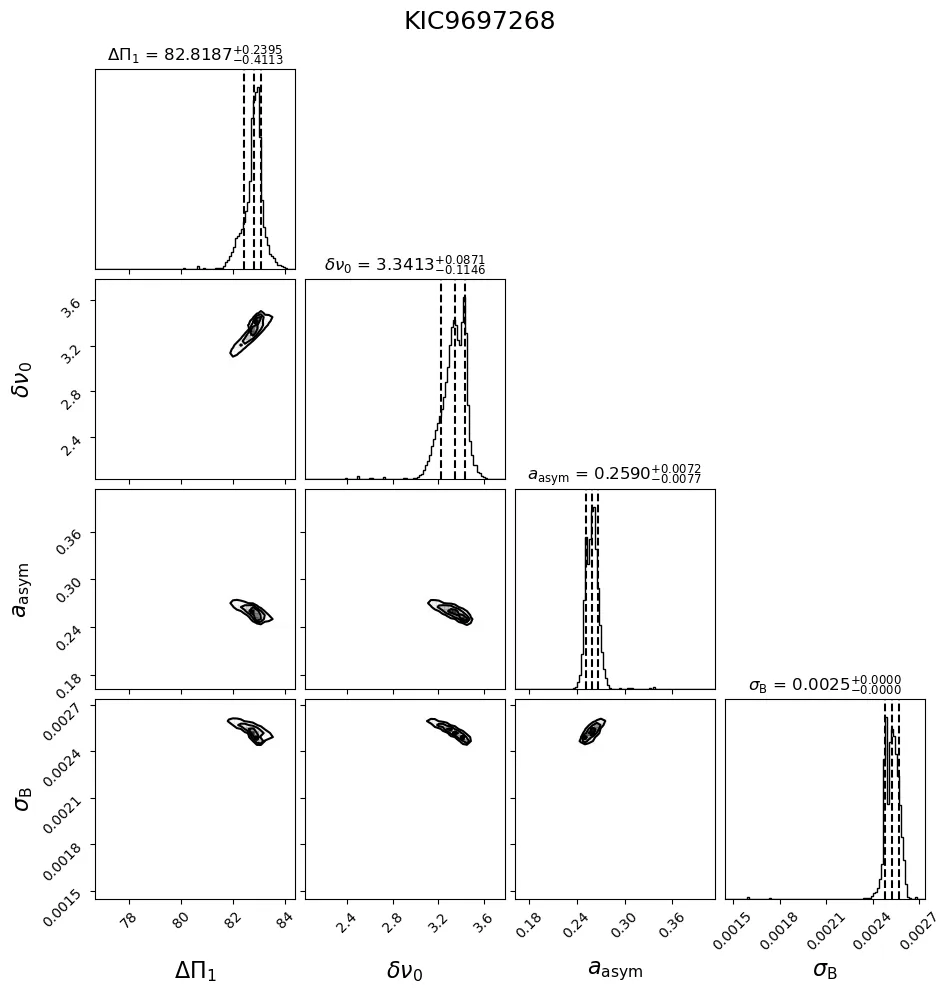
Ocho gigantes rojas —estrellas viejas e hinchadas, como será nuestro Sol en el futuro— se comportan de manera desconcertante. Su superficie oscila con regularidad, como una campana, pero en ese tañido se perciben fallos: algunos tonos desaparecen y el ritmo se rompe. Los científicos sospecharon que en su interior se oculta una mano invisible —el campo magnético— e intentaron calcular su fuerza.
Para explicar las observaciones, hubo que admitir que el campo es muy intenso: de 100 a 700 kilogauss. Para comparar: el campo de un imán de nevera es de unos 0,001 kilogauss. Un campo tan potente no pudo surgir de la nada. Lo más probable es que naciera en la juventud de la estrella, cuando en su interior, como en una olla de agua hirviendo, bullía el núcleo caliente, mezclando la materia y creando una dinamo magnética.
Estas ocho estrellas no son demasiado masivas: aproximadamente como el Sol. El tamaño de su campo magnético coincide con el tamaño del núcleo que la estrella tenía en su juventud. Es decir, el campo es un recuerdo de una juventud turbulenta, congelado en las profundidades. Ahora los astrónomos pueden usar estas estrellas como laboratorios naturales para entender cómo los campos magnéticos viven y mueren dentro de los astros.
Resumen original
tal como lo escribieron los autores, en inglés arXiv:2604.09901
The recent seismic detection of magnetic fields in red giants cores has given the opportunity to characterize these fields, potentially giving information about their origin and their role in the internal transport of angular momentum. We detect strong deviations from the regular pattern of g-mode periods in eight Kepler red giants showing $$l=1$$ doublets. In three of these stars, the modes show partial suppression. We investigate the magnetic origin of these features and determine the characteristics of the core fields that can produce such signatures. We need to invoke strong, near-critical fields. Assessing the effects of such fields on the mixed mode frequencies requires a non-perturbative approach. We use and adapt a formalism that was recently proposed following a similar development as the traditional approximation for rotation (TAR). We then compute asymptotic expressions of mixed mode frequencies including magnetic effects and attempt to reproduce the observed oscillation spectra. We show that for near-critical fields, information can be obtained about the radial profile of the radial field $$B_r$$, as opposed to weaker fields for which only a weighted average of $$B_r^2$$ can be measured. For the eight targets, we find that the $$l=1$$ doublets cannot be identified as the $$m=\pm1$$ components. Instead, we show that very good fits to all the observations can be obtained by identifying the two components as $$m=0$$ and $$m=1$$. These solutions correspond to fields with intensities ranging from 100 to 700 kG that are confined well below the H-burning shell. Our best-fit models for the eight stars have low masses (1.1-1.2 $$M_\odot$$) and the maximal size of their convective core during the main sequence approximately corresponds to the radial extent of the measured magnetic fields. The detected fields could thus have been generated by dynamo action in the main-sequence convective core.
El campo magnético en el núcleo de una gigante roja es millones de veces más fuerte que el de un imán de nevera, pero está escondido muy por debajo de la superficie de la estrella.
En la novela 'Solaris' de Stanisław Lem, el océano del planeta se comporta como un ser vivo; aquí, la propia estrella guarda en su interior una 'memoria' de su juventud en forma de campo magnético.