La galaxia exhala un viento ardiente exprés
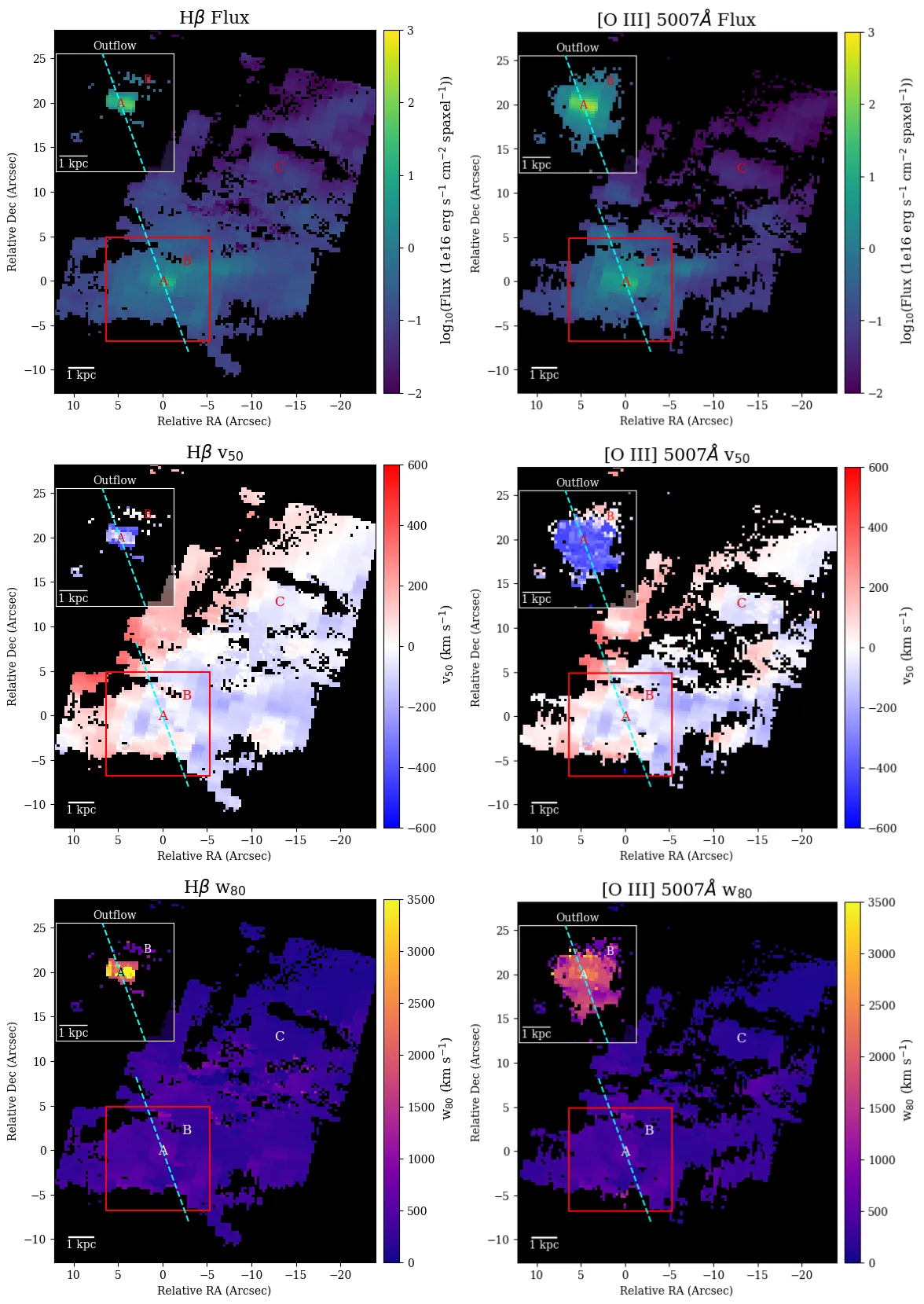
En el centro del cúmulo de galaxias en la constelación de Perseo se encuentra la galaxia NGC 1275. De su núcleo sopla un viento de gas caliente: los astrónomos lo han observado en detalle por primera vez.
Este viento se detecta por el resplandor del hidrógeno y el oxígeno. Alcanza velocidades de hasta 570 kilómetros por segundo, más rápido que una bala. Cada año, la galaxia expulsa aproximadamente 2,7 masas solares. Al mismo tiempo, esa misma cantidad de gas frío cae hacia el centro. Así, la galaxia se equilibra a sí misma: tanto material entra como sale.
Junto al viento también actúa un chorro, un flujo estrecho de partículas que emerge de las cercanías del agujero negro. Allí donde pasa el chorro, el gas brilla de manera diferente. Pero tanto el viento como el chorro solo tienen efecto dentro de un radio de dos mil años luz desde el centro. Más allá, su influencia se desvanece.
Así, la galaxia en el cúmulo de Perseo demuestra cómo el agujero negro y el gas que lo rodea mantienen un diálogo infinito: uno sopla, el otro cae.
Resumen original
tal como lo escribieron los autores, en inglés arXiv:2608.08331v1
We present new Keck Cosmic Web Imager observations of the central few kiloparsecs of NGC 1275, the brightest cluster galaxy of the Perseus Cluster. These integral field spectroscopic data reveal a warm-ionized outflow traced by H$$\beta$$ and the [O III] doublet extending out to $$\sim2.5$$ kpc from the nucleus. The warm-ionized outflow has an [O III]-derived $$v_{50}$$ of up to $$\sim570$$ km/s, $$w_{80}$$ of up to $$3780$$ km/s, and H$$\beta$$-derived outflowing mass of $$(2.7 \pm 0.3)\times 10^6$$ M$$_\odot$$. Our H$$\beta$$-derived warm-ionized outflowing mass rate of 2.7$$\pm$$0.7 M$$_\odot$$ yr$$^{-1}$$ is comparable to the estimated cold molecular disk accretion rate of 1$$-$$10 M$$_\odot$$ yr$$^{-1}$$, which could be a sign of self-regulation between the pc-scale cold gas feeding the active galactic nucleus (AGN) and the warm wind accelerated out to kpc scales. In the host galaxy, we detect an enhancement in the [O III] / H$$\beta$$ ratio in the direction of the receding jet, which may imply jet interaction with the host interstellar medium. The outflow component also shows a clear enhancement of [O III] / H$$\beta$$ that positively correlates with $$w_{80}$$ and $$v_{50}$$, indicative of AGN influence and/or fast shocks. Both the outflow and host galaxy [O III] / H$$\beta$$ ratio decrease with increasing distance from the center, showing that the influence of the AGN is confined to the central $$\sim2$$ kpc. These results are the first resolved measurements of a kpc-scale ionized wind in NGC 1275 and provide a view into how both jets and winds contribute to the feedback cycles in complex cool core cluster systems.
La velocidad del viento del núcleo de NGC 1275 alcanza los 570 km/s: en una hora, ese flujo cubriría la distancia de la Tierra a la Luna.