Un chaudron à fusion sans tartre : le secret est dans les parois express
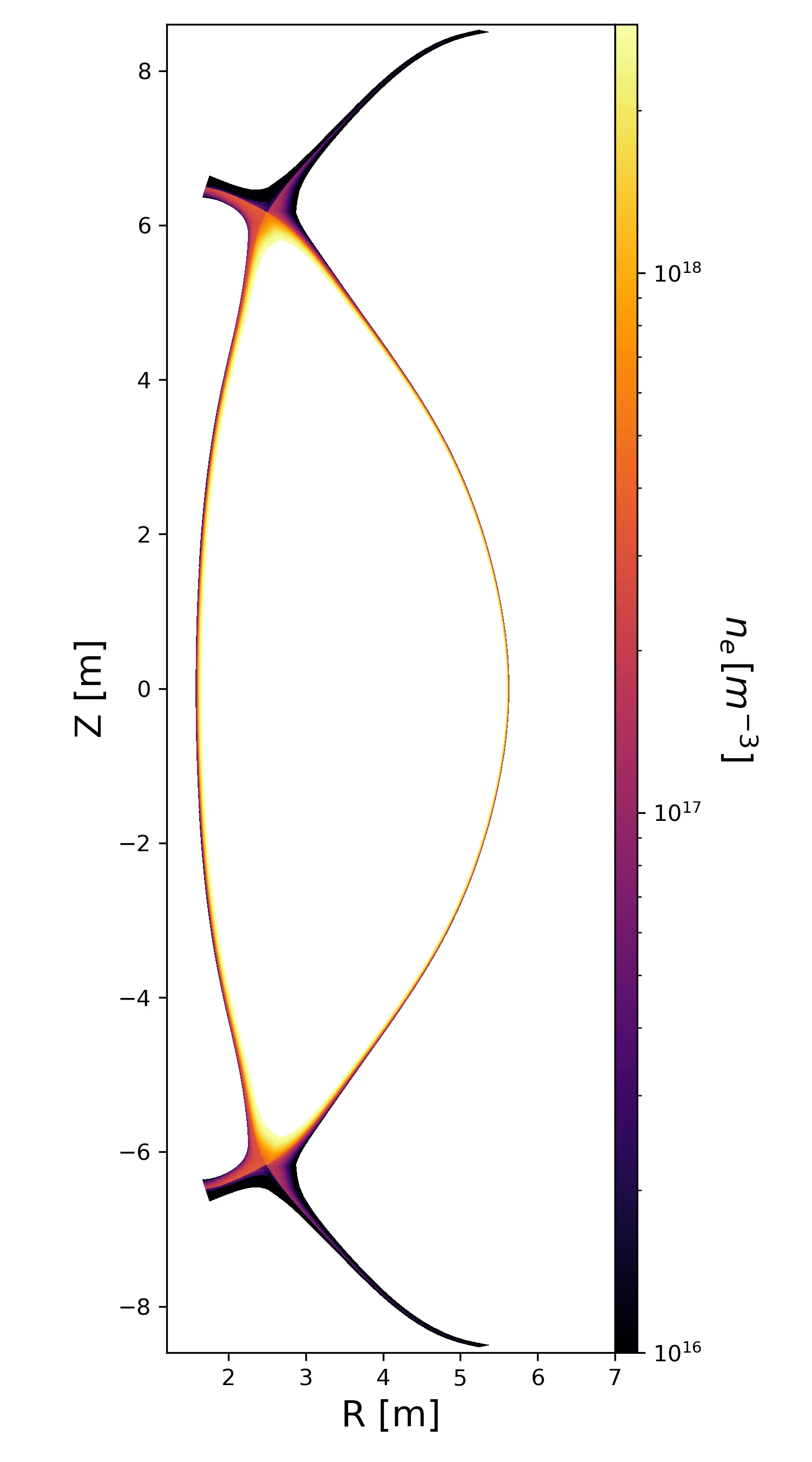
Un réacteur à fusion ressemble à une immense marmite où l'on « cuit » de l'hélium à partir de hydrogène. Le plasma y est chauffé à 150 millions de degrés — dix fois plus chaud que le cœur du Soleil. Mais comme dans toute marmite, il s'y forme du tartre : des impuretés nocives qui se déposent sur les parois et étouffent le plasma.
Les physiciens ont proposé de fabriquer les parois avec un matériau-éponge qui absorbe les impuretés et les empêche de retourner dans le combustible. Cela préserve la chaleur, mais provoque une forte surchauffe. Les calculs informatiques ont montré que si l'on suit le mouvement de chaque particule individuellement, plutôt que comme un flux continu, les impuretés lourdes se coincent d'elles-mêmes dans un coin — le divertor. La chaleur est alors répartie uniformément, évitant la fonte des parois.
Même si la « casserole » principale renvoie des particules, des panneaux absorbants sur d'autres parois peuvent faire passer le réacteur en mode de combustion propre. Cela rapproche des centrales à fusion fiables.
Résumé original
tel que rédigé par les auteurs, en anglais arXiv:2511.09437
Low-recycling regimes are appealing because they entail a high edge temperature and low edge density which are good for core confinement. However, due to considerably enhanced heat flux, the exhaust problems become severe. In addition, in the low-recycling regime, the conventional fluid simulations may not capture the physics of the Scrape-Off Layer (SOL) plasma that lies in the long mean free path regime; kinetic calculations become necessary. In this paper, by performing both Kinetic and fluid simulations, we explore the feasibility of a low-recycling regime in the magnetic geometry of the Spherical Tokamak for Energy Production (STEP); kinetic effects come out to be crucial determinants of the SOL dynamics. The simulation results indicate that a high SOL temperature and low SOL density could be achieved even when the divertor target is not made of a low recycling material. This can be done by using a low recycling material as a wall material. This is an important step towards demonstrating the feasibility of a low-recycling scenario. Lithium, a commonly used low recycling material, tends to evaporate at high heat fluxes which counteracts the desired high temperature, low density regime, and materials that can handle high heat fluxes are generally high recycling. Comparisons of gyrokinetic and fluid simulation results indicate that one can take advantage of kinetic effects to address some of the issues associated with a low-recycling SOL. Specifically, kinetic simulations show better confinement of impurities to the divertor region and greater broadening of the heat flux width due to drifts when compared with fluid simulations. Impurity confinement would help prevent core contamination from sputtering, and a broader heat flux width would help reduce the peak heat load at the target in the absence of detachment.
Dans un verre d'eau se cache assez d'énergie de fusion pour fournir à une maison un an de chauffage et d'électricité.
Dans le film « Spider-Man 2 », le docteur Octopus lance un soleil artificiel — un réacteur à fusion qui échappe à tout contrôle. Le problème du confinement du plasma, que les scientifiques tentent de résoudre aujourd'hui, y tourne à la catastrophe.